Bursting Out!
How Jethro Tull Conquered The US
In 1969, Jethro Tull embarked on their first great American adventure. Within the space of a few short years, they would swap modest-sized stages for packedout shows at Madison Square Garden and Red Rocks Amphitheatre. Ian Anderson and Martin Barre look back on Tull’s journey from mad-eyed bluesy Brits to the fully fledged stadium rock phenomenon that was second only to Led Zeppelin in the 70s.
Words: Dave Everley
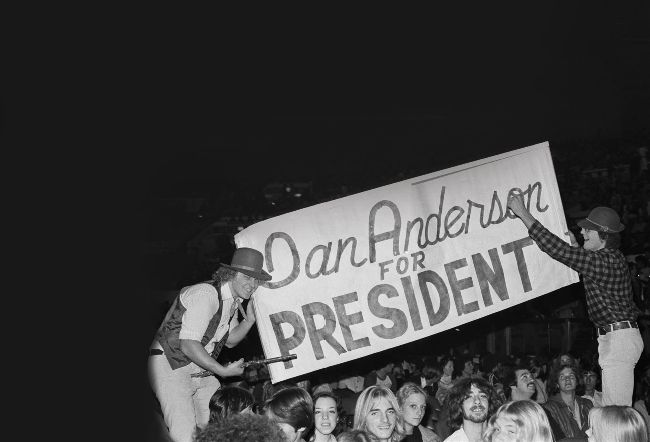
Jethro Tull fans make their feelings very clear, circa 1975.
Image: Lynn Goldsmith/Corbis/VCG via Getty Images
No one wants to be accidentally teargassed onstage, but there are definitely worse places for it to happen than Red Rocks Amphitheatre.
It was June 10, 1971, and Jethro Tull were headlining this beautiful, 10,000- capacity open-air venue built into the natural sandstone formations south of Denver, Colorado. This was the band’s eighth US tour in the two-and-halfyears since they’d first set foot in North America, a work rate they would sustain throughout the coming decade.
Such was the scale of Tull’s US success that demand for tickets for the Red Rocks show outstripped supply.
Dozens of ticketless fans gathered outside the venue’s gates, hoping to cajole, sweet-talk or simply force their way in. The local police department, there to keep some semblance of order, were having none of it. Simmering tensions boiled over, and a riot broke out. That’s when the cops busted out the tear gas.
“This riot was happening outside the venue, so we weren’t aware of what was going on,” says long-serving Tull guitarist Martin Barre, who played with the band from 1968 to 2011.
“We were onstage when they started tear gassing people. Because of the geographical layout, the tear gas was funnelled into the auditorium, so it got the whole audience and the band as we were playing. It’s very unpleasant. It makes you completely inoperable as a human being. It was only afterwards that we were told, ‘There’s a riot, the police are here, you’ve got to get out of the venue.’ It was horrible.”
“Ian’s flute playing was the hallmark of the band, and that in itself got us into people’s aural space. The sound we were producing was unique.”
Martin Barre
According to contemporary reports, the band managed to play for 80 minutes that night, but the fact that Jethro Tull were big enough to sell out a venue as big as Red Rocks in the first place, let alone prompt a riot on the night itself, is remarkable. Received wisdom has it that the likes of Led Zeppelin, the Rolling Stones and, later, Elton John, Bad Company and Fleetwood Mac were the dominant British bands in the US throughout the 1970s, especially when it came to the live arena.
True enough, but Jethro Tull were up there with them, too. Between their first American gigs at the start of 1969 and the end of the following decade, they went from playing clubs and small ballrooms, opening for Blood, Sweat & Tears and Spirit, to headlining sports stadiums and multiple nights at arenas – in 1978, they played a run of five shows at New York’s Madison Square Garden, to a total of nearly 100,000 people.
Their live success was mirrored by their record sales and chart positions. Tull notched up 10 US Top 20 studio albums between 1969 and 1978, including two No.1s in the unlikely shape of 1972’s concept album satire Thick As ABrick and the following year’s darker, knottier A Passion Play. The scale of Jethro Tull’s American success is often overlooked today, but these wild Brits with the mad-eyed singer who stood on one leg while playing flute to unique, complex, thoughtful songs were bona fide rock stars in the USA during the 1970s, albeit reluctant ones.
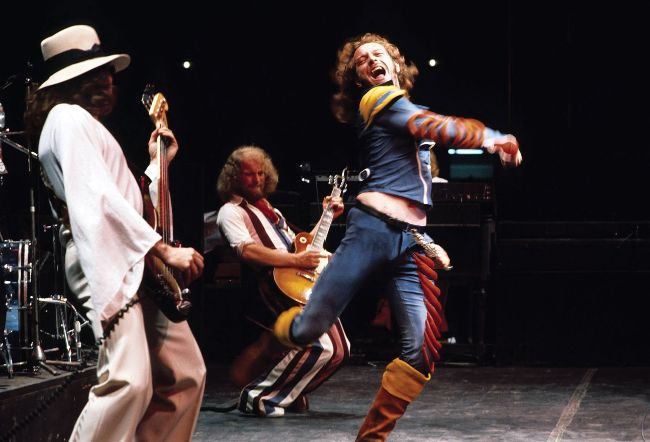
Bringing the energy: Tull onstage in the US in 1976.
RICHARD E. AARON/REDFERNS/GETTY IMAGES
“For a little period of time we were quite big,” says Tull frontman Ian
Anderson, never a man given to overstatement. “I think the thing that sold us was that we didn’t try too hard. We worked hard, but we said, ‘Take it or leave it.’ That’s what happened with The Beatles –they were irreverent and not showbizzy. With Led Zeppelin, they did what they wanted to do. We had this notion of, ‘We’re not doing it for you, we’re doing it for us.’ There’s something strange about that, in that audiences seem to appreciate it. When people try too hard, it can go horribly wrong.”
Tull’s great American adventure began in mid-January 1969. That was when they arrived in New York City, having flown across the Atlantic on aTWA Boeing 707.
“Stuck right at the back,” recalls Barre, who had played his first gig with Tull just a couple of weeks earlier, on December 30, 1968. “Bubbling with excitement.”
“For me it’s never, ‘Oh wow, I’m playing in this venue.’ It doesn’t work like that. You’re tunnel-visioned into thinking, on a split-second basis of what’s coming up next, who this person over here is. Your brain is cueing up foot pedals or trying to remember what I have to sing – thousands of words every night, hopefully in the right order.”
Ian Anderson
Their first two US gigs took place on January 24 and 25, 1969, opening for headliners Blood Sweat & Tears at the Fillmore East, the venue in Manhattan’s Lower East Side run by promoter Bill Graham. The Stateside rock cognoscenti knew who they were –kids hip to the wave of post-Cream blues-rock coming across the Atlantic picked up import versions of their 1968 debut album, This Was, featuring original guitarist Mick Abrahams. But those who turned up were perplexed to find the old men on the sleeve –actually Tull in pensioner get-up –were nowhere to be seen.
“They were quite shocked and upset: ‘Hang on a minute, you’re not like the album cover, where are those guys?’” says Barre. “They thought the cover picture was real. But we won them over.”