Books & Culture
Complex persecution
Is Christianity in the Middle East really doomed to extinction?
by PHILIP WOOD
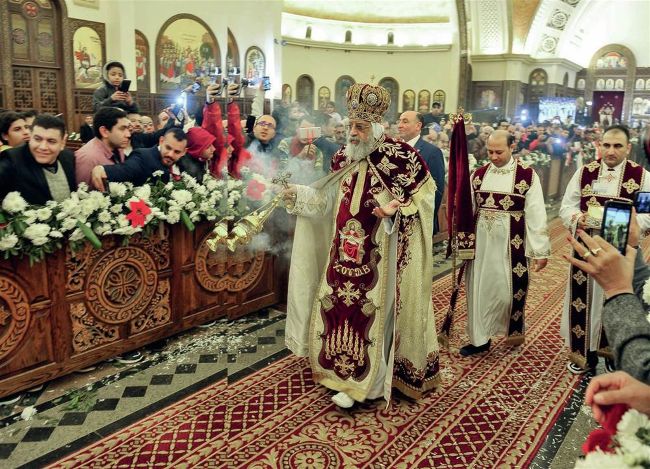
Tawadros II, the Coptic pope, holds Christmas Eve mass at the Nativity of Christ Cathedral in Cairo in 2020
© AFP VIA GETTY IMAGES
During the lifetime of the Prophet Mohammed in the 7th century, Middle Eastern countries like Egypt and Syria had large Christian majorities. Four centuries later, the first Crusade was fought in a land that, even though it was under Islamic rule, was probably still mostly Christian. Yet the Christian population of the Middle East has experienced a steady decline which has been especially steep in the past century, and the last decade most of all.
The reasons for this are a complex mixture of discrimination and persecution on the one hand, and emigration to Europe and the United States on the other. Janine di Giovanni’s primary purpose in her new book The Vanishing is to record the histories of a community that may not last another century. Writing as a practising Catholic, she evokes the importance of faith for providing a sense of belonging to a land made holy by the accretion of stories from the Bible and the lives of the saints—as well as by the everyday memories of Christian families themselves.
This is an interesting work of journalism that mixes personal reflection with a patchwork of reportage. The book charts how recent political events have affected the region’s Christians. In Iraq, Saddam’s surveillance state gave way to outright persecution by the Islamic State (IS). The targeting of Christians might have been encouraged by American refugee policy, which excluded Arab Muslims but allowed in Arab Christians, who then came to be associated with the US and Zionism. In Gaza City, di Giovanni describes a place of thwarted hope, where Gazans are caught between the Israel-Palestine conflict and the intra-Palestinian struggle of Fatah and Hamas. Christian Gazans are particularly vulnerable under Hamas rule: their bookshops have been firebombed and women harassed for refusing to wear the veil.