Bill Nye the Science Guy in Conversation with Michael Shermer
EDITED BY ALEXANDER PIETRUS-RAJMAN
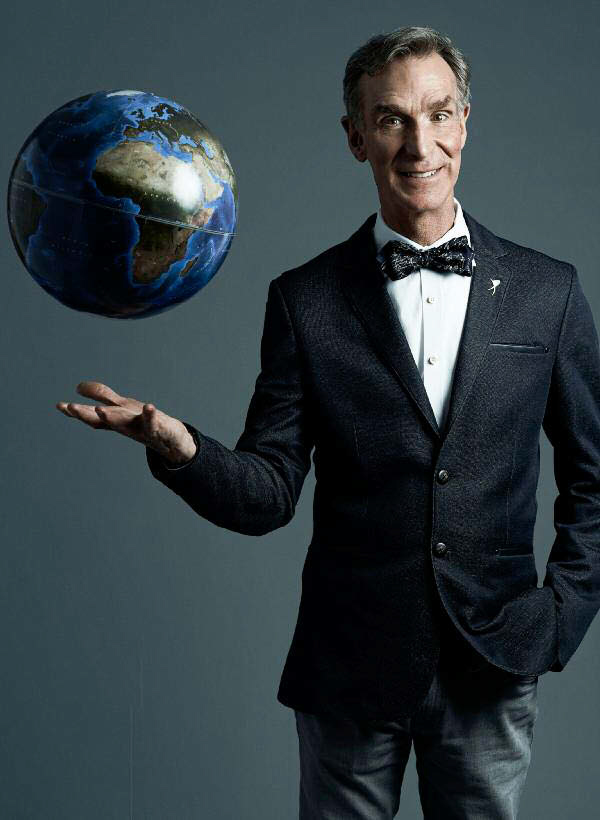
Photo by F. Scott Schafer. Courtesy of the Planetary Society
The following interview with Bill Nye the Science Guy is the first in Skeptic’s new series of Science Dialogues, hosted by Skeptic magazine Publisher and Skeptics Society Executive Director Michael Shermer. The conversation took place on December 18, 2016 at the offices of the Planetary Society, for which Nye is the CEO. It was filmed by the Skeptic Societies’ videographer Brad Davies and is posted at Skeptic.com. The conversation has been lightly edited and shortened for print. The impetus for the conversation was the announcement of the spring 2017 premiere of Nye’s new Netflix series Bill Nye Saves the World.
Bill, of course, is most famous for his 100- episode PBS television series Bill Nye the Science Guy, which aired from September 1993 through June 1998 and garnered 18 Emmy Awards for outstanding writing, editing, directing, performing, etc. Nye also hosted the 2005 The Eyes of Nye television series, oriented more for adults than children, an episode for which Shermer did “psychic” cold readings (http://bit.ly/2iUmST2), and the 100 Greatest Discoveries for the Science Channel. He makes regular appearances on various television talk shows and news networks, and is the author of Undeniable: Evolution and the Science of Creation, and most recently of Unstoppable: Harnessing Science to Change the World. His next book for adults is called Everything All At Once: How Nerds Solve Problems, and for kids Jack and the Geniuses at the Bottom of the World. In addition to debating Ken Ham at the Kentucky creationism museum, an event that was viewed by millions live online, Nye also famously appeared on Dancing with the Stars in 2013, lasting through Week 3 until having to withdraw with a leg injury. His new series is scheduled for release in April, 2017.
Michael Shermer:
Tell us about the new show and how it came about.
Bill Nye:
The show is called Bill Nye Saves the World. The staff and I thought the title was catchy and cool. It’s also a throwback to my famous catchphrase “Change the World,” so we just took it up a notch. Here’s the deal: with the process of science and reason you can understand things better than when you’re not using your head. There are all these problems in our society that are susceptible to analysis. We want people to tackle them from a well-reasoned standpoint and make the world better. So that’s why it’s heartfelt to say we’re trying to save the world. We want everybody to get a scientific perspective of the world around us.
Shermer:
Are these all solvable problems?
Nye:
It is to be hoped. For example, we did an episode on vaccinations. There’s no anti-vaccination movement in India where until recently polio was still classified as an epidemic. We sent our correspondent Emily Calandrelli there to interview the last person generally believed to have contracted polio. The show explains why the anti-vaccination movement is either misguided or not thought through.
Shermer:
The irony of it all is that the main reason kids of anti-vaccination parents don’t get communicable diseases is that everyone around them is vaccinated.
Nye:
I’ve heard people on a conservative cable channel making fun of the expression “herd immunity,” saying it implies we’re being treated like a herd of cattle. I guess it was meant to be a clever pun, but there’s nothing smart about it. Not to give too much away, but on the show we have a demonstration with people in un-velcro-stickable clothing and velcro-stickable clothing. They represent the response of a vaccinated and non-vaccinated person’s immune system to infectious diseases. It’s deadly serious and charming, and powerfully conveys the point.
Shermer:
What are some of the other topics you cover?
Shermer:
What are some of the other topics you cover?
Nye:
There are 13 episodes. We want the show to be as long as it needs to be, so some of them are 28 minutes and some have a running time of 34 minutes. We did a show on pseudoscience, another on artificial intelligence, and one on video games. Did you know that almost half of video gamers are women? And the average age of a gamer is 35 years old? Another really compelling finding we explain on the show is that training surgeons in precise hand-eye coordination is better and faster with a game compared to the traditional, physical manipulative gizmos.
Shermer:
So you’re of the mind that video games are good for us?
Nye:
Well, whether you like it or not…they’re here.
Shermer:
The argument that is often made is that video games distract students from reading, from socializing….
Nye:
Yes, that’s all bad. But I remember that in the same way I went through a chess phase. Eventually my older sister reminded me there was a whole world out there. So whether it’s chess or electronic chess, you need discipline about being social and interacting with people. Games are not inherently good or bad; they just are. But they have this remarkable ability to simulate reality that is, in a way, science fiction.