EAGLES
TAKE IT EASY
Fifty years ago, in the frozen depths of a British winter, the EAGLES recorded their debut album, in doing so defining their signature blend of laid-back country rock. But what took this ambitious group of selfconfessed “control freaks” from the sun-baked climes of California to a cavernous and draughty studio in Barnes, in pursuit of success? “The shop ladies would call you ‘dearie’,” learns Nick Hasted.
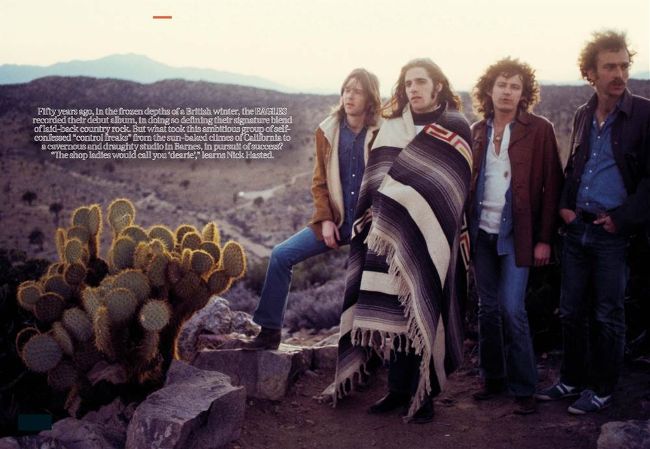
“We are sons of the desert”: the Eagles at Joshua Tree, California, in 1972
Photo by HENRY DILTZ
FEBRUARY 1972. For these four Americans more used to the temperate Californian climate, London in the depths of winter was not the most propitious place to be. But the intense cold was not the only thing the Eagles had to contend with while they recorded their debut album at Olympic Studios. As guitarist Bernie Leadon recalls, “We’re really close to getting this one cut – ‘Just one more, come on guys!’ We get it, the final note is struck, and right as that ringout decayed into nothing, the power went off. The machines all stopped. We went into the control room, because the talkback had cut out. Our producer Glyn Johns said, ‘Well, we’ll just have to listen to it tomorrow…’ It was a blackout, due to the strikes.” Viewed from a distance of 50 years, the irony of the situation is not lost on Leadon. Here they were, recording laid-back, sun-baked country-rock while crisp layers of frost lay thick on the ground outside the studio and Britain was in the grip of a miners’ strike, causing electricity shortages and power cuts. The album they recorded – including “Take It Easy”, “Witchy Woman” and “Peaceful Easy Feeling” – helped define Southern California’s sound during the early ’70s – yet the temperature in their rented Maida Vale digs rarely rose above zero. Hell might not have frozen over, but the pipes almost certainly did. “It was a huge culture shock,” recalls Don Henley. “Trying to find Mexican food in London… and the burgers were horrible!”
At this point, Leadon and his compadres Glenn Frey, Don Henley and Randy Meisner had only been together six months. Many bands in a similar predicament would perhaps have called it a day. But the Eagles were already well advanced with their masterplan – which had led them to chilly London in the first place, specifically to work with Johns, whose track record – The Beatles, Led Zeppelin, The Who – was unimpeachable . “We weren’t perfectionists,” Henley argues. “We did strive for excellence, and that’s two different things. We just tried to make that Eagles record good. I just want to do the best I can do.”
The four men had been in acclaimed but commercially unsuccessful bands before. This time, they left nothing to chance. As Leadon confirms, “We asked ourselves, ‘What was our MO? What are we doing here?’ We wanted it all. Why not? We wanted artistic success, the approval of our peers, commercial success and to be well paid. We had what we called the LCD Show – Lowest Common Denominator. We rehearsed so that if two guys have flu and two of the others aren’t speaking, most of the audience wouldn’t know. I came to look at bands as entrepreneurial, young businesses. Consistency and discipline is a lot of how we succeeded.”