Uranus and Neptune
TRUE-COLOUR IMAGES REVEAL THAT URANUS AND NEPTUNE ARE SIMILAR BLUES
Although the familiar Voyager 2 images of Uranus were published in a form closer to true colour, those of Neptune were stretched and enhanced, making them too blue
Reported by Sharmila Kuthunur
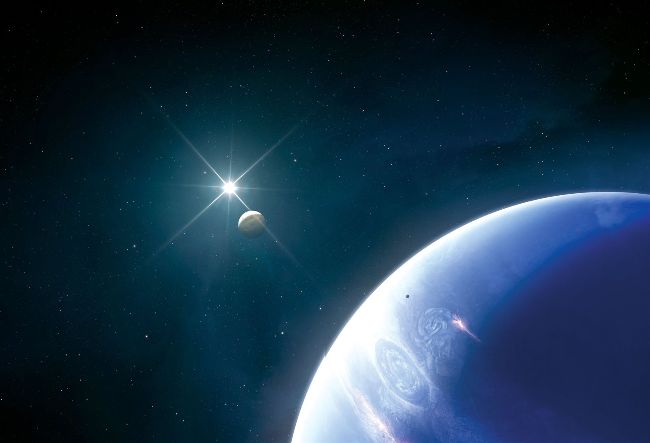
Images of Neptune were stretched and enhanced, made to look bluer like this artist’s impression
© Getty, University of Oxford
In the summer of 1989, from a remote expanse of our Solar System where sunlight is merely I a tepid glow, NASA’s Voyager 2 spacecraft radioed to Earth humankind’s very first images of Neptune. The pictures revealed the Sun’s outermost planet was a stunning deep-blue orb. In contrast, Uranus – Neptune’s planetary neighbour and the first to be discovered with a telescope – appeared noticeably paler. Both seemingly twin worlds have a lot in common. They’re roughly the same size, almost equally massive and are both enveloped with deep atmospheres made of similar materials. So why were the two orbs different shades of blue? This is a question that has puzzled scientists for decades. Now a fresh analysis of Voyager 2’s images shows both ice giants are in fact a similar shade of greenish blue, which is the most accurate representation yet of the planets’ colours.