Dancing around bisexuality
CHARLOTTE DINGLE EXPLORES THE HISTORY OF BISEXUALITY ON STAGE
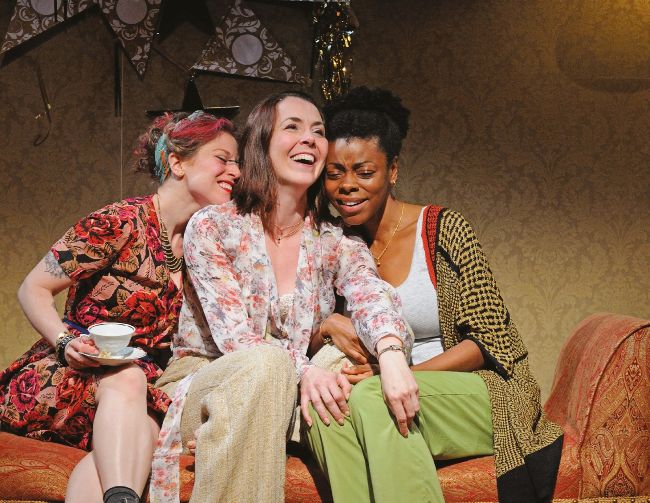
Playing bi (from left): Melancholy, Stop Kiss and By The Bi
PHOTO MARK TUREK
“ Can I be queer and radical and genuine, and be with a boy?”
FROM BI THE BI, A PLAY BY CAROLINE DOWNS AND MORGAN BARBOUR
Fictional representations of bisexual women (and other female-spectrum folk) still have a long way to go. And theatre, of course, is no exception. Indeed, in a world where attending a play is considerably less popular than staring at a screen, it seems to suffer more of a dearth of bisexual characters, particularly sympathetic and realistic ones, than movies, TV and, to a lesser extent, books. Bi women are frequently reduced to lazy stereotypes: they just had to find the right person and choose a side, they’re unhappy and confused, they cheat, they sleep around, they’re in a love triangle, they have to be in a polyamorous relationship…
Historical depictions of bisexuality in plays, scarce to begin with, almost always seem to involve men. We are left, therefore, with little more than a handful of recent and contemporary pieces dealing openly with the issue of female bisexuality.
Jonathan Larson’s popular musical Rent, written in 1994, tells the story of a group of friends living through the Aids epidemic in 1989/90. One of these characters, Maureen – although not an HIV sufferer herself – is your classic hypersexual bisexual woman. She is unable to keep it in her pants, as well as apparently being irresistible to most of the people she meets. At one point her girlfriend, Joanne, and ex-boyfriend, Mark, sing a song called Tango Maureen. “The Tango Maureen, it’s a dark, dizzy merry-go-round,” laments Mark. “She cheated,” exclaims Joanne. “She cheated!” responds Mark. When Joanne and Maureen fall out, Maureen sings to Joanne: “Ever since puberty, everyone stares at me! Boys, girls – I can’t help it baby. But hey don’t you want your girl hot?!” Joanne, horrified at Maureen’s wildness, cries: “I look before I leap. I hate mess, but I love you.” Maureen is chaotic, unpredictable and undecided, and Joanne represents the world of monosexuality as safe and regimented.