BREAKING OUT
With Deathloop, Arkane is reinventing the wheel it spent two decades perfecting
BY ALEX SPENCER
Almost every aspect of Deathloop, in the gradual unfurling of details since the game’s first showing at E3 2019, has come as something of a surprise. Revealed less than a fortnight on from the release of Outer Wilds and mere hours after 12 Minutes got its own E3 spotlight, Deathloop was the title that confirmed time loops as a gaming trend, and carried that trend into the triple-A space.
Then, just as we were starting to grasp the intricate workings of the loop, it was followed by a second revelation: confirmation that Colt and Julianna, the two characters shown in that very first trailer, would both be playable in head-to-head multiplayer –a first for developer Arkane Studios.
Even after seeing the game up close for the first time, the full implications of both are still coming into focus. But in the moment, they’re nudged out by a fresh source of surprise. Because, as game director Dinga Bakaba steers us through one of Blackreef Island’s four regions, we’re actually a little taken aback by just how quick it all is.
Colt applies a machete to the midsection of one poor masked goon, readies a grenade for his next victim and switches to the sniper rifle at a range that makes the scope frankly unnecessary. Finally, to mop up any remaining enemies, he uses the Pepper Grinder, a rapid-fire cannon we’re told is this universe’s equivalent of an assault rifle but looks and sounds like it should be strapped to the underside of a Spitfire. It’s fast, loud and bloody.
THE PEPPER GRINDER LOOKS AND SOUNDS LIKE IT SHOULD BE STRAPPED TO A SPITFIRE
In the Dishonored games, which occupied Arkane’s Lyon team for the eight years prior, action tends to come in carefully planned bursts. A sleep dart here, a teleport there, ducking back into the shadows before anyone’s the wiser. That’s not the rhythm of Deathloop at all. At least, not as played by Bakaba, who manages to compress an entire Dishonored level’s worth of violence into the space of a few seconds.
He’s aided by a set of powers that will be familiar to fans of the studio’s previous work but, vitally, have been recalibrated to make them easier to deploy on the go. Shift, this game’s teleport power, lets you hang in the air and release a shower of bullets before pivoting to blink off in a new direction. Nexus is Dishonored 2’s Domino ability reimagined as a rocket launcher, linking the fates of every person in its blast radius so they can all be felled simultaneously with a single followup headshot. Turrets can be hacked remotely, using a gadget that doesn’t even require you to be aiming directly

Dinga Bakaba, game director on Deathloop at Arkane Studios
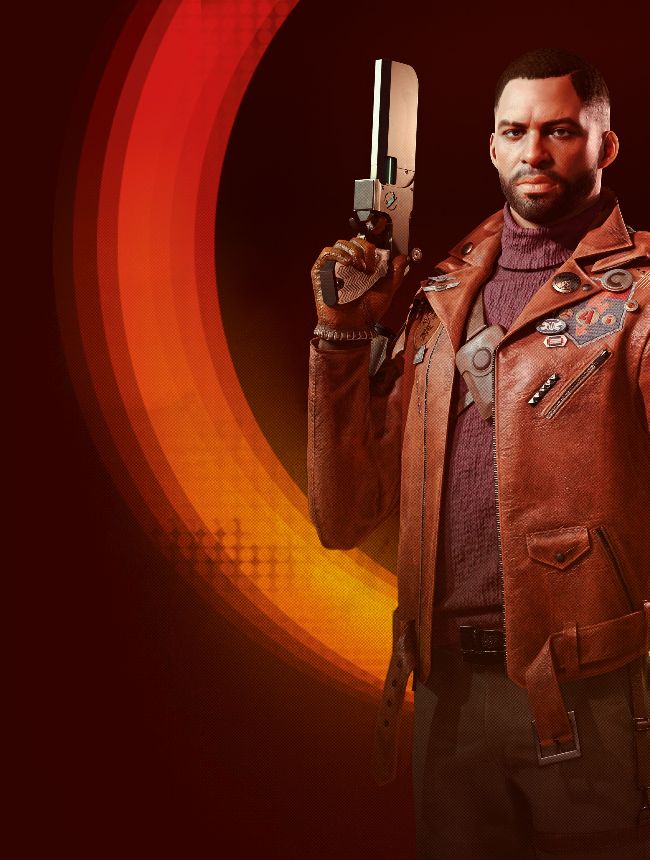
Game Deathloop Developer Arkane Studios Publisher Bethesda Softworks Format PC, PS5
BIRDS AND BATS
With no ability to save, and limited chances each day, the sense of danger is cranked up in
Deathloop. “If the player gets into too much trouble, then they’re done. They die, and they loop back to the beginning of the day,” designer Dana Nightingale says. “So, entering each space, they need to think: what risks am I willing to take on this run?
Because if I mess up and I die, I’m starting over.” This, we suggest, sounds an awful lot like a Roguelike –a format Arkane’s Austin team experimented with in Prey’s Mooncrash expansion – but Nightingale, at least, never thought of this game that way.
“It’s more a case of convergent evolution.
So maybe Roguelikes are birds, and we’re bats,” she says. “We both learned to fly different ways.”
at them. There is rarely any need to stop, or even slow down.
This change of pace is another way in which Arkane is tearing up the unspoken assumptions of its previous releases, and one that simultaneously draws on and feeds back into those other two major departures. So let’s take a leaf out of Deathloop’s book and rewind.
Over the past two decades, Arkane’s twin teams – working in parallel from Lyon and Texas – have released five full games. From Arx Fatalis to Prey, these titles span a breadth of settings and genres, but all of them can be loosely corralled under the banner of ‘immersive sim’. This term can be tricky to define, but the games it describes put the focus on player agency and improvisation over tightly choreographed setpieces, with level design that rewards closer examination. Games, in other words, in the tradition of System Shock, Thief and Deus Ex –a tradition which Arkane has been observing almost entirely on its own, at least in the gaming mainstream, since the decline of Irrational Games.