FITOTR ACK
Custom open source health monitoring
Deciding to spy on himself for once, Michael Reed examines the ways we can keep a record of our activities using various pieces of software.
Part One!
Don’t miss part two in next month’s issue!

OUR EXPERT
Michael Reed
has a circadian rhythm disorder, and he often wishes there were more than 25.7 hours in a day.
QUICK TIPS The social stigma around unusual sleep times emerged from our agrarian ancestors, long before Linux and the accompanying need for all-night coding sessions.
W e’re always being told that the technology corporations are spying on us and gathering data, but there are times when we want to keep tabs on ourselves for the good of our own health. Fortunately, there are loads of Linux applications, mobile apps and websites that can help us to monitor our health, and that’s what we’re going to look at with this short series.
Logging applications can be passive or active. They are either stopped and started by the user or they sit in the background recording what you’re up to for later analysis. Some record useful data after being activated. Sports loggers are an example of this, because they record the start and stop time of your run or cycle ride, but also log your route and constantly record your speed.
You often have to make a decision when deciding to log your sporting, eating or sleeping activities: do you want to work with a mobile app, a desktop application or a website-based service? If you want to record your eating habits and keep a tally of your calorie intake, there are advantages to using a mobile device, and you probably don’t want to carry your laptop around while you’re jogging.
The advantage of bringing technology into the mix when keeping tabs on your activities is that computers have a perfect memory. They record exactly what you did, when you did it and how long you did it for. Once you have all this data recorded, it’s time to look back for an overview to get an idea of the trends and measure your progress towards your goals.
Sports monitoring
We’ve given FitoTrack (https://bit.ly/lxf327fito)a thorough write-up in the past (LXF301), and it continues to be a useful sport activity monitoring utility. When using FitoTrack, before you start an activity such as running or cycling, you begin a new workout of that type, and it then monitors your position using GPS until you press Stop.
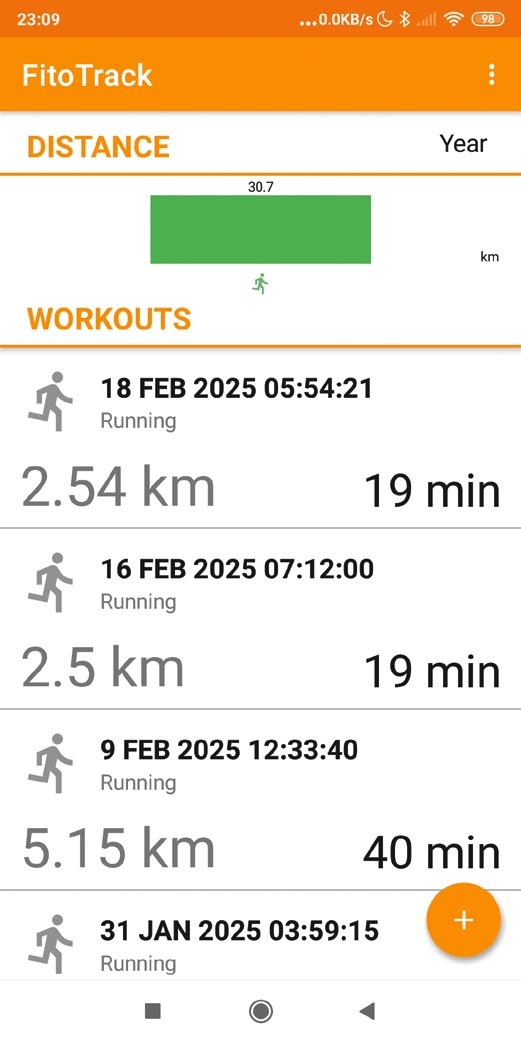
FitoTrack is an open source Android app that records runs, cycle rides and more.
We’re particularly attracted to FitoTrack because it’s an open source solution that was developed on Linux even though it runs on Android phones. The data is stored locally on your phone and it can be exported in a standard format called GPX, which can be read by many Linux utilities.
FitoTrack is a dedicated monitoring app, but many sports bands and smartwatches are also good activity monitors. One snag with these devices, particularly fitness bands, is that they aren’t usually designed to operate independently. Often, you interact with the sports recording data using the manufacturer’s own mobile app, and this means you’re dealing with proprietary software. There’s nothing wrong with that in itself, but it might be abandoned in the future and it’s often not completely clear what is being recorded and where the data is being sent.