Know your stuff
George Dent
MR’s editor and chief model maker can offer advice on almost any subject.
Chris Gadsby
If there’s a tech question, we all look towards Chris!
Peter Marriott
Rumour has it that MR’s resident scenery buff even uses a Gras-Master on his own front lawn…
Dave Lowery
Professional model maker who’s been there, done that and got the T-shirt!
Steve Nall
A modeller since childhood, he also enjoys working on real trains.
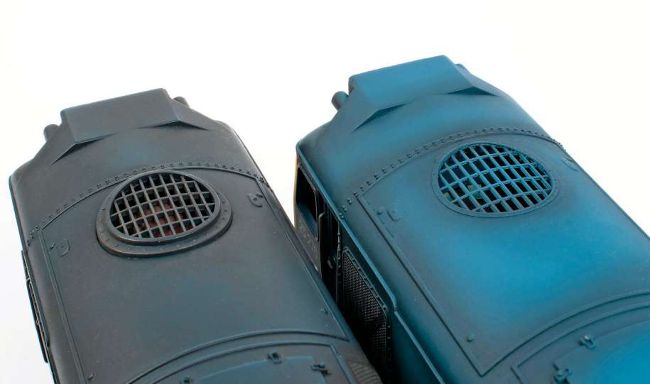
Replacing the bulky moulded roof grille (left) on older Bachmann Class 24/25 models with an etched metal version is a worthwhile project.
HOW TO REPLACE A DIESEL ROOF FAN GRILLE
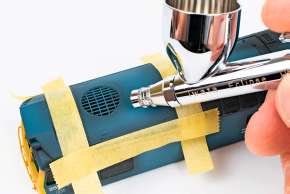
It’s easy to touch-in the new parts with paint by masking-off the roof panel and applying a white primer, followed by the livery colour. Weathering will also help blend it all together.
Q I want to try my hand at detailing a Bachmann Class 25 and have bought a replacement roof fan and grille set from Extreme Etchings. I’m a bit nervous about making a start – any tips for how to shape and install the parts?
Brian Jones, by email
George says: Bachmann’s original Class 24/25s, first released nearly 20 years ago, featured rather chunky plastic roof grilles by today’s standards and really do benefit from the addition of etched metal replacements. I seem to recall that Shawplan and A1 Models initially offered single piece etched brass grilles which simply required shaping and fitting over the existing aperture, making for a straightforward upgrade. Indeed, the most difficult aspect was removing the moulded grille and tidying up the plastic.
However, when the Extreme Etchings range was added to Shawplan’s roster, a much more authentic option became available, albeit with an increased level of difficulty. Consisting of three layers of etched stainless steel – two parts for the grille and a separate retaining ring – an element of assembly was required before installation.
Stainless steel is tougher than brass, so it’s a little more challenging to work with. Cutting the parts from the fret requires a set of good quality metal cutting shears to avoid distorting the material. Care is also needed when tidying up the edges of the parts with needle files. On the plus side, steel is more resistant to being bent out of shape during handling and fettling. The method of shaping the parts is the same for brass, nickel silver and stainless steel, using a steel rod over a cushioned surface to impart a curved profile.
Helpfully, the Extreme Etchings pack comes with an etched assembly jig, which is easily folded to shape. This is designed to help discern the correct profile and to hold the grilles while the two layers are laminated. The parts can be joined with solder or glue. I prefer solder, as it produces a more resilient bond, but a thin cyanoacrylate glue is a viable alternative.
After removing the old plastic grille and flattening the raised beading, the new grille can be glued into position and the etched retaining ring overlay added. The ring is rather fragile and, after making a bit of a mess with glue on my first attempt, I enjoyed better results with clear acrylic varnish as an adhesive, applied with a brush. It took longer to dry but produced a much neater joint. Once subsequent layers of primer and paint were applied, the bond has proved reliable.