New spins…
JETHRO TULL
Praise be! A biblically-inspired Ian Anderson draws from the good book on the prog icons’ first album in almost 20 years.
Words: G rant Moon Illustration: Mark Leary
Edited by Dave Everley prog.reviews@futurenet.com
“This is going to put some people’s noses out of joint,” Ian Anderson told this writer recently when discussing Jethro Tull’s 22nd studio record, their first since 2003’s Christmas Album. “But I think of drawing upon elements of the Bible in the same way as I draw on elements of society as subject material for songs. It’s taking something and turning it into something else. It’s what I do.”
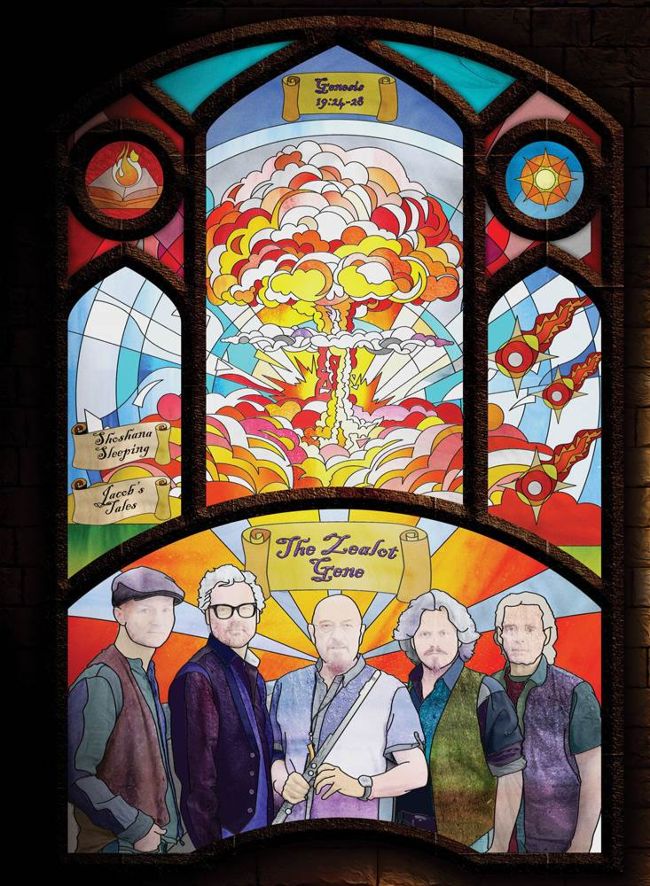
Few artists in the progressive realm or beyond make that conversion in such intelligent, idiosyncratic style. Anderson has turned his mind to religion before – Ronnie Pilgrim’s subverted metaphysical journey in A Passion Play; most of Aqualung’s second side – but rarely as directly as this. The Zealot Gene’s 12 songs come subtitled with the New and Old Testament passages that inspired them. The alchemy lies in how these biblical stories are set to music, and made new.
The titular Mrs Tibbets is Enola Gay Tibbets, the mother of Paul, pilot of the plane that dropped the Hiroshima bomb. The liner notes refer us to Genesis 19:24-28 (the bit about The Lord raining down burning sulphur on Sodom and Gomorrah, overthrowing cities and destroying all living things), while the song ponders how an individual can rationalise their involvement with such mass destruction (‘Don’t feel bad about the melting heat, the burning flesh, the soft white cell demise’). A heavy subject is set to a jaunty tune, with Anderson’s mischievous flute and cheeky vocal delivery in the top line. Throughout the record, that trademark flute radiates sheer character. Raspy and fluttering in parts, melodic and mellifluous in others, it’s the musical sugar on the thematic pill.
The line-up that recorded The Zealot Gene (bassist David Goodier, keyboardist John O’Hara, drummer Scott Hammond and guitarist Florian Opahle) are a tight regiment, here to back the boss and showcase the songs. That priority is also reflected by the album’s frills-free production, almost Lutheran in its minimalism.
The Zealot Gene
INSIDEOUT
It’s ripe with fresh inspiration and resonant of past glories.
Referencing Exodus and billed as “a late-life partner to Aqualung’s My God”, Mine Is The Mountain opens with grand, minor-key piano chords and develops into an exquisitely performed piece of prog theatre. With echoing, stentorian voice and ostensibly perched upon Mount Sinai, Anderson makes a good jealous God, exhorting Moses and Man to obey Him, not to mug Him off in any way, or else. ‘Bring me safe haven for tablets of stone to live through the ages, to scold and to guide you, threaten, cajole you and cut to the bone.’ It’s both funny, and also terrifying.
The Betrayal Of Joshua Kynde is a rocky meditation on the Judases of this world (‘There’s always someone to spoil the party fun’), with a bluesy flute riff and a strong solo from Opahle. Evoking Calvary itself, Where Did Saturday Go? has a folky, modal flavour and a beautifully spare acoustic guitar riff. With its gutsy harmonica intro and mandolin lines, Jacob’s Tales is a short, spiky piece about sibling rivalry and greed, à la Jacob and Esau.
The perky single Shoshana Sleeping underplayed the album’s darker tone, but in context this racy piece about voyeurism and fantasy makes thematic sense. Anderson’s aversion to schmaltz endures, but there’s a softness to Three Loves, Three: ‘Be it love of spirit, of brothers, lovers, sons or blood-heat emotion, burning lava, bright it runs.’ The strident title track warns of mankind’s divisive nature at DNA level, the reductive, binary nature of discourse in the social media age and the dangerous allure of “the populist with dark appeal”. It’s strong and infectious, from its martial-metal intro to the coda’s sinister chords, a potent sting in the tail.
Conceived after seeing drunken revellers during a walk through Cardiff city centre one Saturday night, Sad City Sisters references a passage in Ezekiel about two prostitutes, and features ‘Tramps on a night out, out of season/
Bare legs and arms at the taxi stand’). Thoughtprovoking elsewhere, the all-seeing eye and unflinching worldview seem judgemental here – mean, even (‘So send them home to stumble in, and toss their knickers in the bin’.) The gorgeous folky instrumentation – accordion, mandolin and penny whistle – makes it easy enough to turn the other cheek.
Given its biblical source, The Zealot Gene way well put a nose or two out of joint, but its poetic, erudite and relatively respectful approach should help avoid any spectacular blowback. Anderson’s expectations for it are modest: “Most fans don’t want a new Jethro Tull album,” he told this writer recently, “they want an old Jethro Tull album!” But he who has ears, let him hear: this literate and highly listenable work is a real grower. Ripe with fresh inspiration and resonant of past glories, it belongs high in the Tull canon.
BIG BIG TRAIN
Welcome To The Planet ENGLISH ELECTRIC RECORDINGS
Prog standard-bearers’ 14th album, released in the shadow of loss.
The heartbreaking news of Big Big Train vocalist and multi-instrumentalist David Longdon’s death in November 2021 will inevitably colour perceptions of his band’s 14th album. An outpouring of creative energy that comes just six months after Common Ground, it’s become something different in the wake of his passing.
If it is to form part of his epitaph, then it’s hugely fitting. A musical and thematic extension of Common Ground, much of Welcome To The Planet speaks of positivity, community and shared history – both individual and collective. Opener Made From Sunshine, written by Longdon and guitarist Dave Foster, sets the tone with a warm-hearted, upbeat affirmation of hopefulness.
With strings channelling shades of King Crimson, The Connection Plan puts the BBT spin on what sounds much like a construction that drummer Nick D’Virgilio could have written when fronting Spock’s Beard. Lanterna features keyboard player Carly Bryant’s gorgeous piano throughout. In fine BBT tradition, bassist Greg Spawton harnesses historical and architectural inspiration in a song celebrating ‘mankind building […] tall towers of light to extend our reach into the sea’. Signalling the connection with the Common Ground sessions, there’s also a musical nod to Atlantic Cable from that album.
BBT’s penchant for a particularly British nostalgia is revisited with Proper Jack Froster, Spawton’s bittersweet paean to childhood. Capitoline Venus is a beautiful, brief love song with the subtle Mellotron and Longdon’s affecting vocal delivery now providing even more of an emotional gut-punch.
There’s a contrasting pair of instrumentals. Rikard Sjöblom’s A Room With No Ceiling is a beguiling concoction of 70s sounds and European folk/prog textures with a hint of R&B, while D’Virgilio’s Bats In The Belfry suggests a whiff of funk and soul, giving brass and bass something of a workout (the drummer’s soloing in the second half is outstanding).
Closing the album, the title track boasts some prog musical theatre, hinting at vaudeville and music hall, juxtaposed with expansive massed vocal sections that are simultaneously spacious, contemplative and majestic. Right now though, it’s hard to accept Bryant’s comforting assertion that ‘Everything is okay … Everything. Is. Okay’.
Welcome To The Planet has solid Big Big Train DNA, real heart and great performances, not least from the man whose voice became inseparable from the band’s identity. Although the next destination on Big Big Train’s journey now unclear, it must surely still be informed by David Longdon’s immeasurable legacy.
GARY MACKENZIE
POPPY ACKROYD
Pause ONE LITTLE INDEPENDENT
Minimalist musical approach for maximum pleasure.
The timing of releases is as arguably important as the sounds contained within the grooves. So it is that Poppy Ackroyd’s third, full-length release for One Little Independent Records arrives to coincide with shorter days and longer nights. In doing so, this wonderfully talented pianist and violinist beautifully captures the seasonal melancholy and ennui that hangs in the air.
Not that Pause should be perceived as a dour piece of work – far from it. Witness the delightful arpeggios of Seeding where her fingers dance across the keys with a nimble ease while reaching out to the soul, a feat that’s repeated with the optimistic, strident pace of Release. Elsewhere, Murmurations’ ebbs and flows move with the force and pace of a swollen river.
Ackroyd is possessed of an ability to paint musical pictures with her piano on the blank canvas of your mind. Its pastoral and bucolic qualities evoke images of cold, misty dawns and the sodium haze of foggy, neon-lit twilights. And yet, as evidenced by the album’s title track, this minimalist and autumnal contemplation dares to hope for the distant light of spring. Music to be savoured and embraced. JM
AIRBAG
A Day In The Studio/Unplugged In Oslo KARISMA
Livestreamed lockdown performances kick up quiet storms.
When restrictions prevented Airbag from taking the widescreen soundscapes of 2020’s A Day At The Beach on the road, they inevitably turned to livestream technology, opting to strip the songs down to their bare bones in the process.
The melancholic electronica that formed the slowly unfolding backdrop to A Day At The Beach’s opener Machines And Men is replaced with sparse acoustic guitar here, and even if it doesn’t build the same rising sense of panic as the original, it offers a more despondent take on the song that is just as affecting. It also plays to Airbag’s strengths of drawing influence from the more emotionally raw moments of prime Waters-era Floyd and taking them to new places. That can also be heard in previously unreleased track Come On In, a moving romantic ballad that benefits from sparkling top-of-the-neck guitar and harmony accompaniment.
The high-and-lonesome quality of the songs seems enhanced by the unplugged approach, and so it proves again on beautifully love-lorn readings of Colours and Sounds That I Hear. And days like these can only whet the appetite for bigger nights to come. JS
BIG SCENIC NOWHERE
The Long Morrow HEAVY PSYCH SOUNDS
Low-key stoner all-stars spiral away into orbit.
Much acclaimed in stoner rock circles for their expansive take on an often unchanging genre, Big Scenic Nowhere are arguably too low-key and laidback to be regarded as a bona fide supergroup.
Nonetheless, the Californian crew’s second full-lengther is notable not just for the ongoing presence of three red-eyed legends – Fu Manchu’s Bob Balch, and Yawning Man’s Gary Arce and Bill Stinson. Also here are contributions from former Opeth man and noted prog polymath Per Wiberg, art rock firebrand Reeves Gabrels (David Bowie/The Cure) and hard rock polymath and occasional psychedelic troubadour Tony Reed, whose gruffly soulful vocals anchor these sprawling-out jams.
Everything soars into orbit during the album’s second half, just in time for that last bong hit to kick in. The title track takes a languorous approach to blissed-out drug rock, with an amiable, ambling groove that underpins every intuitive mutation over 20 hypnotic minutes. Noticeably more prog-friendly than last year’s Vision Beyond Horizon debut, The Long Morrow sounds less like the fruit of some light-hearted sideproject than it does the blossoming of an organic meeting of mellow minds. DL
CAN
Live In Brighton 1975 SPOON/MUTE
Latest live album from the Can vaults.
Recorded at Sussex University less than three weeks after the May 2021-released Live In Stuttgart 1975, this latest offering from the Can archives is a different though no less satisfying creature. Looser and freer, it also stands in stark contrast with the sleeker studio album, Landed, from the same year.
Indeed, there’s intrigue to be had as Can dip further back into their career here. Echoes of Future Days’ Bel Air form the basis of the second of the seven largely improvised instrumentals (Zwei) with Michael Karoli’s space guitar and Irmin Schmidt’s winding keyboards blending into a seamless whole. Elsewhere, Sieben uses the shuffling funk of Vitamin C as its launchpad before blasting into the furthest reaches of the universe.
Played to a boisterous audience, these aren’t shapeless jams, but rather a careful interaction between musicians paying attention to each other. Vier is an extraordinary locking-in of Holger Czukay’s bass pulses and Jaki Liebezeit’s circular drumming, as Karoli’s weeping lament and Schmidt’s solid foundations change direction with skill and grace.
An essential history lesson that challenges the present to catch up.
JM
COPELAND, KING, COSMA & BELEW
Gizmodrome Live EARMUSIC
A rollicking good time from Copeland’s genre-fluid supergroup.
With just one fleeting tour in support of their sole studio album, it’s a cause for celebration that the brief dalliance of Stewart Copeland, Adrian Belew, Mark King and Vittorio Cosma was captured for posterity. By selecting performances from all six dates of that 2018 run, Gizmodrome Live showcases the band at their best. “That’s the first time that we’ve actually ended that song correctly,” declares Copeland after the finale of Elephant Talk.
They romp through the album tracks, chucking in tunes from the Copeland and Belew’s back catalogues along theway. As the main vocalist, Copeland throws himself into every song with gusto, but he’s well matched by King, who does a great version of The Police’s Does Everyone Stare. Surprises include Don’t Box Me In, from Copeland’s Rumble Fish soundtrack, and Excesses from his Klark Kent album.