HERITAGE HISTORY
TALYLLYN THE ROOT OF RAIL PRESERVATION
It is 70 years ago this month that the first ever preserved railway service operated, and led to a global heritage movement. Nicola Fox provides a whistle-stop review some of the achievements of the Talyllyn Railway since that first train… and outlines some of its celebratory plans.
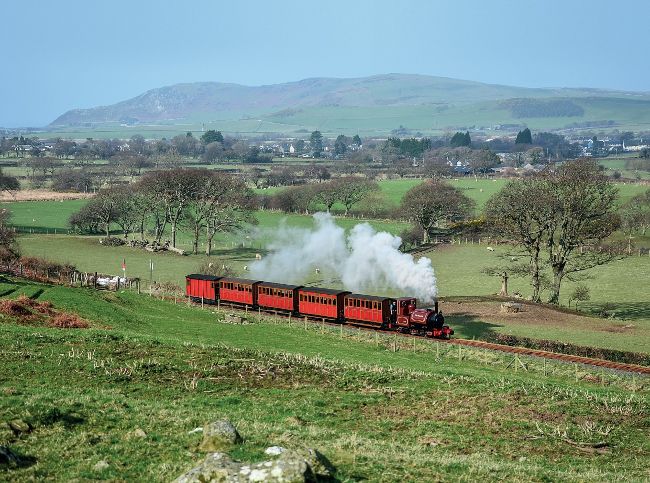
Talyllyn Railway 0-4-2T No. 1 Talyllyn, the line’s original engine, heads east through beautiful Fathew Valley. BARBARAFULLER
IN THE Fathew Valley on May 14, 1951, history was made as a group of enthusiasts ran the first train in preservation. Crewed by volunteers, the notion seemed whimsical; volunteers running a railway, for the sake of running a railway.
The event was reported in passing in the railway press, and the brevity of the report belied how momentous the occasion was.
Seven decades later and the preservation movement has grown to encompass about 200 railways across the length and breadth of Britain – and more globally.
The story of the founding of the Talyllyn Railway Preservation Society (TRPS) and the saving of the railway has been told countless times, but in the 70 years since that first train in preservation, the Talyllyn has changed immeasurably in many ways. In others, the line remains a time capsule of its Victorian self.
So, what has 70 years of preservation looked like?
The locomotive fleet
After that initial jubilation of saving the line subsided, the volunteers set about the business of running a preserved railway. With TR locomotive No. 1 Talyllyn out of action owing to an ominous bulge in the firebox and No. 2
Dolgoch on its last legs, the society had already acquired two locomotives from a nearby railway that shared the same unusual 2ft 3in gauge – the Corris Railway.
The Corris Railway had closed in 1948 and the two locomotives offered for the price of £85 each to the Talyllyn, which refused.
However, station master Campbell Thomas – perhaps seeing that they might be of use one day – kept the two locomotives covered with tarpaulins to protect them from the elements (and prying eyes, perhaps!), even going as far as enlisting the staff of Machynlleth Motive Power Depot to grease the moving parts.
Whether Campbell Thomas was a would-be preservationist or simply a man who didn’t want good machinery to go to waste is unknown, but his efforts meant that by the time the TRPS had been formed, both locomotives, although stored outside, were still usable. A price of £25 per engine was negotiated, which was later reduced to the bargain price of £30-12s-9d for both.
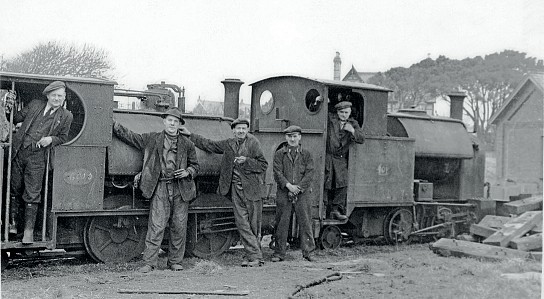
This 1951 view shows TR locos No. 3 and No. 4 atWharf station after arrival from the Corris Railway. TALYLLYN RAILWAY ARCHIVES
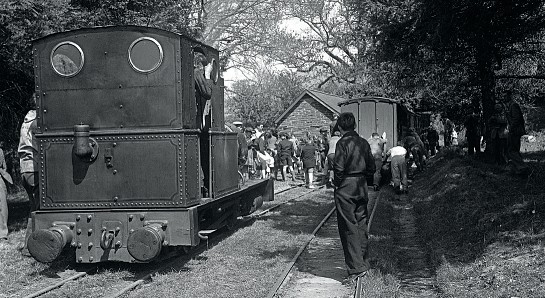
On the first day of operation in 1951, shunting of the stock at Rhydyronen was undertaken by hand! TALYLLYN RAILWAY ARCHIVES
“Among the early volunteers, the railway had the good fortunes to attract the Reverend Wilbert Awdry, whose Thomas The Tank Engine books were proving very popular. He turned up for the 1952 season and was promptly handed the guard’s flag, and set to work guarding the trains for two weeks.”
‘THE LAWNMOWER’
‘The Lawnmower’s’ time on the Talyllyn was memorable but brief.
Two years after its wheels first turned, it was dismantled and converted back into wagon form, this time as flatbed wagon No. 19.
Three years later, a Ruston & Hornsby diesel from Jee’s Quarry was donated to the railway by the Midlands Area Group.
Given the name Midlander, this new locomotive took on The Lawnmower’s previous designation of No. 5.
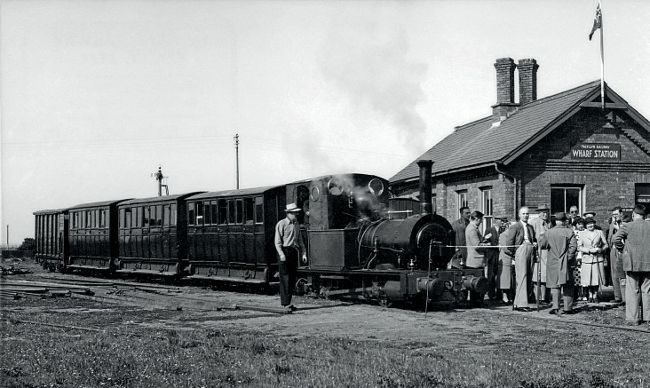
The historic occasion on May 14, 1951, of the first train on a preserved railway anywhere in the world. Wearing the hat by the cab is Tom Rolt, while Bill Trinder is looking at the camera.
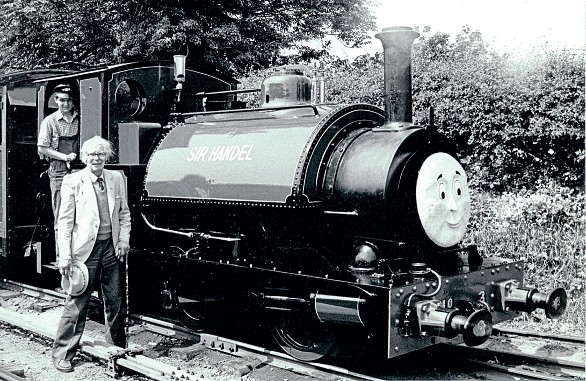
The Reverend Wilbert Awdry, creator of the Thomas The Tank Engine books, with TR loco No. 3 Sir Haydn, renamed Sir Handel for the 1982 season. The Rev Awdry told local press the loco had been borrowed from the Skarloey Railway.
TALYLLYN RAILWAY ARCHIVES