The Case That CAM Is Unethical
HARRIET HALL
Edzard Ernst is arguably the world’s foremost expert on the claims and the evidence (or thereof) for Complementary and Alternative Medicine (CAM). Now he has teamed up with a medical ethicist, Kevin Smith, to coauthor a new book, More Harm Than Good? The Moral Maze of Complementary and Alternative Medicine. Much has been written on CAM, but this book takes a new approach. It asks if CAM is ethical and answers with a resounding “No.”
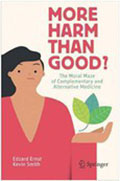
More Harm Than Good? The Moral Maze of Complementary and Alternative Medicine. By Edzard Ernst and Kevin Smith. New York: Springer Publishing, 2018. ISBN 978-3-319-699400. 223 pp. Softcover, $22.99.
In all areas of health care, patients are entitled to expect certain basic precepts to be satisfied: “Practitioners should be competent. Treatments should be based on valid knowledge. Educational and licensing programs should ensure that only qualified practitioners can practice. Autonomy: patients should be free to choose or reject treatments based on full informed consent. Honesty. Absence of exploitation.”
“These basic ethical requirements are frequently neglected, ignored or willfully violated in CAM,” the authors say. They address these precepts one by one in great detail, showing how CAM fails to measure up. They support their argument with plentiful examples from the clinical practice of CAM practitioners.