CELLO BRIDGE DESIGN
X MARKS THE SPOT
For many years the design of the cello bridge has remained constant – but could it be improved? Sebastian Gonzalez presents the results of a comparison between the standard French bridge and a newly designed model, while on page 52 Gaian Amorim tracks the development of the bridge
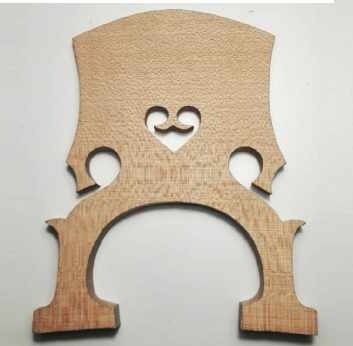
A standard French-model cello bridge blank
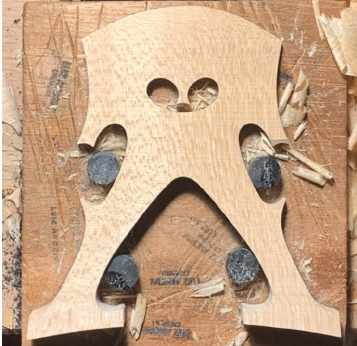
The ‘Model X’ bridge designed by Luiz Amorim, in its final construction stages
FRENCH BRIDGE COURTESY MATTEO PONTIGGIA. MODEL X BRIDGE COURTESY AMORIM FINE VIOLINS
The cello is a beautiful and complex instrument, known for its rich, deep sound. The bridge is an essential component of its structure, responsible for transferring the vibrational energy of the strings into the body and contributing significantly to the overall sound of the instrument. To achieve the best possible sound, the cello bridge needs to be light enough to transmit the movement of the strings efficiently, yet rigid enough to support the static load of the strings.
Throughout history there have been many attempts at designing the ideal cello bridge. Over time, luthiers have arrived at two standard models: the French and the Belgian. These designs have been refined over the years, but the basic principles remain the same. However, in recent times the Amorim family of luthiers in Cremona, Italy, has developed a new cello bridge design, which has garnered some attention in the music world.
Inspired by Amorim’s fifth prototype of cello bridge, called the ‘Model X’ (see page 52), the research team at the Musical Acoustic Lab of the Polytechnic University of Milan conducted a study to investigate how much the shape of a cello bridge’s legs alters its static and vibrational behaviour. We created 3D simulations of both a standard French model bridge and the Model X for the experiment. To study different geometries of the bridge legs, we created simulations using the ‘Finite Element Method’. This reduces complex shapes such as the bridge to make smaller ‘elements’ – multiple triangles, albeit ‘finite’ in number – which make up the volume of the object. The laws of physics can then be applied to them in the computer.
The experiment also involved parametric modelling, i.e. a design that can be controlled with one parameter – in this case the legs of the bridge. In figure 1 the control point can be seen at point ‘P’.
We performed displacement and modal analysis for different boundary conditions, providing a detailed description of the mode shapes and their natural frequencies for different leg shapes. The full study was recently published in the Journal of Applied Sciences in a special issue dedicated to the mechanics, dynamics and acoustics of musical instruments and can be found here: bit.ly/3T4wScP
Lisez l'article complet et bien d'autres dans ce numéro de
The Strad
Options d'achat ci-dessous
Si le problème vous appartient,
Connexion
pour lire l'article complet maintenant.
Numéro unique numérique
April 2024
Ce numéro et d'autres anciens numéros ne sont pas inclus dans une nouvelle version de l'article
abonnement. Les abonnements comprennent le dernier numéro régulier et les nouveaux numéros publiés pendant votre abonnement.
The Strad
Abonnement numérique annuel
€64,99
facturé annuellement