US
13 MIN READ TIME

CELLO BRIDGE DESIGN

X MARKS THE SPOT

For many years the design of the cello bridge has remained constant – but could it be improved? Sebastian Gonzalez presents the results of a comparison between the standard French bridge and a newly designed model, while on page 52 Gaian Amorim tracks the development of the bridge
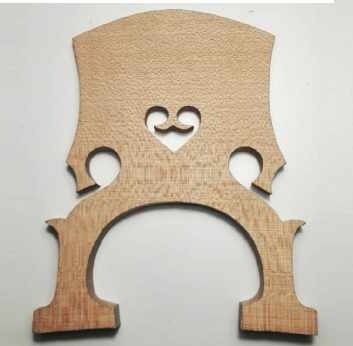
A standard French-model cello bridge blank
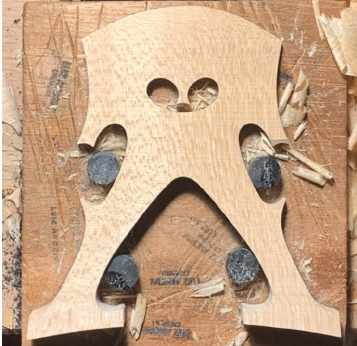
The ‘Model X’ bridge designed by Luiz Amorim, in its final construction stages
FRENCH BRIDGE COURTESY MATTEO PONTIGGIA. MODEL X BRIDGE COURTESY AMORIM FINE VIOLINS

The cello is a beautiful and complex instrument, known for its rich, deep sound. The bridge is an essential component of its structure, responsible for transferring the vibrational energy of the strings into the body and contributing significantly to the overall sound of the instrument. To achieve the best possible sound, the cello bridge needs to be light enough to transmit the movement of the strings efficiently, yet rigid enough to support the static load of the strings.

Throughout history there have been many attempts at designing the ideal cello bridge. Over time, luthiers have arrived at two standard models: the French and the Belgian. These designs have been refined over the years, but the basic principles remain the same. However, in recent times the Amorim family of luthiers in Cremona, Italy, has developed a new cello bridge design, which has garnered some attention in the music world.

Inspired by Amorim’s fifth prototype of cello bridge, called the ‘Model X’ (see page 52), the research team at the Musical Acoustic Lab of the Polytechnic University of Milan conducted a study to investigate how much the shape of a cello bridge’s legs alters its static and vibrational behaviour. We created 3D simulations of both a standard French model bridge and the Model X for the experiment. To study different geometries of the bridge legs, we created simulations using the ‘Finite Element Method’. This reduces complex shapes such as the bridge to make smaller ‘elements’ – multiple triangles, albeit ‘finite’ in number – which make up the volume of the object. The laws of physics can then be applied to them in the computer.

The experiment also involved parametric modelling, i.e. a design that can be controlled with one parameter – in this case the legs of the bridge. In figure 1 the control point can be seen at point ‘P’.

We performed displacement and modal analysis for different boundary conditions, providing a detailed description of the mode shapes and their natural frequencies for different leg shapes. The full study was recently published in the Journal of Applied Sciences in a special issue dedicated to the mechanics, dynamics and acoustics of musical instruments and can be found here: bit.ly/3T4wScP

Read the complete article and many more in this issue of The Strad
Purchase options below
If you own the issue, Login to read the full article now.
Single Digital Issue April 2024
 
$4.99 / issue
This issue and other back issues are not included in a new subscription. Subscriptions include the latest regular issue and new issues released during your subscription. The Strad
Annual Digital Subscription $54.99 billed annually
Save
23%
$4.58 / issue

This article is from...


View Issues
The Strad
April 2024
VIEW IN STORE

Other Articles in this Issue


The Strad
Contributors
EVAN DAVENPORT (Trade Secrets, page 58) is a
SOUNDPOST
Letters, emails, online comments
LETTER OF THE MONTH WINS
one from a selection of products from The
Editorial
Editor's letter
As well as being one of the world’s
FRONT
On the beat
News and events from around the world this month
Love is all around
Dvořák’s Cello Concerto is the inspiration behind a new piece in the genre
COMPETITIONS
Salomé Bonnema Liam Byrne Anastasia Kobekina BONNEMA PHOTO
NEW PRODUCTS
CELLO CASE Worth its weight Gewa reveals its
Life lessons
Tai Murray
THE PROBLEM WITH PIZZICATO
Perfecting bowing is a lifelong quest for string players – but what about pizzicato? Cellist Davina Shum advocates setting aside some dedicated practice time to this neglected technique
Auspicious beginnings
The first violin edition of the Global Music Education League competition took place in Beijing following a four-year delay due to the pandemic. Emma Baker travelled to China to hear the finals
FEATURES
‘Everybody’s playing like their life depends upon it’
Violinist Joshua Bell chats with Pauline Harding about transcending the pyrotechnics of Paganini, the inspiring ethos of the Academy of St Martin in the Fields, and celebrations to mark the centenary of the orchestra’s founder, Neville Marriner
Straight from the heart
Can a new work encourage young, classically trained string players to lose their fear of improvisation and find their individual voice? Violinist Christina Åstrand and composer Signe Lykke explain the concept to Andrew Mellor
PARISIAN SPLENDOUR
Having perfected his skills in the French capital, German bow maker Richard Otto Gläsel was much inspired by the work of his Gallic forebears, from Voirin to Vigneron. Gennady Filimonov tells his story and examines several of his finest works
SCENES FROM A LIFE
As the Carducci Quartet releases its third Shostakovich disc, Tom Stewart hears from the group’s violist and cellist about the extreme contrasts between the two featured pieces – the ninth and fifteenth string quartets
AN OLD-SCHOOL GENTLEMAN
Russian cellist Boris Pergamenschikow enjoyed an influential career both teaching and playing in Europe after leaving the Soviet Union, before his untimely death twenty years ago. Oskar Falta examines his legacy and hears from some of his former students
REGULARS
JOSEPH MARQUÈS
IN FOCUS A close look at the work of great and unusual makers
Making a decorative fleur-de-lys
TRADE SECRETS
MY SPACE
A peek into lutherie workshops around the world
Cultivating wisdom
MAKING MATTERS
BEETHOVEN CELLO SONATA NO.5, SECOND AND THIRD MOVEMENTS
MASTERCLASS
Core values
TECHNIQUE
Reviews
CONCERTS
From the ARCHIVE
New York correspondent Thomas C. Dawson reports on a performance by Maud Powell and solves a mystery regarding the violins of virtuoso Ede Reményi (1828–98)
ELENA URIOSTE
The Violin Sonata by French composer Mel Bonis was a revelation for the US-born violinist, revealing both a new sound world and innovative techniques in music writing
Chat
X
Pocketmags Support