Vous consultez actuellement le France version du site.
Voulez-vous passer à votre site local ?
Dernière édition


Free Sample Issue
Essayez un échantillon Gratuit de Wildlife Australia
Essayez un échantillon Gratuit de

Wildlife Australia Magazine Spring 2024 Retour à l'édition précédente

English
5 Critiques   •  English   •   Leisure Interest (Wildlife)
Only €4,99
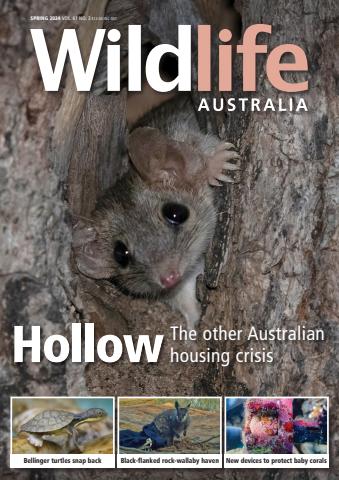
Hallowed mission to protect hollows

AUSTRALIAN wildlife is unique in its dependency on tree hollows – even dead and fallen tree hollows.

This edition looks at the need to protect old-growth bushland, with its abundance of hollows, versus the ease with which that thriving forest can be flattened.

Some ecosystems are at inflection points that could result in local disappearances of koalas, antechinus, possums and – most telling of all – our unique gliders, largely because of bush clearing and the wholesale loss of hollows.

Wildlife Information, Rescue and Education Service (WIRES) speaks plainly about the role hollows play in Australia’s bush ecosystem health.

“Small hollows with narrow entrances suitable for small animals such as the brush-tailed phascogale and the eastern pygmy-possum take about 100 years to form,” WIRES reports. “Hollows of a medium size and suitable for animals such as parrots will take around 200 years to form.

“In Australia many native species need tree hollows, including 17% of bird species, 42% of mammals and 28% of reptiles. They include bats, possums, gliders, owls, parrots, antechinus, ducks, rosellas and kingfishers as well as numerous species of snakes, frogs and skinks.”
This puts the recent dialogue Wildlife Queensland leaders had with Queensland Government environment officials into perspective, leading up to government assurances to secure vital greater glider forest habitat.

A few weeks after this meeting, a Wildlife Queensland team of experts and citizen scientists ventured into St Mary State Forest, near Maryborough, to document a population of greater gliders (Petauroides volans) – but were shocked to see logging taking place less than 3km from this site.

This edition features a range of stories that state and re-state the importance of protecting bushland in which hollows are a feature. Hollows could rightfully be named as one of Australia’s greatest natural resources.
read more read less
Wildlife Australia Preview Pages Wildlife Australia Preview Pages Wildlife Australia Preview Pages Wildlife Australia Preview Pages Wildlife Australia Preview Pages Wildlife Australia Preview Pages Wildlife Australia Preview Pages Wildlife Australia Preview Pages

Wildlife Australia

Spring 2024 Hallowed mission to protect hollows AUSTRALIAN wildlife is unique in its dependency on tree hollows – even dead and fallen tree hollows. This edition looks at the need to protect old-growth bushland, with its abundance of hollows, versus the ease with which that thriving forest can be flattened. Some ecosystems are at inflection points that could result in local disappearances of koalas, antechinus, possums and – most telling of all – our unique gliders, largely because of bush clearing and the wholesale loss of hollows. Wildlife Information, Rescue and Education Service (WIRES) speaks plainly about the role hollows play in Australia’s bush ecosystem health. “Small hollows with narrow entrances suitable for small animals such as the brush-tailed phascogale and the eastern pygmy-possum take about 100 years to form,” WIRES reports. “Hollows of a medium size and suitable for animals such as parrots will take around 200 years to form. “In Australia many native species need tree hollows, including 17% of bird species, 42% of mammals and 28% of reptiles. They include bats, possums, gliders, owls, parrots, antechinus, ducks, rosellas and kingfishers as well as numerous species of snakes, frogs and skinks.” This puts the recent dialogue Wildlife Queensland leaders had with Queensland Government environment officials into perspective, leading up to government assurances to secure vital greater glider forest habitat. A few weeks after this meeting, a Wildlife Queensland team of experts and citizen scientists ventured into St Mary State Forest, near Maryborough, to document a population of greater gliders (Petauroides volans) – but were shocked to see logging taking place less than 3km from this site. This edition features a range of stories that state and re-state the importance of protecting bushland in which hollows are a feature. Hollows could rightfully be named as one of Australia’s greatest natural resources.


SELECTIONNER LE FORMAT :
Accès instantané

Offres numériques disponibles :

Numéro précédent numérique Spring 2024
 
4,99 / issue
Ce numéro et d'autres numéros antérieurs ne sont pas inclus dans un abonnement à l'UE. Wildlife Australia abonnement. Les abonnements comprennent le dernier numéro régulier et les nouveaux numéros publiés pendant la durée de l'abonnement. €2,00 par numéro dans le Cyber Week 2025 Big Annual Subscriptions Sale - General Interest offer. . Si vous souhaitez vous abonner, veuillez consulter notre rubrique Options d'abonnement
Les économies sont calculées sur la base d'un achat comparable de numéros uniques sur une période d'abonnement annualisée et peuvent varier par rapport aux montants annoncés. Les calculs sont effectués à des fins d'illustration uniquement. Les abonnements numériques comprennent le dernier numéro et tous les numéros réguliers publiés au cours de l'abonnement, sauf indication contraire. L'abonnement choisi sera automatiquement renouvelé s'il n'est pas résilié dans la section Mon compte jusqu'à 24 heures avant la fin de l'abonnement en cours.

Wildlife Australia issue Spring 2024

Wildlife Australia  |  Spring 2024  


Hallowed mission to protect hollows

AUSTRALIAN wildlife is unique in its dependency on tree hollows – even dead and fallen tree hollows.

This edition looks at the need to protect old-growth bushland, with its abundance of hollows, versus the ease with which that thriving forest can be flattened.

Some ecosystems are at inflection points that could result in local disappearances of koalas, antechinus, possums and – most telling of all – our unique gliders, largely because of bush clearing and the wholesale loss of hollows.

Wildlife Information, Rescue and Education Service (WIRES) speaks plainly about the role hollows play in Australia’s bush ecosystem health.

“Small hollows with narrow entrances suitable for small animals such as the brush-tailed phascogale and the eastern pygmy-possum take about 100 years to form,” WIRES reports. “Hollows of a medium size and suitable for animals such as parrots will take around 200 years to form.

“In Australia many native species need tree hollows, including 17% of bird species, 42% of mammals and 28% of reptiles. They include bats, possums, gliders, owls, parrots, antechinus, ducks, rosellas and kingfishers as well as numerous species of snakes, frogs and skinks.”
This puts the recent dialogue Wildlife Queensland leaders had with Queensland Government environment officials into perspective, leading up to government assurances to secure vital greater glider forest habitat.

A few weeks after this meeting, a Wildlife Queensland team of experts and citizen scientists ventured into St Mary State Forest, near Maryborough, to document a population of greater gliders (Petauroides volans) – but were shocked to see logging taking place less than 3km from this site.

This edition features a range of stories that state and re-state the importance of protecting bushland in which hollows are a feature. Hollows could rightfully be named as one of Australia’s greatest natural resources.
en savoir plus lire moins
Embrace a wilder life – download Wildlife Australia, the country’s leading nature magazine. Fifty pages of insightful and thought-provoking articles and stunning photographs.
Celebration: Celebrate the essence of Australia – its vast wild landscapes and distinctive wildlife, most found nowhere else in the world
Insights: The articles are written by leading researchers and those whose care for nature comes from deep insights. You won’t find this information by Googling.
Beauty: Immerse yourself in the allure and charm of wildlife with photos by some of Australia’s leading nature photographers.
Understanding: Wildlife Australia is a hub for people who value their relationship with nature and know it is enriched by knowledge. The nature experience can be powerful, but often requires interpretation.
Inspiration: Be inspired by what people are doing to understand and protect nature.
Conservation: Wildlife Australia is a not-for-profit magazine and all profits go to protect nature.

A subscription to Wildlife Australia won't cure arthritis or tonsillitis, but is great for two modern ailments: dislocation from nature and existential malaise. Download the app and see.

En tant qu'abonné, vous bénéficierez des avantages suivants :


•  Une réduction sur le prix de vente conseillé de votre magazine
•  Les nouvelles éditions sont livrées sur votre appareil le jour même de leur sortie
•  Vous ne manquerez jamais un numéro
•  Vous êtes protégé contre les hausses de prix qui pourraient survenir plus tard dans l'année.

Vous recevrez 4 pendant une période de 1 an Wildlife Australia abonnement au magazine.

Remarque : les éditions numériques ne comprennent pas les éléments de couverture ou les suppléments que vous trouveriez avec les copies imprimées.

Votre achat ici à Pocketmags.com peut être lu sur l'une des plateformes suivantes.


Vous pouvez le lire ici sur le site web ou télécharger l'application pour votre plateforme, n'oubliez pas de vous connecter avec votre nom d'utilisateur et votre mot de passe Pocketmags.

Apple Pocketmags Online Pocketmags Google Pocketmags
L'application Pocketmags fonctionne sur tous les appareils iPad et iPhone fonctionnant sous iOS 13.0 ou plus, Android 8.0 ou plus et Fire Tablet (Gen 3) ou plus. Notre lecteur web fonctionne avec n'importe quel navigateur compatible HTML5, pour PC et Mac nous recommandons Chrome ou Firefox.

Pour iOS, nous recommandons tout appareil pouvant exécuter le dernier iOS pour de meilleures performances et une meilleure stabilité. Les modèles plus anciens avec des spécifications de processeur et de RAM inférieures peuvent connaître un rendu de page plus lent et des plantages occasionnels de l'application qui sont hors de notre contrôle.
5,0
/5
Sur la base de 5 Commentaires des clients
5
5
4
0
3
0
2
0
1
0
Voir les commentaires

Articles dans ce numéro


Vous trouverez ci-dessous une sélection d'articles dans Wildlife Australia Spring 2024.

Free Sample Issue
Essayez un échantillon Gratuit de Wildlife Australia
Chat
X
Support Pocketmags