Vous consultez actuellement le France version du site.
Voulez-vous passer à votre site local ?
Dernière édition


Free Sample Issue
Essayez un échantillon Gratuit de Wildlife Australia
Essayez un échantillon Gratuit de

Wildlife Australia Magazine Summer 2024 Retour à l'édition précédente

English
5 Critiques   •  English   •   Leisure Interest (Wildlife)
Only €4,99
THREE-and-a-half decades ago, Douglas Adams wrote the hilarious Hitchhikers Guide to the Galaxy series of novels and radio plays. Then he realised his premise, that aliens were about to destroy planet Earth (to make way for a hyperspace bypass) had a not-so-funny parallel.
Humans were constantly destroying crucial habitat—for similar bypass roads—tipping animal and plant species towards extinction.
Adams sounded the alarm. He wrote a book and a 1989 radio series called Last Chance to See, with zoologist Mark Carwardine, and they scoured the world to see just-about-extinct animals. Although the episodes were light hearted, they left viewers with pangs of uneasiness.
Adams died suddenly of heart failure at age 49, but his broadcaster friend Stephen Fry joined Mark Carwardine to follow up with BBC Television’s documentary series of Last Chance to See in 2009.
Adams believed comedy and irony were effective methods of helping others to comprehend a crisis. He realised our endangered species problem was no laughing matter: “For millions of years, on average, one species became extinct every century... We are now heaving more than a thousand different species of animals and plants off the planet every year.”
Since Douglas Adams said that, flora and fauna extinctions have accelerated to ‘worse’—much worse.
Proof of that is in this edition of Wildlife Australia. Read the endangered species reports from the Biodiversity Council of Australia, the IUCN Red List, the Australian Conservation Foundation and, of course, Wildlife Queensland.
However, the heartening thing today, compared with Douglas Adams’ time, is that so many more Australians are organised and mobilised to challenge those problems.
In Australia’s unique case, environmental science melding with First Nations’ habitat management techniques is both a revelation and a revolution.
Take heed—and take heart. Or, as Douglas Adams would recommend: Don’t Panic.
read more read less
Wildlife Australia Preview Pages Wildlife Australia Preview Pages Wildlife Australia Preview Pages Wildlife Australia Preview Pages Wildlife Australia Preview Pages Wildlife Australia Preview Pages Wildlife Australia Preview Pages Wildlife Australia Preview Pages

Wildlife Australia

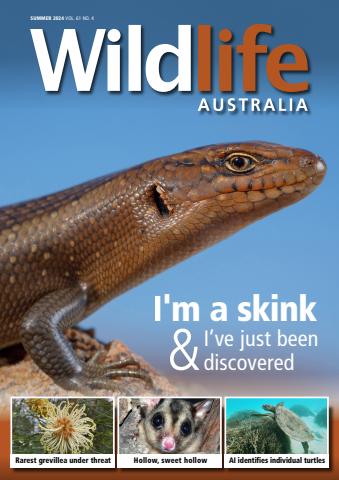
Summer 2024 THREE-and-a-half decades ago, Douglas Adams wrote the hilarious Hitchhikers Guide to the Galaxy series of novels and radio plays. Then he realised his premise, that aliens were about to destroy planet Earth (to make way for a hyperspace bypass) had a not-so-funny parallel. Humans were constantly destroying crucial habitat—for similar bypass roads—tipping animal and plant species towards extinction. Adams sounded the alarm. He wrote a book and a 1989 radio series called Last Chance to See, with zoologist Mark Carwardine, and they scoured the world to see just-about-extinct animals. Although the episodes were light hearted, they left viewers with pangs of uneasiness. Adams died suddenly of heart failure at age 49, but his broadcaster friend Stephen Fry joined Mark Carwardine to follow up with BBC Television’s documentary series of Last Chance to See in 2009. Adams believed comedy and irony were effective methods of helping others to comprehend a crisis. He realised our endangered species problem was no laughing matter: “For millions of years, on average, one species became extinct every century... We are now heaving more than a thousand different species of animals and plants off the planet every year.” Since Douglas Adams said that, flora and fauna extinctions have accelerated to ‘worse’—much worse. Proof of that is in this edition of Wildlife Australia. Read the endangered species reports from the Biodiversity Council of Australia, the IUCN Red List, the Australian Conservation Foundation and, of course, Wildlife Queensland. However, the heartening thing today, compared with Douglas Adams’ time, is that so many more Australians are organised and mobilised to challenge those problems. In Australia’s unique case, environmental science melding with First Nations’ habitat management techniques is both a revelation and a revolution. Take heed—and take heart. Or, as Douglas Adams would recommend: Don’t Panic.


SELECTIONNER LE FORMAT :
Accès instantané

Offres numériques disponibles :

Numéro précédent numérique Summer 2024
 
4,99 / issue
Ce numéro et d'autres numéros antérieurs ne sont pas inclus dans un abonnement à l'UE. Wildlife Australia abonnement. Les abonnements comprennent le dernier numéro régulier et les nouveaux numéros publiés pendant la durée de l'abonnement. €2,00 par numéro dans le Cyber Week 2025 Big Annual Subscriptions Sale - General Interest offer. . Si vous souhaitez vous abonner, veuillez consulter notre rubrique Options d'abonnement
Les économies sont calculées sur la base d'un achat comparable de numéros uniques sur une période d'abonnement annualisée et peuvent varier par rapport aux montants annoncés. Les calculs sont effectués à des fins d'illustration uniquement. Les abonnements numériques comprennent le dernier numéro et tous les numéros réguliers publiés au cours de l'abonnement, sauf indication contraire. L'abonnement choisi sera automatiquement renouvelé s'il n'est pas résilié dans la section Mon compte jusqu'à 24 heures avant la fin de l'abonnement en cours.

Wildlife Australia issue Summer 2024

Wildlife Australia  |  Summer 2024  


THREE-and-a-half decades ago, Douglas Adams wrote the hilarious Hitchhikers Guide to the Galaxy series of novels and radio plays. Then he realised his premise, that aliens were about to destroy planet Earth (to make way for a hyperspace bypass) had a not-so-funny parallel.
Humans were constantly destroying crucial habitat—for similar bypass roads—tipping animal and plant species towards extinction.
Adams sounded the alarm. He wrote a book and a 1989 radio series called Last Chance to See, with zoologist Mark Carwardine, and they scoured the world to see just-about-extinct animals. Although the episodes were light hearted, they left viewers with pangs of uneasiness.
Adams died suddenly of heart failure at age 49, but his broadcaster friend Stephen Fry joined Mark Carwardine to follow up with BBC Television’s documentary series of Last Chance to See in 2009.
Adams believed comedy and irony were effective methods of helping others to comprehend a crisis. He realised our endangered species problem was no laughing matter: “For millions of years, on average, one species became extinct every century... We are now heaving more than a thousand different species of animals and plants off the planet every year.”
Since Douglas Adams said that, flora and fauna extinctions have accelerated to ‘worse’—much worse.
Proof of that is in this edition of Wildlife Australia. Read the endangered species reports from the Biodiversity Council of Australia, the IUCN Red List, the Australian Conservation Foundation and, of course, Wildlife Queensland.
However, the heartening thing today, compared with Douglas Adams’ time, is that so many more Australians are organised and mobilised to challenge those problems.
In Australia’s unique case, environmental science melding with First Nations’ habitat management techniques is both a revelation and a revolution.
Take heed—and take heart. Or, as Douglas Adams would recommend: Don’t Panic.
en savoir plus lire moins
Embrace a wilder life – download Wildlife Australia, the country’s leading nature magazine. Fifty pages of insightful and thought-provoking articles and stunning photographs.
Celebration: Celebrate the essence of Australia – its vast wild landscapes and distinctive wildlife, most found nowhere else in the world
Insights: The articles are written by leading researchers and those whose care for nature comes from deep insights. You won’t find this information by Googling.
Beauty: Immerse yourself in the allure and charm of wildlife with photos by some of Australia’s leading nature photographers.
Understanding: Wildlife Australia is a hub for people who value their relationship with nature and know it is enriched by knowledge. The nature experience can be powerful, but often requires interpretation.
Inspiration: Be inspired by what people are doing to understand and protect nature.
Conservation: Wildlife Australia is a not-for-profit magazine and all profits go to protect nature.

A subscription to Wildlife Australia won't cure arthritis or tonsillitis, but is great for two modern ailments: dislocation from nature and existential malaise. Download the app and see.

En tant qu'abonné, vous bénéficierez des avantages suivants :


•  Une réduction sur le prix de vente conseillé de votre magazine
•  Les nouvelles éditions sont livrées sur votre appareil le jour même de leur sortie
•  Vous ne manquerez jamais un numéro
•  Vous êtes protégé contre les hausses de prix qui pourraient survenir plus tard dans l'année.

Vous recevrez 4 pendant une période de 1 an Wildlife Australia abonnement au magazine.

Remarque : les éditions numériques ne comprennent pas les éléments de couverture ou les suppléments que vous trouveriez avec les copies imprimées.

Votre achat ici à Pocketmags.com peut être lu sur l'une des plateformes suivantes.


Vous pouvez le lire ici sur le site web ou télécharger l'application pour votre plateforme, n'oubliez pas de vous connecter avec votre nom d'utilisateur et votre mot de passe Pocketmags.

Apple Pocketmags Online Pocketmags Google Pocketmags
L'application Pocketmags fonctionne sur tous les appareils iPad et iPhone fonctionnant sous iOS 13.0 ou plus, Android 8.0 ou plus et Fire Tablet (Gen 3) ou plus. Notre lecteur web fonctionne avec n'importe quel navigateur compatible HTML5, pour PC et Mac nous recommandons Chrome ou Firefox.

Pour iOS, nous recommandons tout appareil pouvant exécuter le dernier iOS pour de meilleures performances et une meilleure stabilité. Les modèles plus anciens avec des spécifications de processeur et de RAM inférieures peuvent connaître un rendu de page plus lent et des plantages occasionnels de l'application qui sont hors de notre contrôle.
5,0
/5
Sur la base de 5 Commentaires des clients
5
5
4
0
3
0
2
0
1
0
Voir les commentaires

Articles dans ce numéro


Vous trouverez ci-dessous une sélection d'articles dans Wildlife Australia Summer 2024.

Free Sample Issue
Essayez un échantillon Gratuit de Wildlife Australia
Chat
X
Support Pocketmags