The Mark of Morane
Morane-Saulnier M.S.406
By Richard Mason
The M.S.406 is one of those machines that leads one to ponder a number of what ifs? What if Anglo-French policy in the 1930s had been more belligerent and less geared towards appeasement? What if the French Air Force, a formidable body of men and machines, had been better deployed and directed and had not been obliged from the opening of the Battle of France to fight on the defensive, and what if circumstances had not allowed the luftwaffe to exploit a local superiority in numbers and tactics as a result of better co-operation with ground forces. Might then another allied monoplane fighter have been enshrined alongside the Spitfire and Hurricane, had the leisure to grow and develop at the same pace, and be remembered as a war-winning design, rather than being consigned to the same obscurity as that enjoyed by many aircraft overtaken by events in the opening months of World War ii? What if, and this would have been dependent on the aircraft’s place role in history and subsequent marketability, Airfix had made a kit of the type and released it in a Series 1 plastic bag for 2-/6d? Might we then have a better idea of the kind of machine it actually was?
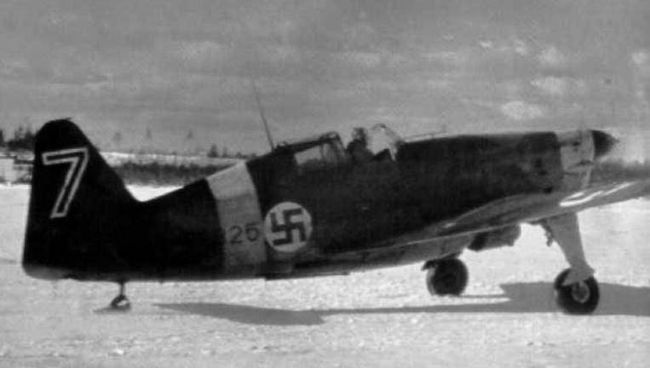
Finnish Morane-Saulnier MS.406, MS-325 of 2/LeLv 28, based at Viitana in the winter of 1941-42. This was one of an initial batch of thirty aircraft received from France in February 1940
It was as early as 1934 that the French Air Force’s Aeronautical Technical Service issued a requirement for a modern single seat interceptor fighter with a monoplane layout and retractable undercarriage. intended to replace the Dewoitine D.371, Dewoitine D.500, and loire 46 then in service, among the companies that responded to the requirement was French aircraft manufacturer Morane-Saulnier. Their contender was designated the M.S.405, a low wing monoplane of mixed construction, with a fabric covered wooden tail, but a bonded metal/wood material (Plymax) skin fixed to duralumin tubing. Morane had concentrated on civil designs in the years since World War i, and the M.S.405 was a significant undertaking for the firm. This, their first low wing monoplane with enclosed cockpit and retracting gear, was a significant advance on their fixed gear parasol monoplanes.
The first M.S405-1 prototype flew on 8th August 1935, demonstrating favourable flying characteristics from the outset. early test flights were flown with a fixed undercarriage, but this was later replaced. The prototype was delivered with all military equipment fitted to participate in service trials in January 1937 and that June was displayed at the Brussels Aeronautical exhibition.
Testing proved a need for wing modification and the second prototype was not airborne until January 1937. Fitted with a 671.1kW (900hp) Hispano-Suiza 12Ycrs engine it was able to attain a speed of 275mph during testing and in March 1937 an initial order was placed for the construction of sixteen preproduction prototypes, which were to incorporate the design improvements that had been made upon the M.S.405-2, leading to the aircraft being redesignated M.S.406.