LANZAROTE
FIRE STARTER
Lanzarote’s volcanoes have inspired locals to make everything from art to wine. A tour of the island reveals the landscape’s impact, including lava-sand beaches, caldera hiking trails and a subterranean cave
WORDS: BEN LERWILL.

A winemaker with a handful of picón, or volcanic ash;
PHOTOGRAPHS: ANNA HUIX
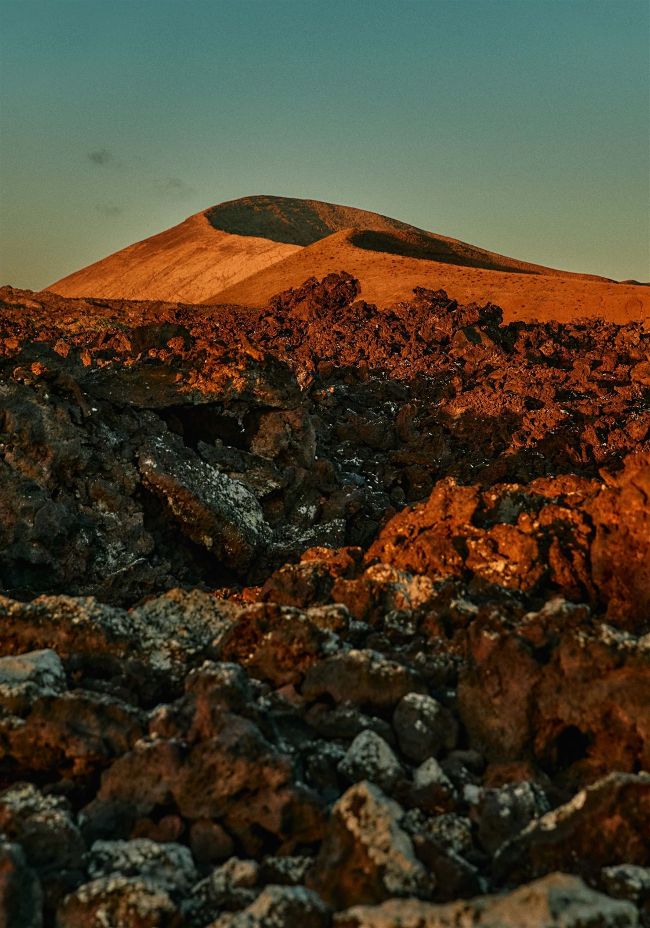
the texture-rich landscape around Caldera Blanca
THERE’S NOTHING LIKE CLIMBING A VOLCANO AT DAWN.
It’s just an hour past sunrise when I reach the rim of Caldera Blanca, a steep-sided hulk of igneous rock on the western flank of Lanzarote. The sun casts a reddish wash over the land. Up here — some 1,500ft above the broiling swell of the Atlantic — the only sounds are the wind and the waves, but the whole island is spread out at my feet. In all directions are dozens of other peaks, silent mounds rising from the jagged flatlands. Three centuries ago, the summit I’m standing on didn’t even exist. In 1730, the ground began belching a morass of ash and lava across the island in a series of cataclysmic eruptions, covering almost a quarter of its entire area. Many villages had to be abandoned for good. The seismic activity went on to last more than 2,000 days, spewing fury from a vent in the earth’s crust and birthing countless new volcanoes, including Caldera Blanca. Today, the caldera’s vast, craggy summit feels prehistoric, yet it’s younger than St Paul’s Cathedral.
During the eruptions, a local parish priest named Andrés Lorenzo Curbelo kept a diary. He described gigantic mountains blooming like thunder from a fissure in the ground and “fiery lava streams descending like rivers”. The island was left with one of the rawest and most elemental topographies in the world; its cracked geology, lunar starkness and strange succulent plants meaning it now regularly doubles on screen as an extraterrestrial planet.
Magma has drawn me here. I’ve come to explore the island’s volcanic terrain, to find out not only how it fires the imaginations of many Lanzaroteños — the residents who call the place home — but how, in many cases, its lava-formed landscapes also get used as a resource. What looks bare and inhospitable to some becomes a realm of beauty and possibility in the eyes of many more. Artists adore it, winemakers prosper from it, walkers and cyclists roam its dark hillsides.
“The island has something magnetic about it,” explains my young guide for the week, Rocío Romero, her hair a blaze of red curls. “I grew up in Granada, but I came here eight years ago and realised I couldn’t leave.” In the afternoon, we seek out the nearby El Cuervo volcano, which is partially collapsed. Black stones crunch underfoot as cacti stand silhouetted in the middle distance; the sky is hot and cloudless. El Cuervo is gnarled and huge, its top jagged like torn paper. Walking inside through an opening, we find its crater dotted with straggly shrubs. “In Lanzarote,” says Rocío, “the land gets a hold of you”.