Insights into spiny-tailed lizards
While many herp enthusiasts enjoy keeping a range of different species, some people become fascinated by a particular genus, or even an individual species, and as a result, they can frequently make a very significant contribution to advancing our knowledge about the care, behaviour and breeding of their chosen type of reptile. Here Kamiel Hamers of HammerHead Reptiles, based in the Netherlands, tells his story.
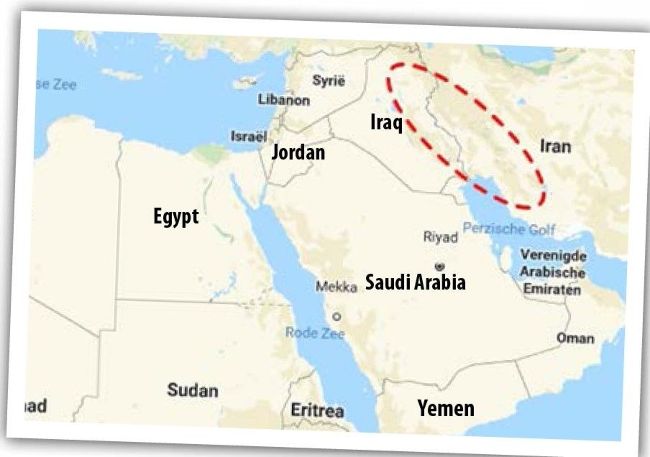
The approximate distribution of the Iraqi spiny-tailed lizard is highlighted here in red. Map courtesy of the author
All photos courtesy of the author.
My introduction to the Iraqi spiny-tailed lizard or mastigure (Saara loricata) began when I saw a photograph of the species (which was then classified as Uromastyx loricata) in the book entitled Uromastyx, written by Thomas Wilms. But it was not until in 2010 that I actually saw these lizards alive for the first time.
I was contacted by a friend, Petr Kodym (who is featured in that book written by Wilms). Petr was selling three babies that he had bred, and asked if I would be interested in them. I was already breeding a few uromastyx species myself by that stage, and so was happy to be able to add these rare lizards to my collection.
When I collected them, the youngsters were really tiny, but they immediately started to eat well in my care. And that is how my association with this species began.
Background
There are only three species of Saara: S. loricata itself, plus the Iranian mastigure (S. asmussi) and the Indian spiny-tailed lizard (S. hardwickii). All three used to belong to the genus Uromastyx, but recent study and DNA research (Wilms and Böhme 2007) has led to them being separated them into the genus Saara.
Saara loricata inhabits desert and semi-desert parts of Iraq, extending into southwest Iran. The weather here reflects the steppe climate, meaning that there are really hot summers and damp winters. The lizards themselves occupy large burrows in the ground.
All the Saara species are currently listed on CITES Appendix II, meaning that wild stock can still be imported if the country of origin permits export, although occurring in a troubled part of the world means that acquiring further stock of S. loricata is far from straightforward in any event.
Appearance
People seeing Saara (and indeed Uromastyx) lizards for the first time often think that they look like tortoises which have lost their shells, and to some extent, that’s a pretty accurate description. They have bulky heads, and a flattened, stocky body with short but strong limbs, and feet equipped with powerful claws for digging purposes.
Yet undoubtedly, the most pronounced feature of these lizards is their spiky tail. The scalation of the tail between the spikes is one of the main visible features that sets Saara species apart from Uromastyx.
Kamiel Hamers (HammerHead Reptiles) from the Netherlands has been keeping reptiles for more than 20 years now. He mainly has desert lizards with a focus on Uromastyx. At the moment, he keeps 14 different species of Uromastyx and Saara and has been breeding 10 different species from these groups over the past decade. He acquired his first baby Saara loricata in 2010 and has been breeding them since 2013.
The Iraqi spiny-tailed lizard grows quite large, up to about 55cm (22in) in terms of its total length, while measuring about 30cm (12in) from the head to the base of the tail. There is sexual dichromatism (a difference in colouration) between the sexes, as the males gain an orange to red shade on their backs when mature.
Keeping the Iraqi spiny-tailed lizard
My main focus in this article is to give an insight as to how I keep and breed these magnificent lizards. However, first of all, I want to emphasise that there is no single right way to do so, and that what I am describing here is simply my way, and it works very well for me.
Accommodation
Iraqi spiny-tailed lizards need pretty big enclosures. They must have a good temperature gradient, extending from 25-28°C (77-82°F) at the cool end to about 55°C (131°F) at the hotspot. I keep a pair in a set up measuring 300x80x60cm (118x32x24in) or bigger. As a result of their size, there are not many “standard” vivariums that you can use for these lizards, but you may be able to combine commercial units like I did, by connecting two Pro Cages, each of which measured 150x80x60cm (59x32x24in), or build your own accommodation.
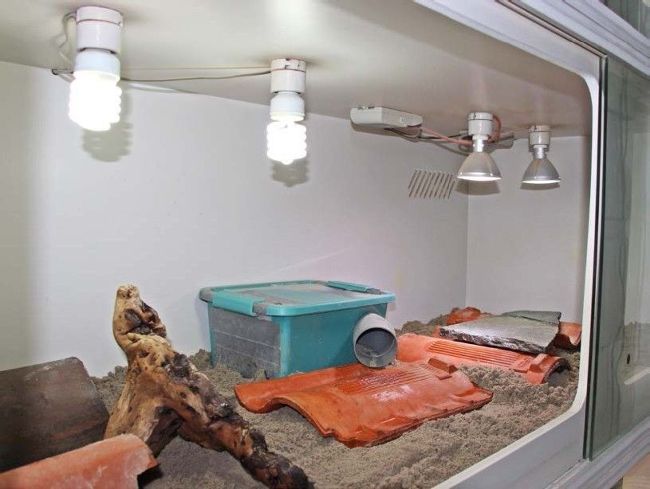
Kamiel uses different types of set-up. This is a vivarium intended for a single egg-laying female, with the egg box and entrance clearly visible here in the centre.