CREMONESE ARCHINGS
LEARNING CURVES
How did the old Cremonese makers work out their archings? Gareth Ballard presents a detailed method for analysing the various curves – and creating your own from the same principles
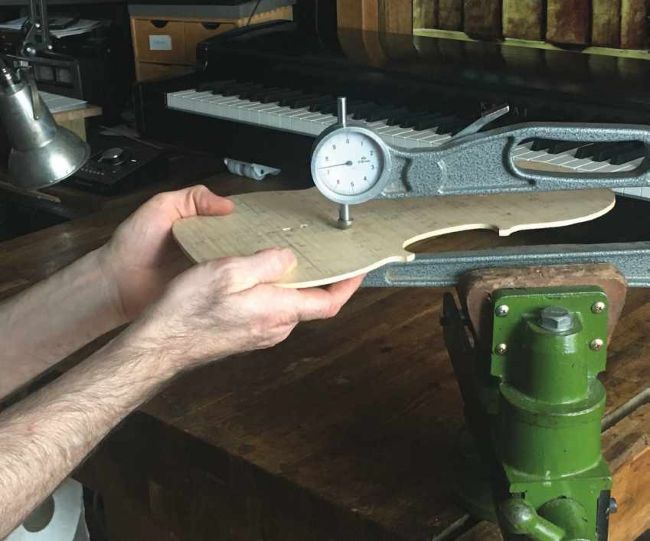
Using a dial calliper on an instrument back
ALL PHOTOS, GRAPHS AND DIAGRAMS GARETH BALLARD
Many violin makers, myself included, obsess about the methods of describing the outline of their instruments, but strangely glaze over when asked about the arching. I can only imagine that this is largely because they think it is unfathomable – surely not dull. In my opinion, it is the shaping of the arching, and the subsequent thicknessing of the front and back plates, that really distinguish a maker’s ability to produce a good-sounding instrument. These are the factors that govern the way the wood will flex. In this pursuit we look to the Cremonese masters for inspiration, although the method they used was never recorded or passed on to later generations. Some believe the Italian plague of 1629–31 was largely responsible for this break in the passing-on of knowledge, and there is some fascinating debate on the subject; suffice to say, violin makers have been working blind ever since.
In this article I would like to share with you a technique I have developed over the past 15 years or more, that highlights the true structure of the Cremonese instruments and, critically, then allows you to copy the instrument’s structure authentically (which I will argue is not possible with current approaches).
When creating the arch of a new instrument, the standard method is to make arching templates from plans such as The Strad ’s posters. External templates are made for five cross-sections across the plate (front or back) and one for the long arch. The wood is then worked until a perfect fit is made when a template is held to the arching exterior.
The issue I have with this approach is that you will, inevitably, have to make your plate either thicker or thinner than the original to achieve the same flexibility, as every piece of wood is unique. Once you have created a perfect copy of the outside, the plate is turned over and wood is removed from what will be the interior until you reach the desired flexibility. So you cannot simply copy the graduations (thicknesses) of another instrument as this will not result in the same degree of flexibility. What’s more, its propensity to flex will even vary within one piece of wood. If the outside remains constant and you have different graduations (thicknesses) from the instrument you are copying, you will have inadvertently changed the constructional shape, and your instrument will therefore not vibrate the same way.