CA
  
You are currently viewing the Canada version of the site.
Would you like to switch to your local site?
12 MIN READ TIME

CREMONESE ARCHINGS

LEARNING CURVES

How did the old Cremonese makers work out their archings? Gareth Ballard presents a detailed method for analysing the various curves – and creating your own from the same principles
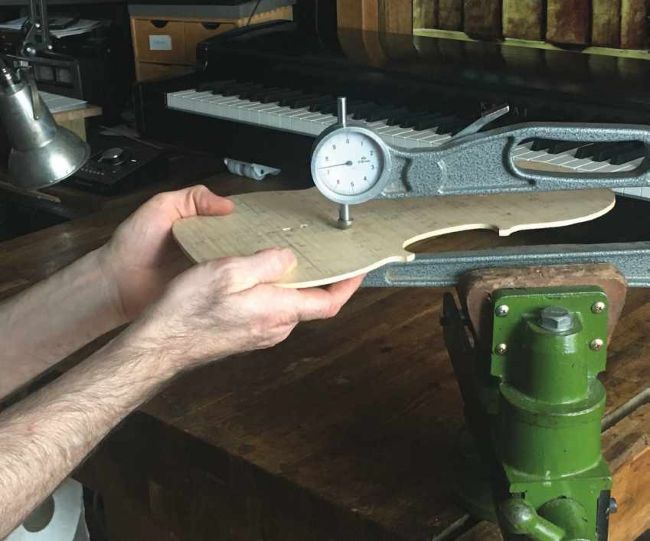
Using a dial calliper on an instrument back
ALL PHOTOS, GRAPHS AND DIAGRAMS GARETH BALLARD

Many violin makers, myself included, obsess about the methods of describing the outline of their instruments, but strangely glaze over when asked about the arching. I can only imagine that this is largely because they think it is unfathomable – surely not dull. In my opinion, it is the shaping of the arching, and the subsequent thicknessing of the front and back plates, that really distinguish a maker’s ability to produce a good-sounding instrument. These are the factors that govern the way the wood will flex. In this pursuit we look to the Cremonese masters for inspiration, although the method they used was never recorded or passed on to later generations. Some believe the Italian plague of 1629–31 was largely responsible for this break in the passing-on of knowledge, and there is some fascinating debate on the subject; suffice to say, violin makers have been working blind ever since.

In this article I would like to share with you a technique I have developed over the past 15 years or more, that highlights the true structure of the Cremonese instruments and, critically, then allows you to copy the instrument’s structure authentically (which I will argue is not possible with current approaches).

When creating the arch of a new instrument, the standard method is to make arching templates from plans such as The Strad ’s posters. External templates are made for five cross-sections across the plate (front or back) and one for the long arch. The wood is then worked until a perfect fit is made when a template is held to the arching exterior.

The issue I have with this approach is that you will, inevitably, have to make your plate either thicker or thinner than the original to achieve the same flexibility, as every piece of wood is unique. Once you have created a perfect copy of the outside, the plate is turned over and wood is removed from what will be the interior until you reach the desired flexibility. So you cannot simply copy the graduations (thicknesses) of another instrument as this will not result in the same degree of flexibility. What’s more, its propensity to flex will even vary within one piece of wood. If the outside remains constant and you have different graduations (thicknesses) from the instrument you are copying, you will have inadvertently changed the constructional shape, and your instrument will therefore not vibrate the same way.

Read the complete article and many more in this issue of The Strad
Purchase options below
If you own the issue, Login to read the full article now.
Single Digital Issue January 2023 and String Courses supplement
 
$6.99 / issue
This issue and other back issues are not included in a new subscription. Subscriptions include the latest regular issue and new issues released during your subscription. The Strad
Annual Digital Subscription $74.99 billed annually
Save
26%
$6.25 / issue

This article is from...


View Issues
The Strad
January 2023 and String Courses supplement
VIEW IN STORE

Other Articles in this Issue


Editorial
Editorís letter
We’vecome a long way over the past twelve
Contributors
Contributors
PARISANDREW (Opinion, page 23) is a British luthier
SOUNDPOST
LETTER of the MONTH
Letters, emails, online comments
FRONT
Classica l unclassifed
News and events from around the world this month
NEWS IN BRIEF
Santiago Cañón-Valencia kicked off Copa Airlines flight bit.ly/3WZQte4
OBITUARIES
ANDREW DAWES Canadian violinist Andrew Dawes died on
PREMIERE of the MONTH
In memory of
Petz Vienna
www.pk.at/shop
Good as gold
CELLO STRINGS
Life lessons
The US cellist on how a disciplined early approach enabled him to embrace the possibilities of new experiences
TIME TO CUT THE CORD?
Luthier Paris Andrew argues that, rather than slavishly copying Antonio Stradivari models, makers should study and explore some of the other beautiful instruments that exist
A birthday celebration
POSTCARD from...
FEATURES
BLINK IF YOU DARE
Daniel Pioro is a violinist to watch – uncompromising about speaking his mind, whether it comes to challenging mediocrity, championing new works or combining ancient and modern. He talks to Tom Stewart about his philosophy, his new album, and the fresh ideas he is bringing to his ongoing residency at London’s Southbank Centre
DANIEL PIORO ON HIS VIOLIN
The violinist has played a modern instrument inspired by the ‘Viotti’ Stradivari since 2012
FROM RUSSIA WITH LOVE
A bow made entirely from ivory has long been considered an enigma as it has never been attributed to a country, let alone to a maker. Now Gennady Filimonov reveals its origins – made by one of the finest and most respected Russian artisans in history
ONCE MORE, WITH FEELING
How does repetition in instrumental practice benefit our playing? Pedro de Alcantara provides tips on how to bring some creativity and intentionality into your practice time
SINGING A NEW SONG
Following major competition successes, the US violinist Maria Ioudenitch has made her debut recording based on song arrangements treated with understated nuance. She tells Rita Fernandes about the forthcoming album
The competitive advantage
How can you win at a competition, even if you don’t pick up a prize? Charlotte Gardner gleans the advice of top figures in the music industry on how to make the most of the experience
REGULARS
CESARE CANDI
A close look at the work of great and unusual makers
Making a soundpost jig
Makers reveal their special techniques
MY SPACE
A peek into lutherie workshops around the world 
Berlin’s Oberlin
Points of interest to violin and bow makers
BEETHOVEN GROSSE FUGE OP.133
Teaching & Playing
GROSSE FUGE
Dem Kardinal Erzherzog Rudolph gewidmet
Scaling the heights
Thoughts on effective scale and arpeggio practice
Reviews
Your monthly critical round-up of performances, recordings and publications
RECORDINGS
AKIHO LigNEouS Suite; Deciduous; Speaking Tree Ian Rosenbaum
BOOKS
The Northern Silence: Journeys in Nordic Music and
From the ARCHIVE
The pseudonymous ‘Lancastrian’ (Dr William Hardman) interviews virtuoso violinist Adolph Brodsky, then principal of the Royal Manchester College of Music
IN THE NEXT ISSUE
FRENCH FOCUS
MARIO BRUNELLO
The Italian cellist recalls the first time he performed Bach’s Sonatas and Partitas on the violoncello piccolo, and how the experience informed his understanding of the composer
CONTENTS
W elcome to the 2023 edition of String
COURSE SUGGESTIONS
START YOUR COURSE HUNTING HERE!
Before you start combing through the string courses listed in this guide, take a look at these suggestions to help find the course that’s right for you
QUESTIONS TO GET YOU STARTED
WHY DO YOU WANT TO GO ON A
COURSES FOR PLAYERS AND TEACHERS
PLAYERS KEY Instruments vn violin va viola vc
COURSES FOR MAKERS
Luthier Chris Sandvoss works on a cello back
INDEX
A Aboyne Cello Festival.....................................25 Academy of Improvising Kids.......................22
Chat
X
Pocketmags Support