BUZZCOCKS
Attitude Adjustment CHERRY RED
Steve Diggle pushes the band’s familiar sound into new areas.
By Peter Watts
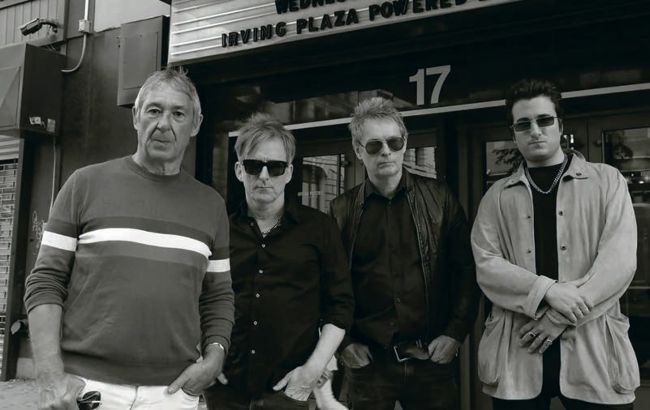
Onward and upward: Buzzcocks in New York, 2024
JANETTE BECKMAN
7/10
HOW do you get the Buzzcocks sound? Steve Diggle says that’s like a chef revealing his secrets, but admits that one crucial ingredient is his old H&H amp. This was acquired almost 50 years ago with the advance the band got for signing to United Artists – you can see it on the cover of Singles Going Steady. “It gives that transistorised valve sound and you can hear it very distinctively on that first album,” he explains. “In Manchester, people wondered why we used these little amps, but it meant you could get distortion at a very low volume, and that became our identity. Double-track a riff through the H&H amp and you get that unique Buzzcocks sound.”
The double-tracked H&H riff pops up a few times on Attitude Adjustment, a reminder that the soul of the band continues to burn. Following 2022’s impressive Sonics In The Soul, this is the band’s second album since the death of Pete Shelley in 2018 – a loss that many assumed meant the end of the band as a recording force. But Diggle showed no intention of giving up, and while Attitude Adjustment carries enough buzzsaw Buzzcocks guitar to soothe fans, it also shows Diggle widening the pool of influences and genres that can be drawn upon by this version of the band: Diggle, bassist Chris Remington and Danny Farrant on drums.
There’s a nod to Motown on “Break That Ball And Chain”, an acoustic protest song in the shape of “All Gone To War”, a smidgen of dub on “Heavy Streets” and, in “Just A Dream I Followed”, a tribute to Bob Dylan that concludes with yet another of those joyous guitar solos that have peppered and delighted Buzzcocks’ tracks from “Spiral Scratch” to today. Attitude Adjustment was recorded in January 2025 during a gap in the band’s touring schedule, with the band working at Studio 7, the same location they used for Sonics In The Soul. The success of that record was a confidence booster for Diggle, confirming that he’d made the right decision to carry on without Shelley. Now he wanted to maintain momentum. He began to write, one of the first being “The Greatest Of Them All”, a slower song that opened another creative door by encouraging Diggle to explore observational songs about contemporary life.