Quines
Gerda Stevenson’s Tribute to Women of Scotland
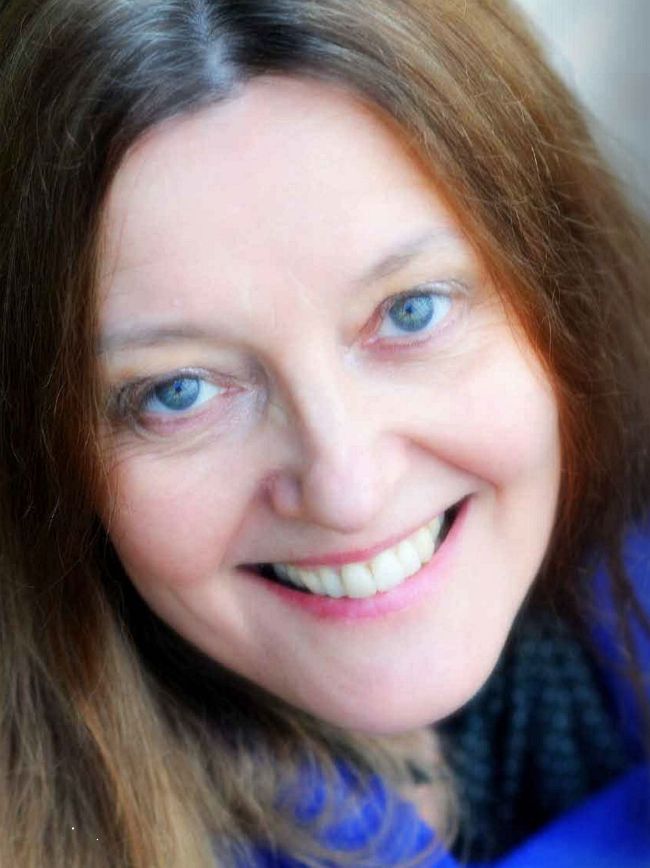
Gerda Stevenson
(Photo by Anna Wiraszka)
by Vivien Martin
The snow had cleared and the sky was that brilliant blue that makes it so hard to be indoors, making it a perfect day to be out and on my way down to the Borders. The sun was still shining when we reached our destination: an old, two-storied stone cottage, nestling below the Pentland Hills. A welcoming house: warm, bright and comfortable; full of the colourful and well-loved possessions that reflect the lives of Gerda Stevenson and her family. And that included - glossy-coated and full of life - Luna, Gerda’s Border Collie, who dropped a tennis ball at my feet and looked up in that eternally hopeful way that dogs do.
It’s not easy to pigeon-hole someone as versatile as Gerda Stevenson. She’s been rightly called ‘one of Scotland’s great Renaissance women’. She’s an award-winning writer, actor, playwright, radio-dramatist, theatre-director, singersongwriter and poet. A woman who moves easily from playing Mother MacClannough in Mel Gibson’s Braveheart, through starring on stage in Edwin Morgan’s Scots language translation of Phaedra, to the clipped tones of Paul Temple’s glamorous wife Steve, in the BBC Radio4 dramatisations. But there’s still more, for she’s equally at home writing, directing and performing in her thought-provoking, humorous yet heart-rending play Federer Versus Murray, as she is composing and performing her own beautiful songs in Night Touches Day.
I’ve come down to talk to Gerda about her new book of poetry, Quines: poems in tribute to women of Scotland, published on March 8th, which, very appropriately, is International Women’s Day. Doubly apt, as 2018 is also the year that marks the centenary of the first women getting the vote.
Quines is a celebration of sixty-seven extraordinary Scottish women, told uniquely through a sequence of fifty-seven poems. Not just the ‘usual suspects’ though, for Gerda’s poems highlight the lives and achievements of women some of us will never have heard of before. Yet they’re women whose contributions to Scotland, and beyond, were enormous. With the patience of an archaeologist, Gerda has carefully scraped away at the neglect of years to unearth some real treasures, bringing to light the stories of women who made a mark in their time, but who have been allowed to ‘disappear’ by the writers of history.
These sixty-seven lives cover a vast expanse of years. ‘Five thousand years between us, and yet not a moment, it seems…’ Gerda writes in the opening poem, as she recalls the impact of coming face-to-face with the reconstructed head of a young Iron Age woman who lived long, long ago in Shetland and yet who looks not one jot different from any of us today. “She was thousands of years old and, although I was looking at her reconstructed head, she appeared to me to be more alive than anyone I’d met for a long time. Who was she? What language did she speak? Why did she die so young? She looked uncannily contemporary. Does history really separate us, or does it reveal how much we have in common? A poem was brewing…” And brew it did, to become not just one poem, but fifty-seven! Poems that span not only the centuries, but also vast differences in wealth, social-class and profession. Yet the stories in this book demonstrate that time and status really don’t separate us as much as we might imagine.