SWIM HISTORY
POISON IN THE POOL
How a deadly chemical became the world’s preferred means of keeping swimming pools clean and tidy.
ELAINE K HOWLEY
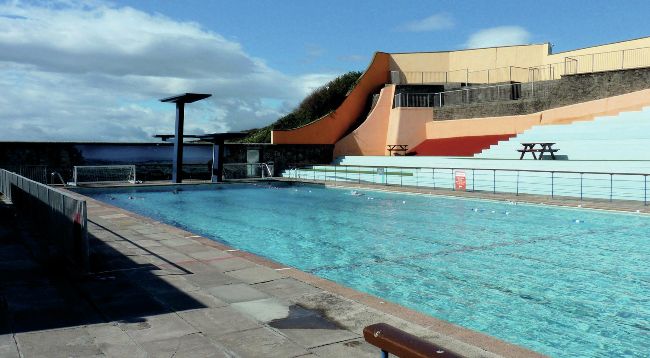
Portishead Lido
It’s probably safe to say unequivocally: Nobody wants to swim in a dirty pool. It’s probably also safe to assert that nobody wants to swim in toxic chemicals. But in an odd twist of chemistry and history, modern pools typically get and stay clean through the application of a chemical that’s capable of felling even the strongest person. That special cleaning agent is called chlorine. It’s a halogen gas— element number 17 on the periodic table—and swimmers the world over are intimately familiar with its hallmark, antiseptic scent.
Over the past century, chlorine has become so closely associated with swimming pools that it may come as a surprise for some to learn that chlorine was initially a byproduct of industry used widely in textile manufacture and is still sometimes used as a tool of warfare.
CHLORINE’S FIRST RELEASE
Chlorine does not exist naturally on Earth—it likes to combine with other compounds, in particular sodium, which creates salt, the stable, abundant substance that makes chips more tasty and swimmers more buoyant in the sea.
But chlorine can be liberated by running an electrical current through seawater. The Royal Society of Chemistry reports that chlorine was first isolated in 1774 by the Swiss-German chemist Carl Wilhelm Scheele, but he didn’t recognize he’d stumbled upon a new element during his experiment.
Instead, it was English chemist Sir Humphry Davy who in 1810 recognised that Scheele had made elemental chlorine when a greenish-yellow gas emerged after he repeated the experiment—reacting hydrochloric acid with manganese dioxide. (In ancient Greek the word χλωρός (khlōrós) means “pale green.”)