JOURNEY OF THE SAMURAI
Trevor Hogg gets lessons from Sucker Punch on how to wield a katana and defeat the invading Mongols in Ghost Of Tsushima…
Trevor Hogg
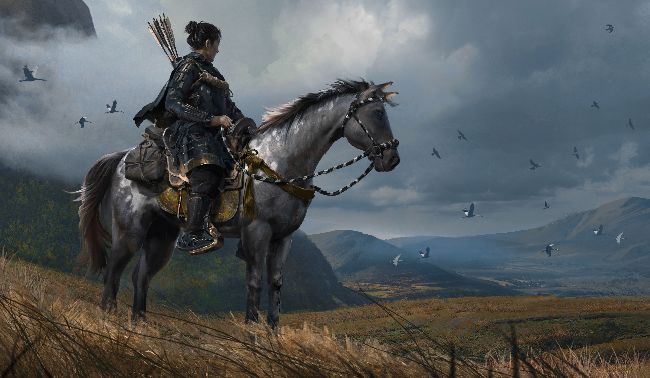
Concept art that incorporates animals such as birds is a subtle way to guide players from one location to the next
Branching out from the inFamous video game franchise where present-day humans with supernatural abilities decide to become either forces of good B or evil, Sucker Punch travels back to late 13th century Japan in Ghost Of Tsushima where a samurai goes from following his code of honour to adopting guerrilla warfare tactics in order to quell a Mongol invasion. “We chose the Mongol invasion of Tsushima in 1274 because the stakes of the battle were right there,” explains Nate Fox, creative director at Sucker Punch. “You would play as a samurai defending his home from foreign invaders, warriors who brought gunpowder weapons for the first time to Japan. What moral lines would that samurai have to cross in order to safeguard the people that he loves most? How would he have to evolve, bending his samurai code to succeed?” A cornerstone for the project was to create an open-world experience. “We set out to make a game about a samurai that wandered the countryside and helped his countrymen in a time of crisis. Giving players the freedom to choose where they wanted to go was key to capturing that feeling, which meant the game had to be open world.”
“Open world means freedom, a world that will allow players to explore by themselves,” notes Joanna Wang, environment art lead, Sucker Punch. “How often have you seen a tall mountain in a video game and said, ‘I want to go there.’ Yes! The goal for Ghost Of Tsushima is always, ‘If you can see it, you can reach it’. We want players to be curious about this world, navigating up steep mountains, riding through dense forests, crossing shallow rivers and climbing treacherous cliffs. Tsushima is designed based on those experiences, to let players become a wandering samurai free to explore a rich and diverse world set in feudal Japan. The biggest challenge we faced building the island of Tsushima was scope. Imagine if you needed to hand place every blade of grass in a giant field. What if you then needed to change the size, shape or even the grass type later? That would be crazy! So, we made procedural tools that would allow us to build a massive world unbelievably fast and would still be really flexible if we changed our minds later on. These tools allowed us to be more creative and expressive in our artistic choices.”