U bekijkt momenteel de Netherlands versie van de site.
Wilt u overschakelen naar uw lokale site?
General Interest


Free Sample Issue
Probeer een Gratis monster van Astronomy Now
Probeer een Gratis monster

Astronomy Now Magazine

12 edities per jaar   |  English
0 Beoordelingen   •  English   •   General Interest (Astronomy)
From €3,08 per uitgave
The wonders of the Universe explained for everyone to understand.
read more read less
Astronomy Now Preview Pages Astronomy Now Preview Pages Astronomy Now Preview Pages Astronomy Now Preview Pages Astronomy Now Preview Pages Astronomy Now Preview Pages Astronomy Now Preview Pages Astronomy Now Preview Pages

Astronomy Now

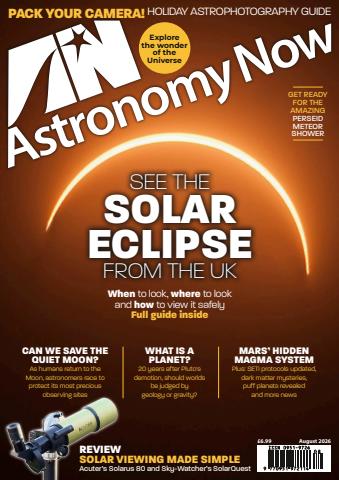
August 2026 The August 2026 issue of Astronomy Now is led by the biggest UK solar-eclipse event for many years. On 12 August, a deep partial eclipse of the Sun crosses the country, with much of the UK seeing around 90 percent of the Sun covered by the Moon. Our full guide explains when to look, where the eclipse will be best seen, what to expect from your location and, most importantly, how to view it safely. And that is only the beginning of a remarkable month for skywatchers. Two weeks later comes a dramatic partial eclipse of the Moon, while the annual Perseid meteor shower enjoys especially favourable conditions, with no moonlight to spoil the show. Also in this issue, we mark 20 years since Pluto’s demotion and ask what really makes a planet. Should a world’s status be decided by its orbit and gravitational dominance, or by its geology and character as a world? It is a debate that reaches far beyond Pluto itself. We also look to the Moon’s future and ask whether lunar astronomy can survive the human return. The lunar far side could be astronomy’s greatest refuge from Earth’s radio noise, but as landers, bases, satellites and rocket debris begin to crowd the Moon, astronomers are racing to protect its most precious observing sites. In the news pages, discover evidence that Mars once hid a vast underground magma system, why the Bullet Cluster still matters in the dark-matter debate, how SETI researchers are updating the rulebook for first contact, and why two newly confirmed planets are lighter than candy floss. Plus, Colin Stuart explains how stars form, Martin Howe shows how to take astrophotos on holiday with a digital camera, Jamie Gregory-Macdougall tests Acuter’s Solarus 80 and Sky-Watcher’s SolarQuest, Nik Szymanek reviews new AI-assisted noise-reduction software, and our observing section guides you through the August night sky, from Vulpecula’s Dumbbell Nebula to the month’s eclipses, planets, comets and deep-sky highlights.


FORMAAT SELECTEREN:
Directe toegang

Beschikbare digitale aanbiedingen:

Enkele digitale editie August 2026
 
7,99 / issue
Jaarlijks Digitaal abonnement SPECIALE AANBIEDING: Nu €36,99 Was €53,99 jaarlijks gefactureerd
Sla
61%
€3,08 / editie
Maandelijks Digitaal abonnement €5,99 maandelijks gefactureerd
Sla
25%
€5,99 / editie
Beschikbaar met
Pocketmags Plus
Onbeperkt lezen abonnement
 
Krijg onbeperkte toegang tot Astronomy Now en meer dan 600 andere geweldige titels. Vernieuwd bij €11,99 / maand na 30 dagen. Annuleer op elk gewenst moment. Meer informatie
Besparingen zijn berekend op de vergelijkbare aankoop van losse nummers over een abonnementsperiode op jaarbasis en kunnen afwijken van geadverteerde bedragen. Berekeningen dienen alleen ter illustratie. Digitale abonnementen omvatten het laatste nummer en alle reguliere nummers die tijdens uw abonnement verschijnen, tenzij anders vermeld. De door u gekozen termijn wordt automatisch verlengd, tenzij u tot 24 uur voor het einde van het lopende abonnement opzegt in de Mijn Account-zone.

Astronomy Now issue August 2026

Astronomy Now  |  August 2026  


The August 2026 issue of Astronomy Now is led by the biggest UK solar-eclipse event for many years. On 12 August, a deep partial eclipse of the Sun crosses the country, with much of the UK seeing around 90 percent of the Sun covered by the Moon. Our full guide explains when to look, where the eclipse will be best seen, what to expect from your location and, most importantly, how to view it safely.

And that is only the beginning of a remarkable month for skywatchers. Two weeks later comes a dramatic partial eclipse of the Moon, while the annual Perseid meteor shower enjoys especially favourable conditions, with no moonlight to spoil the show.

Also in this issue, we mark 20 years since Pluto’s demotion and ask what really makes a planet. Should a world’s status be decided by its orbit and gravitational dominance, or by its geology and character as a world? It is a debate that reaches far beyond Pluto itself.

We also look to the Moon’s future and ask whether lunar astronomy can survive the human return. The lunar far side could be astronomy’s greatest refuge from Earth’s radio noise, but as landers, bases, satellites and rocket debris begin to crowd the Moon, astronomers are racing to protect its most precious observing sites.

In the news pages, discover evidence that Mars once hid a vast underground magma system, why the Bullet Cluster still matters in the dark-matter debate, how SETI researchers are updating the rulebook for first contact, and why two newly confirmed planets are lighter than candy floss.

Plus, Colin Stuart explains how stars form, Martin Howe shows how to take astrophotos on holiday with a digital camera, Jamie Gregory-Macdougall tests Acuter’s Solarus 80 and Sky-Watcher’s SolarQuest, Nik Szymanek reviews new AI-assisted noise-reduction software, and our observing section guides you through the August night sky, from Vulpecula’s Dumbbell Nebula to the month’s eclipses, planets, comets and deep-sky highlights.
meer lezen minder lezen
The wonders of the Universe explained for everyone to understand.

Als abonnee ontvang je de volgende voordelen:


•  Een korting op de verkoopprijs van je tijdschrift
•  Je tijdschrift elke maand op je apparaat
•  Je zult nooit een editie missen
•  Je bent beschermd tegen prijsstijgingen die later in het jaar kunnen plaatsvinden

Je ontvangt 12 edities gedurende een periode van 1 jaar Astronomy Now abonnement op een tijdschrift.

Opmerking: Digitale edities bevatten niet de omslagitems of supplementen die je zou vinden bij gedrukte exemplaren.

Uw aankoop hier op Pocketmags.com kan op elk van de volgende platforms worden gelezen.


Je kunt hier lezen op de website of de app downloaden voor jouw platform, vergeet niet in te loggen met je Pocketmags gebruikersnaam en wachtwoord.

Apple Pocketmags Online Pocketmags Google Pocketmags
De Pocketmags-app werkt op alle iPad- en iPhone-apparaten met iOS 15.6 of hoger, Android 8.0 o hoger, en Amazon Fire-tablets vanaf 2018, hoewel eigenaren van oudere Fire-modellen de Amazon Appstore rechtstreeks op hun apparaat kunnen controleren om de compatibiliteit te bevestigen. Voor iOS-gebruikers raden we aan een apparaat te gebruiken dat de nieuwste versie van iOS kan draaien voor optimale prestaties en stabiliteit, aangezien oudere hardware met minder processorkracht en RAM-geheugen een tragere paginaweergave of incidentele stabiliteitsproblemen kan ervaren als gevolg van geheugenbeperkingen van het apparaat. Als alternatief werkt onze web-reader met elke moderne, HTML5-compatibele browser, hoewel we Chrome of Firefox aanbevelen voor de beste ervaring op pc en Mac.
N/A
Gebaseerd op 0 Beoordelingen van klanten
5
0
4
0
3
0
2
0
1
0
Bekijk beoordelingen

Artikelen in deze editie


Hieronder vindt u een selectie van artikelen in Astronomy Now August 2026.

Free Sample Issue
Probeer een Gratis monster van Astronomy Now
Chat
X
Pocketmags ondersteuning