PREHISTORIC PERILS
EXPLORING THE LOST WORLD
Mike Hankin revisits the prehistoric perils of Sir Arthur Conan Doyle’s The Lost World, which has been adapted for the movies many times over the years…
Sir Arthur Conan Doyle’s 1912 novel The Lost World was not the first story to feature hidden regions on Earth with surviving prehistoric life. That honour undoubtedly goes to French author Simon Tyssot de Patot’s 1714 tale Voyages et Adventures de Jacques Massé. However, even if there does exist more than an echo of the classic Jules Verne novel Journey to the Centre of the Earth (1864), which must have had an influence on Doyle, the story and characters the author created would be the main template for many similar stories to follow.
The eccentric and irascible Professor George Edward Challenger is certainly not everyone’s idea of the dashing hero (although he did have reporter Edward Malone and hunter Lord John Roxton with him to more closely fit the bill), but he would still go on to appear in four more stories with his Lost World companions. Sadly, The Poison Belt (1913), The Land of Mist (1925), When the World Screamed (1928) and finally The Disintegration Machine (1929) fall far short of the entertainment level of Challenger’s original adventure.
These further adventures of Professor Challenger never really capture the spirit of The Lost World and in the case of The Land of Mist, despite its intriguing title, it is little more than a promotional piece for Doyle’s interest in Spiritualism and to be totally honest a little tedious.
Although not giving the Professor stories that would have made him more popular, Conan Doyle did actually state that Challenger was his favourite character, but then he did have a rather love/hate relationship with most famous literary creation, consulting detective Sherlock Holmes.
In a similar vein to Holmes being inspired by the analytical skills of lecturer Dr. Joseph Bell of the University of Edinburgh, so Doyle found his Challenger in English explorer Colonel Percy Harrison Fawcett, whom he had met and befriended at a lecture at London’s Royal Geographical Society.
Another inspiration was Professor William Rutherford, a lecturer in Physiology at the University of Edinburgh while Doyle was a student there - in the latter’s case more for his appearance and manner. Whether or not these two esteemed people minded being compared with the Professor’s bull-headed behaviour and appearance, which was described by Conan Doyle as resembling a gorilla, has never been established.
There was also another candidate, George Budd, one-time medical partner of Doyle who apparently shared many of Challenger’s characteristics. Doyle extracted the characters of Edward Malone and Lord John Roxton from journalist E. D. Morel and diplomat Roger Casement, acquaintances during the author’s involvement with the Congo Reform Association in the early part of the last century.
Doyle’s friendship with explorer Colonel Fawcett also gave him inspiration for his story in the form of his tales of exploration and of the high plateau of Huanchaca in the province of Caupolican in Bolivia and his reports of seeing “monstrous tracks of unknown origin.”
Papers in the Royal Geographical Society contained observations of the steep, inaccessible cliffs of Mount Roraima in Venezuela that had been first reported by English explorer Sir Walter Raleigh in 1595 and then in a later more detailed report from Sir Robert Hermann Schomburgk. Doyle also heard lectures by British botanist Everard im Thurn, who made the first ascent of Mount Roraima in 1884, which appear to cement it as the inspiration for the lost plateau. It is easy to visualise the adventure that was forming in Doyle’s mind.
PREHISTORIC STRAND
Following on in similar lines to Doyle’s Sherlock Holmes stories, the story of The Lost World made its first appearance in the British publication The Strand Magazine between April and November 1912, with the story published in book form on October 15th of that year.
Conan Doyle had a bit of fun with the readers by posing for a group photo in the First Edition, supposedly depicting the members of the expedition to The Lost World. Utilizing a little bit of camera trickery, Doyle’s brother-in-law posed as both Lord John Roxton and Professor Summerlee, with photographer William H. Ransford standing in as Edward Malone and with a heavily made-up Doyle as Challenger.
A monster battle from 1918’s The Ghost of Slumber Mountain;
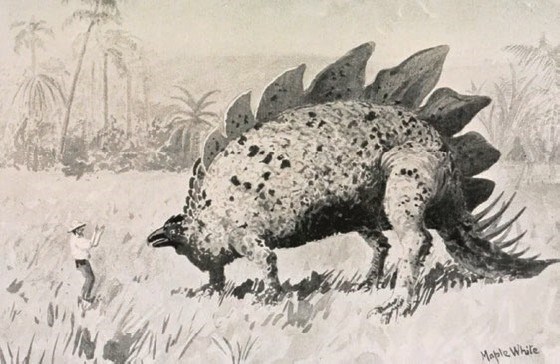
an original book illustration;
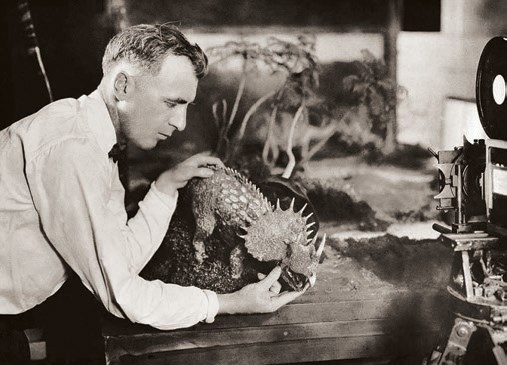
Master animator Willis O’Brien at work
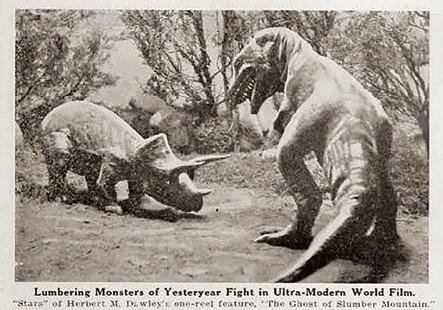
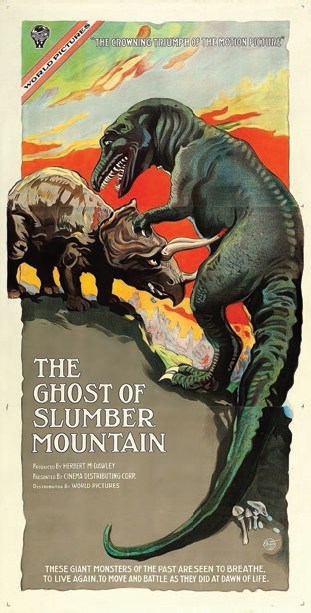
There can be little doubt that had The Lost World been published maybe twenty years later, when film technology had advanced to a sufficient level, it would most probably have been a subject picked up immediately by some enterprising film producer. As it was, the first producer to see the potential of the property was William Selig, the founder of the first film studio on America’s West Coast. Documents held in the Margaret Herrick Library at the Academy of Motion Picture Arts and Sciences, which include a synopsis, a scenario of the first part of the film and a number of illustrations, reveal striking similarities to the 1925 version, with the introduction of original explorer Maple White’s daughter and even to the casting of Lewis Stone as Lord Roxton. The project failed to go any further with the closure of the Selig Polyscope Studio in 1918, leaving J. G. Wainwright of Cineproductions Ltd. in London acquired a five-year option from Doyle to the film rights to the story in 1919, for the then considerable sum of £500. On the other side of the Atlantic in a small studio in New York, a young filmmaker was creating life-like representations of prehistoric creatures by the method of animating articulated models made of steel and rubber. Willis O’Brien had been making short animated comedy films featuring prehistoric creatures since 1914, first independently in San Francisco, then for the Edison Company in New York. Now he had teamed up with another filmmaker, Herbert M. Dawley, who had been working along similar lines, to make a longer film that would present animated creatures within a live-action story. The Ghost of Slumber Mountain (1919) was an unusual novelty subject and proved a great success, garnering $100,000 at the box-office, from a budget of around $3,000. However, the alliance between O’Brien and Dawley would become problematical and they would soon go their own ways, although their paths would soon cross again.
Into the story came entrepreneur Watterson R. Rothacker, who had seen O’Brien’s earlier films and noted the success of The Ghost of Slumber Mountain. He offered O’Brien the chance to make films of a similar nature for his Chicago- based concern, The Rothacker Film Manufacturing Company.
It is possible that O’Brien talked to Rothacker about The Lost World as a possible project, because before long, with financial backing from the Catherine Curtis Corporation, Rothacker was trying to secure the rights from Wainwright and extend the option with Doyle. Rothacker announced in the August 9th 1919 edition of The Moving Picture World that O’Brien had already completed a few novelty shorts for the company, but as no details have ever emerged about these films, was this in fact a front for experiments to do with The Lost World? Certainly, the deal with Wainwright and Doyle wasn’t finalised until after a much-publicised event that involved O’Brien’s work.