The Watcher
ALLAN MARTIN
An iScot Short Story
I know exactly when the story began. It’s not something you forget. That was when my cousin Donnie and his wife Shona came for lunch at the Manse. It was a Thursday, in early December, cloudy and cold, rain in the air, maybe hoping to manage a little sleet. He gave me the usual early Christmas present, a bottle of good whisky. This year the Caol Ila Distiller’s Edition: a very nice dram indeed. But there was something else too. Not quite as big as a football, wrapped in a brown paper bag. “I picked this up this morning,” he said, “In a little place down in the Grassmarket. I know you like this kind of stuff, Ken, and he said it was genuine.”
I unwrapped the paper. A simple round pottery jar with a flat base, handrather than wheel-made, brownish clay with a rough texture, and a narrow mouth, sealed with some material which was now as hard as concrete. I knew at once that it really was genuine. But genuine what? “What did the man say about it?” I asked. “Well, only that he thought it was from the Middle East, Egypt maybe, very old, time of the pharaohs maybe. He didn’t say what it was for, if that’s what you meant. You look rather suspicious. Have I done something wrong? I thought you’d like it.” He looked suitably pained. “I’m sorry, Donnie. I really do appreciate it,” I reassured him, “And it’s exactly because it interests me that I’m asking about it.”
Before I’d decided to enter the ministry, I’d worked in Museums for twenty years. And even if the ancient Middle East wasn’t my specialism, you get to recognise the real McCoy when you see it, and especially, when you feel it. With pottery, it’s usually the texture that gives away the fakes. Unless you go to a lot of trouble to replicate the techniques used three or four thousand years ago, you won’t get it right. And that’s before we’ve started analysing the clay, or doing any scans. And this one was the real McCoy.
“What do you think it is, Ken?” asked Shona.
“The fact it’s sealed makes me think it’s a funerary object, sort of thing that would be put in a grave. But what’s in it, I’ve no idea. Might be a body part.” Their jaws dropped. “Or simply a talisman of some sort,” I hastened to add, “A little statue or a lucky rock. Who knows?” My wife Val had come in from the kitchen, and had a look too. “Look down here, on this side” she said, “There’s an inscription. It’s quite faint, very eroded I suppose. Looks like cuneiform.”
Sure enough, with some more lights on, the writing was just visible. Unfortunately, although I can recognise a few hieroglyphics, I’d never studied cuneiform. However, I still had some contacts at the National Museum, I’d see if they could tell me anything.
“Thanks again, Donnie,” I reassured him, “This is really fascinating.”
“It’ll keep him occupied for the next fortnight!” joked Val. She didn’t realise how right she was.
The next morning I took the train into Edinburgh and walked to the National Museum. The previous evening I’d emailed Dr Annelise Bylander, whom I knew from my museum days, and fixed an appointment for 10 am. I brought the pot, wrapped up in an old curtain, in my rucksack.
Annelise is quite short, but possesses an air of authority that isn’t just put on, and her knowledge of the ancient world is encyclopaedic. She took the pot from me very carefully and felt it. “This is genuine,” she said, “No doubt about it. And rather old. I’d say at a rough guess about 2,800 BC.” Luckily I wasn’t holding the pot, or I’d probably have dropped it!
She took it over to the window and looked at it closely. “You’re right, of course. A funerary urn. Stopped with a wooden plug and sealed with lashings of resin. Hmm, and here’s some writing. You’ll be wanting to know what it says. Come back in an hour. I can’t stand people hanging around while I’m working.”
There’s plenty to see there, and an excellent cafe, so that wasn’t a problem.
An hour later I was back in Annelise’s office. She came straight to the point. “This is stolen property. Looted from the Iraq Museum in Baghdad, in 2003, at the end of the Gulf War. The US Army failed to safeguard the building, and looters got in sometime between the tenth and the twelfth of April. Not just casual looters; this was organised by guys who knew exactly what was worth taking, and where they could sell it. But the people they paid to do the actual thieving weren’t as on the ball, and as well as a few very important pieces, they also grabbed whatever smaller stuff came to hand.”
“How do you know this piece came from there?”
“There’s a list, drawn up by the staff as soon as they got back into the building. Some valuable pieces were taken, but since a lot of stuff had already been removed from the public display areas for safekeeping, the loss wasn’t as bad as first thought. Nevertheless, it’s never good to lose pieces that are up to five thousand years old. A lot of the stuff has been recovered, and smaller pieces still turn up from time to time. Like this one.”
A simple round pottery jar with a flat base, handrather than wheelmade, brownish clay with a rough texture, and a narrow mouth, sealed with some material which was now as hard as concrete
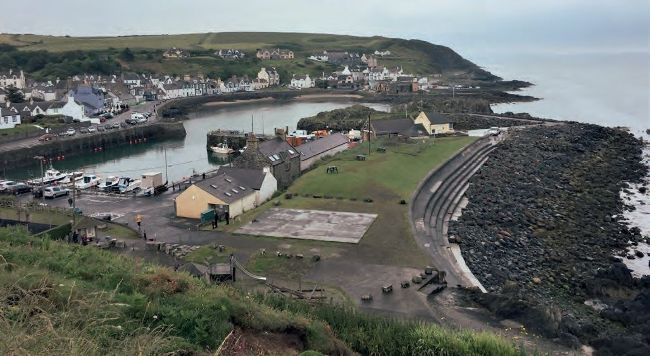
Portpatrick
“So what can you tell me about it?”
“The catalogue confirms my guess; it dates from about 2,750 BC. Interestingly, it’s one of a pair, which were displayed together in the museum. They were found in the ruins surrounding the ziggurat of Ur during the excavations in 1854, and brought back by the organisers to the British Museum. They sat in a basement until 1931, when, as Ur was again being dug, they wanted to make a show of handing a few minor pieces back to the Iraqis. You don’t by any chance also have the other one?”
“No, Donnie only bought the one. I can certainly ask him if there was another one in the place he got it.”
“That would be very helpful. If the other one came over here, and we can track it down, they can go back to Iraq as a pair. You do realise they’ll have to be returned?” “Of course. That’s not a problem. Even to have something like this for a short time is a privilege. Should I leave it with you, or hand it to the police?”
“No. We have to be careful. If the authorities get a whiff of it, it’ll be snatched from us and disappear back into the basement at the BM. And the Iraqis will never see it again. So my advice would be to take it home, very carefully, and put it away somewhere safe. If we can find the other one, I’ll arrange to hand the pair directly to the Iraqi Embassy. I’ve got a few contacts there.”
“So what was it?”
“Oh, didn’t I say? In fact it wasn’t clear what was in the jars. X-rays in Baghdad only showed what could have been fragments of bone or wood or even stone. We could do some more detailed scans here, but I’d rather it was away sooner rather than later. If I put it in for a scan, word will reach the bureaucrats at the top and we’ll never get it back home.”
“And the inscription?”
“Yes. That said ‘I am the watcher of Da-atk.’ Or words to that effect. According to the catalogue in Baghdad, there was no inscription on the other, apart from the single word ‘Da-atk’. Da-atk would have been someone of importance, possibly a senior priest, the jars being found in the temple complex, and the other a servant, maybe even a bodyguard. I’d guess the two jars were buried with Da-atk in his tomb.”
“Then let’s hope we can find the other one too.” I phoned Donnie from the museum cafe, and asked him exactly where the shop he’d got the jar was. Then I went down to the place, just off the far end of the Grassmarket, a small and unimpressive little antique shop next to a pizzeria. The owner a middle-aged gentleman of perhaps Middle Eastern origin smiled and bowed. I explained that a relative had bought the pot there – I kept it well out of sight in my rucksack – and had mentioned that there might be a matching one too. I wondered if he still had the other.
Sadly, he said, it was no longer available. It was true, he had acquired the two together. But not long after my relative had purchased the one, on the same day in fact, the other had also been sold.