LORA
Long-range wireless without pesky bills
Exchanging data over long ranges without paying carriers a fortune sounds like a dream, but Tam Hanna and LoRa technology let you do it!

OUR EXPERT
Tam Hanna
has wrangled with wireless module designs from the time when everyone thought 3G would kill us all. Let his experience in wireless networking save you both pain and effort.
Even though legacy network operators improved their IoT
E
networking game significantly, there are still situations where non-cellular systems work better. After all the dust around the Sigfox organisation’s bankruptcy has lifted, a large and smiling winner remains: the LoRa/LoRaWAN network protocol developed by Semtech. Not only has it managed to take its place in the wireless industry without political turmoil, but the technology works both in a peer-to-peer and in a network fashion. Furthermore, the availability of a wide array of development boards means that you can get started without having to get involved with any surface mount soldering.
Espressif + Module = Win!
Hardware developers working on wireless systems show a Pavlovian reaction towards Espressif’s ecosystem. However, Espressif does not currently provide a LoRa-capable microcontroller. Instead, third-party vendors offer development boards that combine an ESP32, additional peripherals and a LoRa chip. The board used in the following steps is the WiFi LoRa 32(V3) developed by Chinese brand Heltec – it,
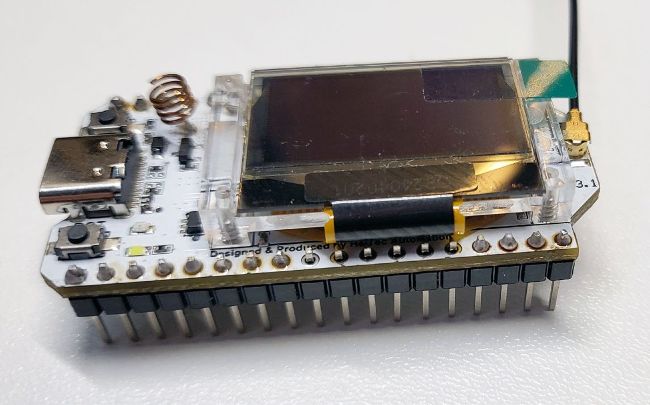
This connector should not be heated up.
fortunately, can be purchased (around US$20) from various retailers. More information about it is at https://heltec.org/project/wifi-lora-32-v3/. Furthermore, a total of three variants exist. The following steps take place on the third version of the board, which can be easily identified as it also has a USB C port for communication. Previous models made do with micro USB and had a slower ESP32 core. Soldering in the pins is not particularly difficult. The area around the LCD connector is best left untouched, as the risk of heat damage to the FPC connector is real. Finally, the video found at https://bit.ly/lxf326solderprovides hints for those not particularly experienced with soldering.
LOR A LOR A QUESTIONS
Connecting remote IoT sensors to a base station does not require a high speed – quite the contrary; low speed rates are perfectly acceptable if they lead to lower power consumption and higher range. This is the raison d’être of LPWAN technology – the term stands for low power wide area network. LPWANs can be created by carriers, but non-cellular LPWANs permit you to become their own network carrier. LoRa, an abbreviation of Long Range, turned out to be the victor of the wireless protocol wars. Managed by US company Semtech, LoRa is a wireless technology for sensor networking. A speed of 0.3kbit/s to 50kbit/s makes the average modem appear fast – on the other hand, the minimal power consumption means that coin-cellpowered sensors have a realistic chance of serious battery life. Also, the system works purely in the licence-free band, meaning no costs are incurred for pointto-point links.
While the details of the implementation of the air interface are beyond the scope of this article, the low price and ease of integration mean that every maker should know the basics of LoRa. Furthermore, affordable development boards lead to a flat learning curve.