PREDICTING THE UNPREDICTABLE
Ian Evenden investigates how supercomputers and machine learning are revolutionizing the science of predicting extreme weather events.
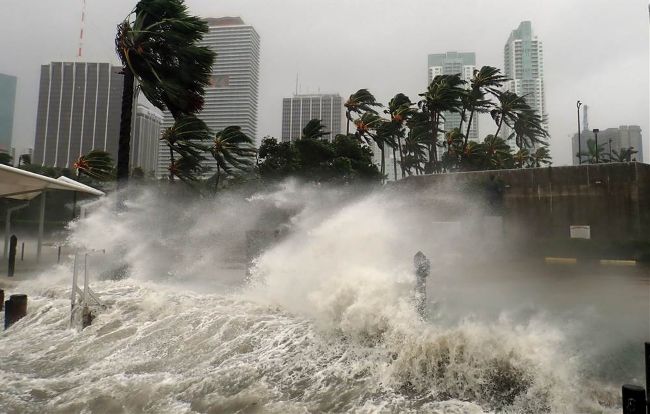
Hurricane Irma strikes Miami, Florida, in 2017. Could computer forecasting reduce the impact of storms?
© WARREN FAIDLEY/GETTY IMAGES
THE MAMBILA PEOPLE, who live across Cameroon and Nigeria in West Africa, like to watch the movements of crabs and spiders. As part of a practice called Nggam, a stick and a stone representing a binary choice are offered to the multilegged creatures, along with some cards placed between them. This is all part of a plan to tell the future.
The wisdom-seekers leave the cards intact for up to 15 minutes, during which time the crab or spider may have come out of its hole and disturbed the cards, producing a pattern that can be interpreted. If particular cards have been moved toward the stick or the stone, then that choice is bound to become reality.
Elsewhere, some people still believe to this day that the position of the stars and planets at the time of their birth has an effect on their future. While in ancient Rome, a haruspex consulted the entrails of sacrificed animals to gain insight into what was about to happen.
In Victorian England, the Hermetic Order of the Golden Dawn played a fourplayer variant of chess in an attempt to predict future events, while the Ancient Greeks practiced dracomancy (predicting the future by way of dragons), though it’s not clear where they found them.
Of course, another way to predict the future is to use computers.
WEATHER FORECASTING
Knowing what the weather is going to do is often a case of simply looking out of the window, but being able to predict weather conditions several days in advance is another matter. Being able to predict the future is more useful than knowing whether you’ll need a light jacket or waisthigh rubber waders this afternoon.
But predicting the weather is a difficult science because there’s a lot going on in our atmosphere. There’s a lot of data to be processed from orbiting satellites, airplanes, ships at sea, land-based weather stations, and more. But weather forecasting had more humble origins.
It takes us back 170 years, to Vice- Admiral Robert Fitzroy, a celebrated sailor in the British Navy who had been on the second voyage of the HMS Beagle with Charles Darwin, would become governor of New Zealand, and a man who thought the weather ought to be predictable. It generally wasn’t of course, and at the time was considered to be completely chaotic. Indeed, when the idea of forecasting the weather a mere 24 hours in advance was floated in the British Parliament in 1854, the whole place rocked with laughter.
In the 1800s, weather forecasting’s cutting-edge technology was a frog. Having caught one, you kept the poor creature in a glass jar with a small ladder and some water at the bottom. The idea was that, if the weather was going to be fine, the frog would climb the ladder, and if it was going to rain it would languish at the bottom in the water. Changing this water every week or so was considered essential. Indeed, even today, meteorologists in Germany are sometimes called ‘Wetterfrosch’, or weather frogs.
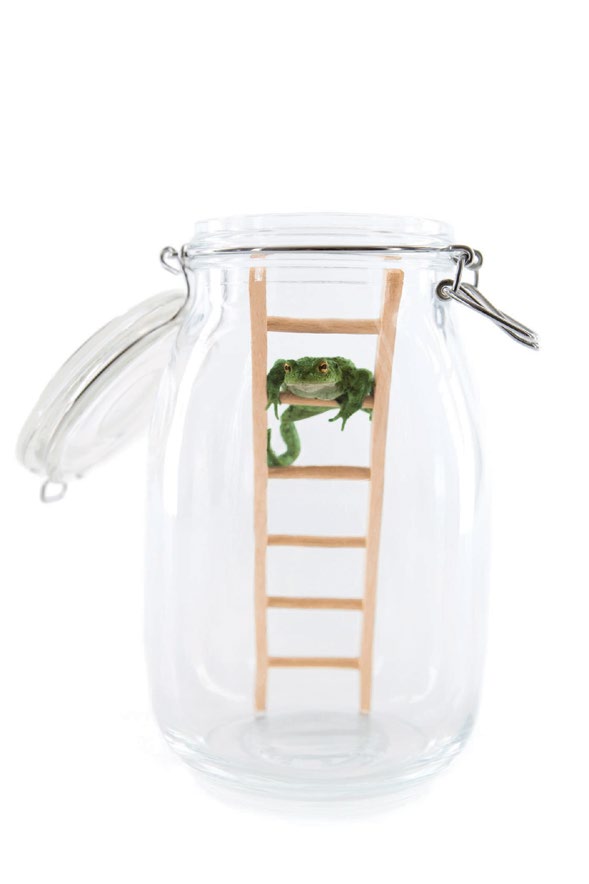
A frog in a jar was the cutting edge of 1800s weather forecasting tech.
© WIKIPEDIA, PRESS IMAGE/MET OFFICE, BLUEXIMAGES/GETTY IMAGES
IMPROVING ACCURACY
Of course, this was a rather hit and miss method of weather forecasting, but with the loss of the ship Royal Charter in bad weather in 1859, Fitzroy, who had set up a small office to worry about the weather five years earlier, was authorized to start issuing storm warnings, which he did with the aid of a new invention, the electronic telegraph. From his office in London, he gathered information from 15 coastal weather stations and, if he thought a storm was likely, would send a message to the nearest port, warning shipping. He developed weather charts known as ‘forecasts’—a previously unknown word—and by 1861, was delivering these forecasts of the weather two days ahead, published in The Times newspaper.

A portrait lithograph made by Herman John Schmidt of Vice-Admiral Robert Fitzroy, founder of the Met Office.
Unfortunately, Fitzroy’s forecasts weren’t always accurate. “Yesterday, at two o’clock, we received by telegraph Admiral Fitzroy’s signal of a southerly gale. The gallant meteorologist might have sent it by post, as the gale had commenced the day before and concluded fully 12 hours before the receipt of the warning,” read a letter in the Cork Examiner.