U bekijkt momenteel de Netherlands versie van de site.
Wilt u overschakelen naar uw lokale site?
32 MIN LEESTIJD

Speaking In Tongues

In 1973, King Crimson released what would become their classic fifth album. Larks’ Tongues In Aspic marked the beginning of a new era for the band, who welcomed not only a revised line-up but also a more dynamic sound compared to their earlier releases. Prog looks back on the making of a record that would steer the group into uncharted musical waters.

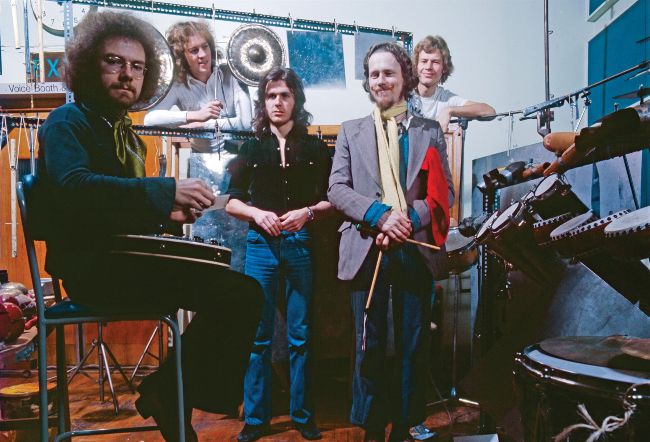
A new Crimson dawn. L-R: Robert Fripp, David Cross, John Wetton, Jamie Muir, Bill Bruford.
Image: DGM Archive/Willie Christie

“If your version of rock music is sex, drugs and rock’n’roll, or three chords and the truth, there isn’t an awful lot of that on Larks’ Tongues In Aspic.”

Bill Bruford

By April 1972 King Crimson were in serious disarray. The group who had caused such a stir in 1969 with their live shows and their debut album – the epochal progressive rock statement In The Court Of The Crimson King – had gone through three line-up changes for each of their three subsequent and sporadically brilliant studio albums: In The Wake Of Poseidon, Lizard and Islands. But what had once looked like the most promising band of the early 70s now appeared to be the most unstable. King Crimson had, it seemed, essentially ceased to exist.

Guitarist Robert Fripp’s uneasy artistic relationship with lyricist and co-founder Peter Sinfield had ended. Fripp explained to Richard Williams of Melody Maker that he “didn’t feel that by continuing to work together we could improve on what we had already done”. And the line-up that had recorded Islands and toured the US in 1971 was falling apart. Another US tour had been booked and they flew out in January to fulfil their contractual obligations, but on their return in April the break-up was made official.

No one but the most gifted seer could have predicted then that within a year a new version of the group would release an album, Larks’ Tongues In Aspic, which would not only be the equal of their debut, but one of the most audacious, inventive and imaginative albums in the whole of 70s progressive rock.

Even before the break-up, disgruntled Melody Maker reader Fred Foster had written in to the paper complaining that the most recent King Crimson line-up, “had no more right to the name KC than Emerson, Lake & Palmer and McDonald and Giles”. He added, “To simply give the new group a new name would clear the confusion by showing that Crimson is dead.”

Mr Foster was closer to the truth than he’d realised. Unbeknown to the public, Fripp had started playing in a trio with violinist and keyboardist David Cross, who he’d seen play with Waves – and who had been trying to get a deal with EG, the company that managed Crimson – and percussionist Jamie Muir. Fripp’s initial idea was to record a raga-style improvised album and the trio had played together at Muir’s house in Highbury, London.

“That was all fantastic,” Cross tells Prog, “but I didn’t join a pre-existing band called King Crimson. It never had a name beyond ‘Indian-style improvisation album’. Robert probably wouldn’t have had the support of his manager if he had done something like that. Then something shifted, whereby he put the two things together.”

The original line-up of King Crimson had split up in December 1969, less than three months after the release of their debut album. In 2012, Fripp told this writer, “It was heartbreaking but there was still something there to be pursued and I knew that whatever we did in the next two years – this was Peter and myself – would be wrong. But we had to do it to get to the other side.”

The “other side” that Fripp spoke of was the fifth incarnation of King Crimson. It was heralded in July 1972 by the surprise announcement that drummer Bill Bruford had quit Yes to join the group. But it was of no surprise to Bruford, who had been a fan since their earliest days.

“The reason why we were different was that we were prepared to jump off the cliff.”

John Wetton

“I played fairly easy to get,” Bruford now admits to Prog, “I kind of stuck myself in front of Robert and said, ‘I’m here.’ Yes and King Crimson had played together on the same bill [in the US in 1972], but for several months it was, ‘Not yet, Bill’, and then eventually it was, ‘Okay, Bill, let’s do this’, as if I had been a tomato ripening upon the vine ready to burst forth with goodness.

“I was thrilled to be part of it, although I’m not sure I really knew what I was getting myself into. I didn’t know Robert very well. I just jumped in and hoped for the best. I don’t mind doing that, but of course it can go wildly wrong.”

The Melody Maker gossip column ‘The Raver’ from August 5, 1972 included this entry: “Bill Bruford quitting Yes was strange timing… Gigs with KC don’t exactly last, at least on present form.”

Did Bruford share those sentiments in any way? “I didn’t,” he says. “I was a romantic, and saw the positive gloss over potential pitfalls. I was aware that I had done my best in Yes; it was time for a change. I thought Robert could provide a space where I could grow and learn, and I was right.”

Fripp called on another well-known player and an old friend from Bournemouth: bass guitarist and vocalist John Wetton. Bruford had seen him on TV with Family and recognised him as one of the “bass players of the moment”. Wetton had previously enquired about joining King Crimson in 1971, but bass guitarist and vocalist Boz Burrell had just been drafted in, so he joined Family instead.

“I saw the first King Crimson at The Marquee and the London College Of Printing in 1969,” Wetton told this writer in 1997. “I thought they were outstanding in that they were so different from anything else, but you knew it was quality.”

Ontgrendel dit artikel en nog veel meer met
Je kunt genieten:
Geniet volledig van deze editie
Direct toegang tot 600+ titels
Duizenden oude edities
Geen contract of verplichting
ABONNEER NU
30 dagen proberen, dan gewoon €11,99 / maand. Op elk moment opzeggen. Alleen nieuwe abonnees.


Meer informatie
Pocketmags Plus
Pocketmags Plus

Dit artikel komt uit...


View Issues
Prog
Issue 138
IN DE WINKEL BEKIJKEN

Andere artikelen in dit nummer


REGULARS
PRESENTS…
Arjen Lucassen sampler – handpicked by Arjen himself
Ed’s Letter
Hello, and welcome to the new issue of
Bloddy Well Write
Send your letters to us at: Prog, Future Publishing, 121-141 Westbourne Terrace, London, W2 6JR, or email prog@futurenet.com. Letters may be edited for length. We regret that we cannot reply to phone calls. For more comment and prog news and views, find us on facebook.com under Prog.
TWEET TALK
Follow us on twitter.com/ progmagazineUK
YES RETURN WITH MIRROR TO THE SKY
IF IT’S OUT THERE, IT’S IN HERE
EVERYONE’S A VIP FOR PENDRAGON!
The British proggers to play six shows and unveil new mini-album, North Star.
ESBEN AND THE WITCH ON THEIR “PUREST” ALBUM YET
Hold Sacred is the trio’s sixth LP, and “perhaps their last”.
FEARLESS CROWNLANDS ARE BACK
The Canadian prog rock duo return with their mighty second album this spring.
THE FUTUREISHERE FOR HAWKWIND
With live shows incoming, Dave Brock and crew explore inner space on album 35.
BLOOD CEREMONY TO TAKE IT BACK TO THE OLDWAYS
The Torontonians return with new LP and Euro/UK tour.
AMPLIFIER MAKE THEIR HOLOGRAM
Upcoming mini-album is an “entrée” for the band’s long-awaited new LP, Gargantuan.
SWEET 16? LEPROUS SINGER GOES SOLO
Einar Solberg’s debut album features Ihsahn and members of Bent Knee, Vola and more.
BIG BIG TRAIN TO TOUR AND RELEASE INGENIOUS DEVICES
A fresh face in the group and Abbey Road strings on new LP.
FAD GADGETS
Rhodri Marsden on three of the latest must-have gizmos currently putting the prog in progress.
RICKY WARWICK
Inspiring the wider music world…
MOUNDRAG
Heavy sounds from French brothers-in-prog with no strings attached!
PINK FLOYD’S ENDLESS RIVER… OF BILE
A Prog reader asks if there will ever be oil on these Waters?
SHELL BEACH
Our far-out trip to far-flung prog
EBB
Gutsy, authentic and multifaceted rock from these Scottish proggers.
CABIRIA
Epic and ambitious post-rockers… to the power of three.
WIZRD
Soft Ffog and Krokofant musicians team up for unpredictable prog-psych joy.
JAH WOBBLE
The endlessly creative bassist ruminates on how London still inspires him to write and why compilations of his work won’t please everyone – least of all himself.
THE PROG INTERVIEW
PHILIP SELWAY
GENESIS
Auntie knows best: the prog titans get a career-spanning, if incomplete, box set drawn from the Beeb’s archives.
TAKE A BOW
LEPROUS VENUE O2 SHEPHERD’S BUSH EMPIRE, LONDON DATE
MY PROG
EDDIE MULDER (LEAP DAY)
FEATURES
Building The Architect
Emerging from the shadow of Sound Of Contact, Simon Collins and Kelly Nordstrom return as eMolecule with a sci-fi concept album about tyranny and redemption. The duo talk to Prog about being musical soulmates and the importance of always moving forwards and not looking back, with their lives, careers and music.
This Is Us. Have it!
Having been voted best unsigned band of 2022 in the Prog Readers’ Poll, as well as performing at multiple festivals before they’d even released a full-length album, Square Wild aren’t here to mess about. Except they are! Vocalist and guitarist Lucy Shevchuk explains how they’re striving to make fun the centre of their world.
Animal Magic
On their seventh studio album, Haken are ready to bust any pre-conceptions about where they might or might not fit musically. Fauna is inspired by the natural world and finds the progressive metal six-piece entering new musical territory. Multi-instrumentalist Richard Henshall and returning keyboard player Pete Jones reveal the story behind its creation and the “anything goes” attitude that helped to shape it.
Attack Of The Klones
Klone’s new album, Meanwhile, is an exciting slice of concise yet progressive rock. Guitarist and co-founder Guillaume Bernard tells Prog about the hankering for gigs that inspired it – as well as their career-long journey from metal to art-rock.
Land Ahoy!
After a five-year wait, Damanek are back with their third album, Making Shore. Founding member Guy Manning talks to Prog about the obstacles they overcame to get the record finished, writing a 30-minute epic and the drawbacks of being a multinational band.
Lords Of The Ages
Formed in London in 1969, Magna Carta went on to become one of the UK’s best-loved progressive folk bands. They could even count David Bowie among their fans. Following the release of their multidisc career retrospective, When All Is Said And Done, founder member and singer-songwriter Chris Simpson discusses their legacy, working with Davey Johnstone, and that time he got into trouble with The Beach Boys’ security team…
Better Late Than Never
After splitting in 2012, Australia’s The Butterfly Effect’s classic line-up are back with IV, their first album in 14 years. But does absence make the heart grow fonder? Prog catches up with guitarist Kurt Goedhart from the forward-thinking rockers to find out.
Indian Summer
On their latest release, Light Up, Solstice are continuing the trilogy they began on their 2020 comeback album, Sia. With an armful of new tunes and their current line-up fully ensconced, founding guitarist Andy Glass discusses creative freedom, the joy of playing live and finding the motivation to keep carrying on.
In Exile
In 2014, Ne Obliviscaris ventured into unchartered waters and launched a crowdfunding campaign that enabled them to finance a world tour, something no other band in the world has achieved. As they now gear up to release their fourth album, Exul, they explain the emotional story of its conception.
Happy Trails
Five years after the release of his solo debut, Innerland, Engineers leader Mark Peters returns with Red Sunset Dreams. His second long-player combines his passion for Americana with an unexpected discovery about his home town in north-west England. Prog caught up with the musician to find out more.
Chat
X
Pocketmags ondersteuning