Days Of Future Passed
Fifty-one years ago, Germany-based Nektar finally made headway in their native UK with fourth album Remember The Future. The conceptual piece explored prescient themes of the environment and looking after the planet against a sci-fiinspired backdrop. Long-serving bassist Derek ‘Mo’ Moore recalls the story of the recently reissued record that was way ahead of its time.
Words: James McNair
“Frank Zappa loved our music, though, and he actually wanted to sign us to his label.”
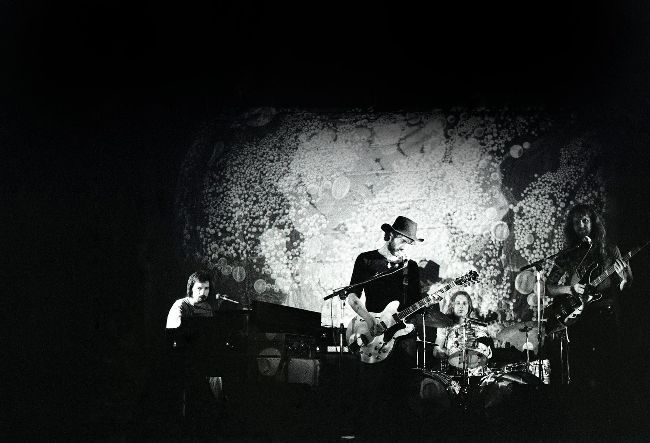
Amagical time: Nektar live in 1973 at the album photo session.
Images: Karin Janssens
By 1973, the year in which Nektar made their most celebrated album, Remember The Future, the four virtuoso Brits who comprised the group were honorary Germans. They lived in Germany, they’d recorded three LPs for the German label Bellaphon/ Bacillus, they had German girlfriends or wives, and German artist Helmut Wenske painted their album sleeves. Thanks to their mind-expanding live shows and LPs, such as their 1971 debut Journey To The Centre Of The Eye, Nektar sat at the epicentre of a vibrant, bohemian scene that drew hip young German devotees.
“The UK scene at that time was mainly based on pop music,” says Nektar’s bassist Derek ‘Mo’ Moore today. “That was all you heard on the radio. But in Germany people weren’t very interested in pop music –they wanted to listen to something new, something fresh. We loved people like Vanilla Fudge and The Moody Blues, but we tried not to listen to too much of other people’s stuff so that we wouldn’t be influenced by it.”
Together with frontman/guitarist Roye Albrighton, keyboardist Allan ‘Taff’ Freeman and drummer Ron Howden, Moore had formed Nektar in Hamburg four years earlier. Quickly scoring a month-long residency at the city’s famed Star Club in 1969, they trod boards previously played by The Beatles and countless other luminaries, playing from 6pm-2am every night, one hour on, one hour off. This punishing schedule lent itself to improvisation, something at which Nektar soon came to excel. They performed to packed, relatively small-capacity crowds, writing fabulous new music on the hoof, and later adapting it for their recording sessions.