STALACTITE MINERAL SPECIMENS
ODD, UNCOMMON AND BEAUTIFUL
By Bob Jones
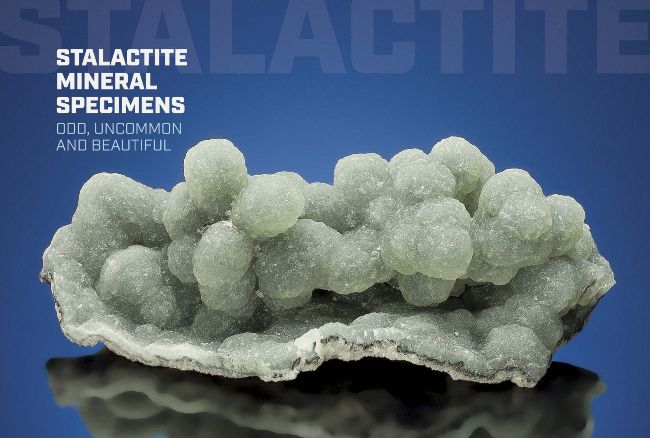
This specimen began as small thick Prehnite stalactites of light green coloring, with a sparkly luster, that later developed rounded terminations. The stalactites sit atop a layer of Datolite microcrystals, and this specimen was extracted from Prospect Park Quarry, in Passaic County, New Jersey.
HERITAGE AUCTIONS
Mineral collectors certainly enjoy a variety of tastes in what they collect. Some stick to one species like quartz or calcite. In one case, I know a fellow who enjoys collecting just malachite in all its forms. Other mineral collectors take a broader approach to their specialized collection. They may stick to just thumbnails or miniatures, or one locality like Tsumeb or Bisbee, or one country.
Others only collect the minerals from their state. My son, Evan, is well-known for his extensive Arizona collection. My collecting after World War II focused on luminescent minerals, culminating in my Master’s thesis, “Luminescent Minerals of Connecticut.” That’s the beauty of mineral collecting. It can be as broad or as narrow as a collector prefers.
One unusual and rather limited type of mineral collecting is to collect specimens of stalactite minerals. It would be really fascinating to try while challenging a collector’s tenacity to maintain the search for fine examples of such odd specimens.
After all, how often do you see a really nice, undamaged mineral stalactite?
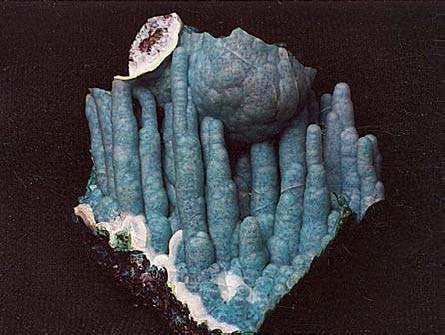
This fine, large cluster of chrysocolla stalactites is from the 1997 find in the Ray mine, Arizona (Evan Jones collection)

This superb stalactite azurite is the best one found in the 1986 find at the Morenci mine, Morenci, Arizona. (Unique Minerals specimen)
The very nature of such a physical form lends itself to easy damage when you are collecting in a mineral pocket. Any long, slender mineral protrusion hanging from the roof of a mineral pocket would, by its very structure, easily suffer damage.