BREAK DOWN
APPLE INTELLIGENCE
Better late than never, Apple’s take on AI focuses on the personal information that you store on your Apple devices
Words: Cliff Joseph
THE AI-PHONE
Apple Intelligence will be available on Macs and iPads, but its ‘personal intelligence’ features will probably have the greatest impact on the iPhone, because of the amount of personal and professional information that we store on smartphones these days.
You’ll notice the difference on the iPhone as soon as you take it out of your pocket – or at least you will if you have an iPhone 15 Pro or Max, as those are the only models that can currently run Apple Intelligence. Take a look at your Lock screen and you’ll find that Apple Intelligence can prioritise your Notifications, placing the most important messages at the top, and also providing a brief summary of each notification so that you can quickly read through without needing to unlock the phone. There’s also a new Focus mode, called Reduce Interruptions, that only shows you urgent or time-sensitive notifications, such as the time of a meeting. The Apple Mail app works in a similar way, with the ability to prioritise urgent emails that need immediate attention, and to display summaries of each email message so that you can quickly bring yourself up to date.
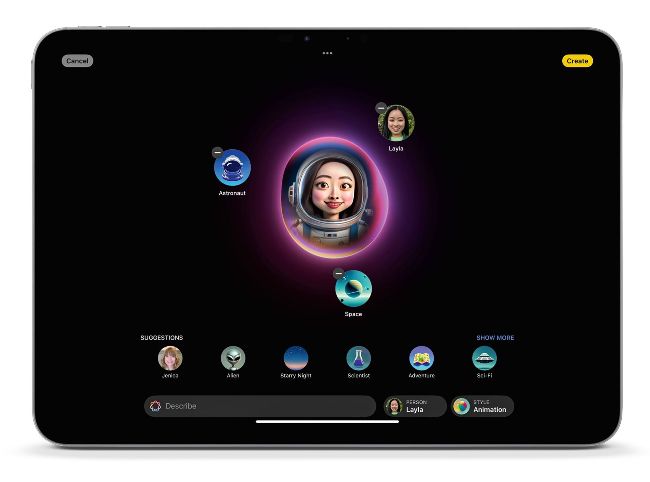
The Smart Reply feature will speed up emails when you’re on the move, prompting you to provide information and then automatically typing out the reply for you. The ability to create Genmojis for instant messages is bound to be a big hit too, while the Image Playground feature goes further and allows you to create more complex images that can use the likenesses of people in your Photos library to create more personalised messages.
Siri should be a lot more useful too. In fact, Siri also gets a bit of a makeover, with a new glowing appearance that wraps right around the edges of the screen and looks as though it’s taking control of the iPhone. As well as being able to understand more complex verbal commands (at long last!), Siri can also perform tasks that involve multiple apps – so you could tell it to open Photos then “select that photo of Pete that I took yesterday, and email it to Mary”. All these features will be available in Apple Intelligence when it launches later this year, but Apple is also working on other features that it hopes to add in the future, such as the ability for the Notes app to record and transcribe audio. It’s also planning to add this ability to the Phone app as well – although, with Apple’s emphasis on privacy, it stresses that all participants in the phone call will be warned when this feature is in use.
Well, it took its time, but Apple has finally taken the plunge and embraced artificial intelligence - and, as always, it has managed to put its own distinctive spin on the technology as well. That’s because Apple didn’t simply announce the use of generic ‘AI’, like so many other companies in the last year or so. Apple’s version of ‘AI’ stands for ‘Apple Intelligence’, and it puts a particular emphasis on features that understand your personal needs, but which also respect your privacy.
That’s very much the Apple way of doing things. For all its boasts about innovation, Apple rarely invents entirely new technologies. What it does very well, though, is to spot emerging technologies and then figure out a way to turn those technologies into an attractive product that appeals to a huge worldwide audience. Apple wasn’t the first company to come up with a portable music player, or even a smartphone, but when it launched the iPod in 2001, and the iPhone in 2007, it came up with devices that were simply far better designed than any of their rivals, and those products conquered the world because millions of people really wanted to own those cool gadgets and hold them in their hands (see also – the MacBook Air, iPad and AirPods).