U bekijkt momenteel de Netherlands versie van de site.
Wilt u overschakelen naar uw lokale site?
Laatste editie

Wildlife Australia Magazine FREE Sample Issue Speciale Editie

English
5 Beoordelingen   •  English   •   Leisure Interest (Wildlife)
Only €0
THERE IS a brutal realisation creeping across Australian communities that time is running out for many of our most unique species – mainly because their habitat is running out.

Humans are simply part of nature and totally reliant upon it for survival – a point author, ecologist, photographer and film-maker Simon Mustoe has been driving home for many years. It is a key theme of his latest book, Wildlife in the Balance.

“Where ecosystems are concerned, no species (even human) is more important than another,” he writes in his opinion piece Fact: Animals make ecosystems habitable (p16). This is actually a message of hope, not despair, from Mustoe.

Hope that we humans are coming to our senses is also a theme of acclaimed international wildlife photographer Tim Laman and his latest book, Bird Planet (p38). He believes people who admire birds are steadily drawn closer to the natural world – and protecting it.

Then there is the concerted drive by Deborah Tabart and the Australian Koala Foundation to establish a viable interconnected habitat – an area of about 1.5 million kilometres – that stretches from Cairns to Melbourne (p13). After three decades, AKF is tired of waiting for government.

Yet with help from the Western Australian government, Dirk Hartog Island’s Return to 1616 Ecological Restoration Project just celebrated its halfway mark, releasing 85 western grasswrens. The birds are back after being made extinct here in the 19th century (p18).

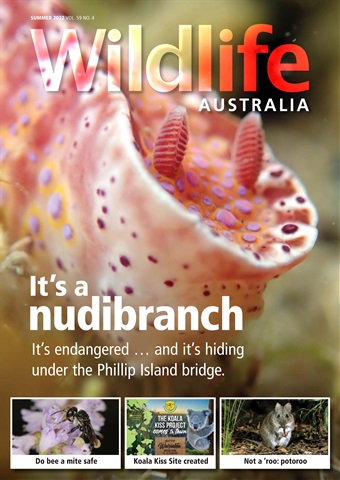
There are many other examples in this edition: People saving endangered nudibranch colonies under a bridge in Victoria (p32); returning the rare Gilbert’s potoroo to its original habitat at Two Peoples Bay (p22); and native stingless beekeepers moving their hives to safety from the scourge of the varroa mite.

Humans are interdependent with wildlife and the natural world. We just need reminding.
read more read less
Wildlife Australia Preview Pages Wildlife Australia Preview Pages Wildlife Australia Preview Pages Wildlife Australia Preview Pages Wildlife Australia Preview Pages Wildlife Australia Preview Pages Wildlife Australia Preview Pages Wildlife Australia Preview Pages

Wildlife Australia

FREE Sample Issue THERE IS a brutal realisation creeping across Australian communities that time is running out for many of our most unique species – mainly because their habitat is running out. Humans are simply part of nature and totally reliant upon it for survival – a point author, ecologist, photographer and film-maker Simon Mustoe has been driving home for many years. It is a key theme of his latest book, Wildlife in the Balance. “Where ecosystems are concerned, no species (even human) is more important than another,” he writes in his opinion piece Fact: Animals make ecosystems habitable (p16). This is actually a message of hope, not despair, from Mustoe. Hope that we humans are coming to our senses is also a theme of acclaimed international wildlife photographer Tim Laman and his latest book, Bird Planet (p38). He believes people who admire birds are steadily drawn closer to the natural world – and protecting it. Then there is the concerted drive by Deborah Tabart and the Australian Koala Foundation to establish a viable interconnected habitat – an area of about 1.5 million kilometres – that stretches from Cairns to Melbourne (p13). After three decades, AKF is tired of waiting for government. Yet with help from the Western Australian government, Dirk Hartog Island’s Return to 1616 Ecological Restoration Project just celebrated its halfway mark, releasing 85 western grasswrens. The birds are back after being made extinct here in the 19th century (p18). There are many other examples in this edition: People saving endangered nudibranch colonies under a bridge in Victoria (p32); returning the rare Gilbert’s potoroo to its original habitat at Two Peoples Bay (p22); and native stingless beekeepers moving their hives to safety from the scourge of the varroa mite. Humans are interdependent with wildlife and the natural world. We just need reminding.


FORMAAT SELECTEREN:
Directe toegang

Beschikbare digitale aanbiedingen:

Speciale digitale editie FREE Sample Issue
 
GRATIS
LEES NU
Deze speciale editie is niet inbegrepen in een Wildlife Australia abonnement. Abonnementen omvatten de nieuwste reguliere editie en nieuwe uitgaven die tijdens uw abonnement zijn uitgebracht en beginnen vanaf slechts €2,00 per uitgave in de Cyber Week 2025 Big Annual Subscriptions Sale - General Interest aanbod.

Abonnementsopties
Besparingen zijn berekend op de vergelijkbare aankoop van losse nummers over een abonnementsperiode op jaarbasis en kunnen afwijken van geadverteerde bedragen. Berekeningen dienen alleen ter illustratie. Digitale abonnementen omvatten het laatste nummer en alle reguliere nummers die tijdens uw abonnement verschijnen, tenzij anders vermeld. De door u gekozen termijn wordt automatisch verlengd, tenzij u tot 24 uur voor het einde van het lopende abonnement opzegt in de Mijn Account-zone.

Wildlife Australia issue FREE Sample Issue

Wildlife Australia  |  FREE Sample Issue  


THERE IS a brutal realisation creeping across Australian communities that time is running out for many of our most unique species – mainly because their habitat is running out.

Humans are simply part of nature and totally reliant upon it for survival – a point author, ecologist, photographer and film-maker Simon Mustoe has been driving home for many years. It is a key theme of his latest book, Wildlife in the Balance.

“Where ecosystems are concerned, no species (even human) is more important than another,” he writes in his opinion piece Fact: Animals make ecosystems habitable (p16). This is actually a message of hope, not despair, from Mustoe.

Hope that we humans are coming to our senses is also a theme of acclaimed international wildlife photographer Tim Laman and his latest book, Bird Planet (p38). He believes people who admire birds are steadily drawn closer to the natural world – and protecting it.

Then there is the concerted drive by Deborah Tabart and the Australian Koala Foundation to establish a viable interconnected habitat – an area of about 1.5 million kilometres – that stretches from Cairns to Melbourne (p13). After three decades, AKF is tired of waiting for government.

Yet with help from the Western Australian government, Dirk Hartog Island’s Return to 1616 Ecological Restoration Project just celebrated its halfway mark, releasing 85 western grasswrens. The birds are back after being made extinct here in the 19th century (p18).

There are many other examples in this edition: People saving endangered nudibranch colonies under a bridge in Victoria (p32); returning the rare Gilbert’s potoroo to its original habitat at Two Peoples Bay (p22); and native stingless beekeepers moving their hives to safety from the scourge of the varroa mite.

Humans are interdependent with wildlife and the natural world. We just need reminding.
meer lezen minder lezen
Embrace a wilder life – download Wildlife Australia, the country’s leading nature magazine. Fifty pages of insightful and thought-provoking articles and stunning photographs.
Celebration: Celebrate the essence of Australia – its vast wild landscapes and distinctive wildlife, most found nowhere else in the world
Insights: The articles are written by leading researchers and those whose care for nature comes from deep insights. You won’t find this information by Googling.
Beauty: Immerse yourself in the allure and charm of wildlife with photos by some of Australia’s leading nature photographers.
Understanding: Wildlife Australia is a hub for people who value their relationship with nature and know it is enriched by knowledge. The nature experience can be powerful, but often requires interpretation.
Inspiration: Be inspired by what people are doing to understand and protect nature.
Conservation: Wildlife Australia is a not-for-profit magazine and all profits go to protect nature.

A subscription to Wildlife Australia won't cure arthritis or tonsillitis, but is great for two modern ailments: dislocation from nature and existential malaise. Download the app and see.

Als abonnee ontvang je de volgende voordelen:


•  Een korting op de verkoopprijs van je tijdschrift
•  Je tijdschrift elke maand op je apparaat
•  Je zult nooit een editie missen
•  Je bent beschermd tegen prijsstijgingen die later in het jaar kunnen plaatsvinden

Je ontvangt 4 edities gedurende een periode van 1 jaar Wildlife Australia abonnement op een tijdschrift.

Opmerking: Digitale edities bevatten niet de omslagitems of supplementen die je zou vinden bij gedrukte exemplaren.

Uw aankoop hier op Pocketmags.com kan op elk van de volgende platforms worden gelezen.


Je kunt hier lezen op de website of de app downloaden voor jouw platform, vergeet niet in te loggen met je Pocketmags gebruikersnaam en wachtwoord.

Apple Pocketmags Online Pocketmags Google Pocketmags
De Pocketmags-app werkt op alle iPad- en iPhone-apparaten met iOS 13.0 of hoger, Android 8.0 of hoger en Fire Tablet (Gen 3) of hoger. Onze webreader werkt met elke HTML5-compatibele browser, voor pc en Mac raden we Chrome of Firefox aan.

Voor iOS raden we elk apparaat aan dat de nieuwste iOS kan gebruiken voor betere prestaties en stabiliteit. Eerdere modellen met lagere processor- en RAM-specificaties kunnen te maken krijgen met een langzamere paginaweergave en incidentele app-crashes, die buiten onze controle liggen.
5,0
/5
Gebaseerd op 5 Beoordelingen van klanten
5
5
4
0
3
0
2
0
1
0
Bekijk beoordelingen

Artikelen in deze editie


Hieronder vindt u een selectie van artikelen in Wildlife Australia FREE Sample Issue.

Chat
X
Pocketmags ondersteuning