DISCOVERIES
2022 IN SCIENCE
This year, the news headlines have been dominated by UK politics, the energy crisis and the Ukrainian war. But there have been some fascinating scientific discoveries too. Here’s the proof…
WE NOW KNOW MORE ABOUT THE DAY THE DINOSAURS DIED
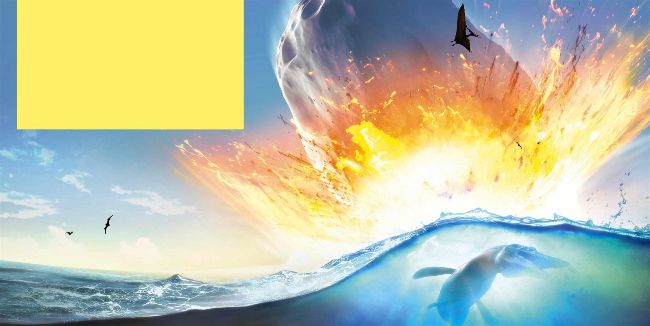
Around 66 million years ago, an asteroid smashed into what is now the Yucatán Peninsula. The impact threw dust and debris into the atmosphere, leading to widespread climate change that altered the path of Earth’s evolution
GETTY IMAGES, AERWINS, ESO/EHT COLLABORATION
In March, palaeontologists led by Robert DePalma were digging in the Hell Creek region of North Dakota in the US, when they found a fossilised dinosaur leg. That in itself was not unusual, as the region has long been known to be rich in fossil deposits. But this particular dinosaur, a Thescelosaurus, is believed to have been killed in the asteroid strike that wiped out the dinosaurs around 66 million years ago.
This makes it unique in the fossil record. In fact, until just a few years ago, no fossil had been found that lived even around the time of the impact. While debris and ash from the event shows up in core samples as a thin layer of dark sediment known as the KT (or K-Pg) boundary, no fossils had ever been found in the layers immediately below that, which represent a million years or so of evolution.
Dinosaurs could therefore, in theory, have died out thousands of years before the impact. But in 2013, DePalma was digging in an area of Hell Creek when he unearthed fish fossils buried in the same stratum as microtektites. These are beads of glass that form when molten rock is blasted into the air by an asteroid impact and then rains back down, solidifying as it falls. DePalma realised he had stumbled upon a geological snapshot of the extinction event itself and has since found many more fossils at the top-secret site, which he has named Tanis. He published his results in 2019 and caused an uproar in palaeontology circles.
But the discovery of the ‘dino drumstick’ in March is perhaps even more game-changing.
It was found among fossilised debris that is believed to have been washed there in a huge wave of water after the asteroid smashed into what is now the Yucatán Peninsula.
“The 1.5m-thick surge deposit is temporarily constrained by the presence of ejecta – chemically and radiometrically shown to be associated with the Chicxulub impact – through the two main packages of sediment in the surge deposit,” said University of Manchester palaeontologist Prof Phillip Manning, who is DePalma’s PhD supervisor. “The limb of the Thescelosaurus is still relatively ‘inf lated’, given the muscle mass of the limb is constrained by the skin envelope that shows little sign of decay, collapse or breakdown. This dinosaur may have died before the impact, but not more than a few days before. But given other soft tissue is found in the surge deposit, it seems likely that the animals were at least interred by this event.”