COMPOUND INTERVALS
As he continues his series focusing on intervals Shaun Baxter ventures ‘beyond the octave’ to exploit even more adventurous sounds.
ABILITY RATING
✪ ✪ ✪ ✪ ✪ Advanced
Info
Key:
A
Tempo: 160bpm
Will improve your
✔ Use of compound intervals
✔ General interval knowledge
✔ Creation of new sounding lines
This current series of lessons has been devoted to employing different interval skips within the Mixolydian mode or scale. So far, we have looked at each interval in sequence, all within an octave (2nds, 3rds, 4ths, 5ths, 6hs, 7ths, octaves). In this lesson, we are going to look at ways of using intervals greater than an octave to create very ear-catching lines and effects.
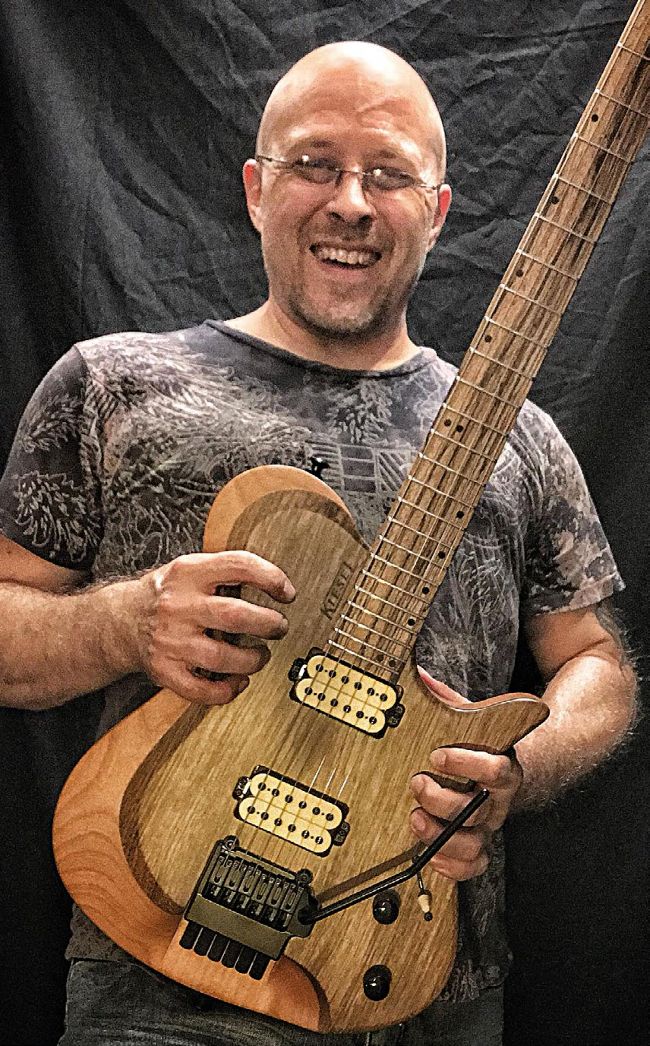
Scott Jones with his unusual Kiesel Guitars Z6X model
DANIEL KNIGHTON / GETTY IMAGES
Focusing on a particular concept, such as 10ths, will force you to think of the notes of a scale in new ways and provide you with many new and fresh-sounding ideas.
Diagram 1 shows what each of the intervals that we have studied so far are called when played an octave higher (a 2nd becomes a 9th; a 3rd becomes a 10th etc). But it’s also possible to go beyond two octaves and play 16th, 17th etc, and you should definitely experiment with those; however, we will keep within two octaves for the purposes of this particular lesson.