US
14 MIN READ TIME

TIME

What is time? A look at some of the ways we measure this unstoppable force of nature and its intimate connection with space

© Getty

DID YOU KNOW?

In ancient times, an hour was a 12th the duration of daylight, varying in length with the seasons

Time is something we all take for granted, yet it can be very difficult to grasp when we think hard about it. As long ago as 400 CE, Saint Augustine remarked that he knew exactly what time was, except when he tried to explain it. Many of us might say the same thing today, and the world’s philosophers are still arguing with about the exact nature of time and how we perceive it. Fortunately, there are some aspects of the subject that we’re now able to pin down much more precisely, thanks to super-accurate timepieces and sophisticated mathematical theories. The next few pages are a guided tour of some of the most fascinating highlights. We’ll start by looking at the way our measurement of time has evolved over the centuries, from ancient sundials and megalithic calendars like Stonehenge, through the earliest mechanical timepieces to the ubiquitous quartz-driven electronic clocks and watches of today. Then we’ll take a dip into Einstein’s mind-bending theory of relativity, which shows how space and time are intimately interconnected, and how different observers can see time passing at different rates. Finally, we’ll come bang up to date with the latest generation of high-tech atomic clocks, some of which are so accurate that they wouldn’t lose so much as a second in the entire lifetime of the universe.
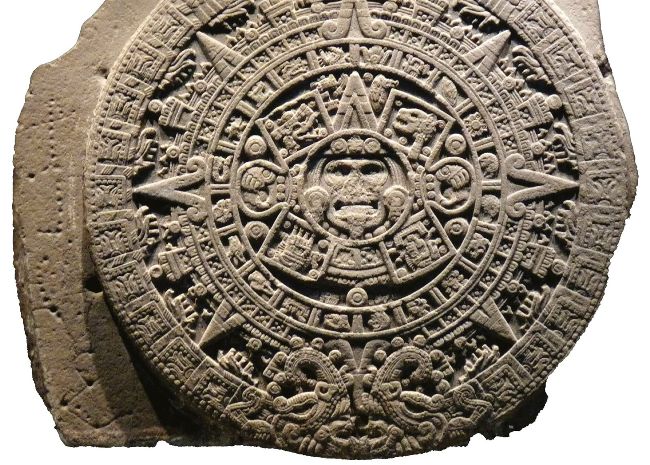
The Aztec calendar seen here is a more recent relative of the ancient Mayan calendar

GOING BACK IN TIME

For prehistoric people, keeping track of the time of year was much more important than knowing the time of day. As a result, their most sophisticated attempts at timekeeping were not so much clocks as calendars. They watched the Sun and Moon changing position in the sky in order to keep track of the seasons, and several of their most striking monuments are built around solar or lunar alignments for this purpose. The summer solstice alignment of Stonehenge is the most famous of these, although Newgrange in Ireland – which is aligned with the winter solstice – is equally impressive and even older.

As for the time of day, the oldest and simplest method of working it out also used the Sun. This is the sundial, which does have the disadvantage that it won’t work at night or on a cloudy day. A more reliable alternative, which emerged in ancient Egypt, is the water clock. This may be less familiar today than the hourglass, a somewhat later invention, but it works on the same basic principle, just using flowing water instead of sand grains.

Unlock this article and much more with
You can enjoy:
Enjoy this edition in full
Instant access to 600+ titles
Thousands of back issues
No contract or commitment
Try for 99c
SUBSCRIBE NOW
30 day trial, then just $9.99 / month. Cancel anytime. New subscribers only.


Learn more
Pocketmags Plus
Pocketmags Plus

This article is from...


View Issues
How It Works
Issue 187
VIEW IN STORE

Other Articles in this Issue


WELCOME
WELCOME
“The earliest such mechanisms didn’t have familiar clock
REGULARS
Volcanic descent
© Getty In this image, an abseiler can
Amplified aphid
© Getty This imposing view of a green
Jellyfish rides
© Getty Sitting politely on top of a
A disco ball in space
© NASA Although it might look like the
Five Earth-like worlds may lurk at the edge of the Solar System
Rocky planets captured by the Sun may reside in
Dolphins are bullying baby manatees
Bottlenose dolphins have been observed attacking manatee calves
Hubble observes a supernova 2.5 billion times brighter than the Sun
An image of the galaxy UGC 5189A, taken
Scientists develop a ‘crying’ model of human eye tissue
The scientists behind the new model hope it
Nearly 75 per cent of the US is at risk from earthquakes
Nearly 75 per cent of the US could
New technology may cut electric vehicle charging times and boost their range
© Ministry of Culture / Getty A technology
Gene variant guards against Parkinson’s disease
The circular DNA of mitochondria contains key genes
1.75-billion-year-old fossils provide evidence of photosynthesis
The Great Oxidation Event saw oxygen levels on
WISH LIST
The latest MOVIE NIGHT GADGETS
Why doesn’t NASA take parts into Earth orbit and build a spaceship to go to Mars up there, like the ISS?
Amazing answers to your curious questions
THE LIBRARY
The latest book releases for curious minds
MAKE A WATER BRIDGE WITH STRING
This simple experiment shows how you can make water defy gravity within the laws of physics
INBOX
Speak your mind
FAST FACTS
Amazing trivia that will blow your mind
TRANSPORT
ABOARD THE WORLD’S LARGEST SOLAR BOAT
This catamaran runs on sunshine, powering its journey around the globe
ANATOMY OF A WRECKED CAR
The humble hospital scanner has been supersized to look inside mangled car wrecks and learn how to make cars safer
HISTORY
THE FIRST MAP-MAKERS
How did ancient cartographers calculate and draw the contours of their countries?
WHO WERE THE FIRST AMERICANS?
The first humans in the Americas were thought to have travelled across a land bridge from Asia 13,000 years ago, but new evidence suggests otherwise
SPACE
SEASONS IN THE SOLAR SYSTEM
Do other planets have a spring, summer, autumn and winter?
SUMMER IN THE SOLAR SYSTEM
How the seasons shift for each planet as it orbits around the Sun
INSIDE THE ASTEROID BELT
Any ideas this sprawling ring of debris orbiting the Sun had of forming a planet were wiped out by the Solar System’s largest inhabitant
SCIENCE
INSIDE A GIANT FUSION MACHINE
JT-60SA will pave the way for making nuclear fusion a viable energy source of the future
WHAT ARE YOUR TONSILS FOR?
You might not pay them much attention until you get sick, but these lymph nodes at the back of the mouth can shield you from illness
STEM CELLS UNCOVERED
Long billed as the next big thing in medical treatment, a change in approach may unlock stem cells’ limitless potential
WHAT IS KERATIN?
Learn about the vital protein that helps hold your body together
ENVIRONMENT
HOW TO SURVIVE THE AUSTRALIAN OUTBACK
From bush tucker basics to sourcing trapped water and combating crocodiles
WHERE DID THE OZONE LAYER COME FROM?
The invisible layer in the atmosphere that protects us from deadly radiation formed billions of years ago
TECHNOLOGY
WHAT ARE PLANKTON?
Drifting through the world’s waters are tiny organisms that feed fish and trap carbon
GARDEN TOOL GUIDE
These manual and electric implements are vital for growing plants and maintaining a perfectly manicured lawn
HOW A BOWLING ALLEY WORKS
Explore its inner mechanisms and discover how pins and balls quickly resume position
Chat
X
Pocketmags Support