RESURRECTING DINOSAURS
Does the discovery of their cells – and possibly even DNA – mean we stand a chance of bringing these long-lost beasts back to life?
WORDS HAYLEY BIRCH
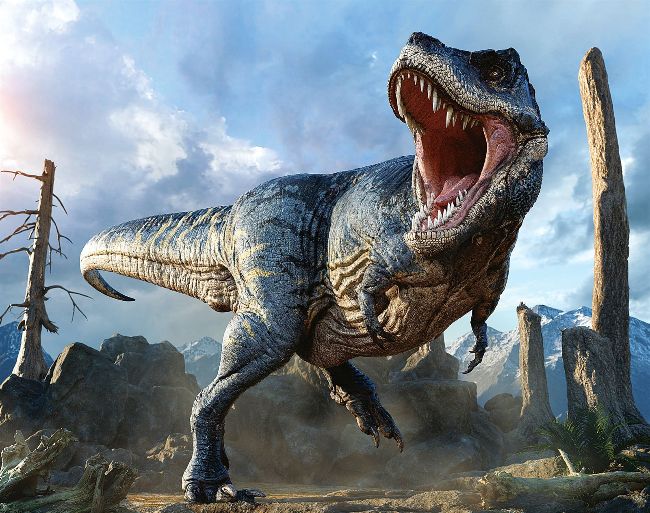
© Getty
Staring at the screen in the darkened theatre of the visitor centre, Dr Ellie Sattler shakes her head and whispers, “Palaeo-DNA, from what source? Where do you get 100-million-year-old dinosaur blood?” We all know the scene. It’s ‘the science bit’ in Jurassic
Park – the part apparently so convincing that it’s led science-fiction fans the world over to wonder why we can’t just patch together a dinosaur via the miracle of cloning. And wonder we might because, as it turns out, 100-million-year-old dinosaur blood may not be impossible to come by.
Since before Jurassic Park, Mary Schweitzer, a palaeontologist at North Carolina State University, has been finding traces of blood in the fossilised bones of dinosaurs. Textbooks tell us that blood and bone cells decay too readily to be found in the fossil record. But in 2005 in the journal
Science, Schweitzer published pictures showing what looked like blood vessels and bone cells in the leg bone of a Tyrannosaurus rex. “We had all this soft tissue that was consistent with blood and bone cells in every way,” says Schweitzer.
“I knew it completely went against what I had been taught.”
Did you know?
Stegosaurushad a brain the size of a walnut
The pictures whipped up a scientific storm. If it could be proved that the round structures Schweitzer had found were cells belonging to a dinosaur that had been dead for millions of years, then our ideas about fossilisation must be wrong. We’d also have answered Dr Sattler’s question. For science-fiction fans, it was just a short leap from dinosaur blood to DNA, and resurrecting a living, breathing Trex. Just rip out the DNA, stick it in an ostrich egg and hey presto! A dinosaur! Right? Did Not so fast. As Dr Patrick Orr, a fossil expert at University College Dublin, explains, there’s a difference between the presence of soft tissue and the molecular signatures of proteins and DNA that once resided within that tissue. While Orr’s own studies have unearthed bone marrow in 10-million-year-old rocks, his investigations don’t extend to the chemical constituents. “There’s no question, as far as I’m concerned, that decay-prone tissues, such as the blood vessels that were reported originally, can and do make it into the geological record,” says Orr. “But it was quite clear as the discussion evolved that it was the actual chemical fidelity that Mary was commenting on. That’s a completely separate field.”