Blu-ray … Blu-ray! As Gerry and Sylvia Anderson’s string-supported supersub launches in high definition for the first time, Alistair McGown looks back at a high watermark in the Supermarionation canon...
“ANYTHING CAN HAPPEN OVER THE NEXT FEW PAGES!”
“Stand by for action!”
As a rapid thundering drumbeat sounds the alarm, a depth charge explodes at sea.
“We are about to launch Stingray!”
Brave Aquanauts Troy and Phones descend the injector tubes into the cockpit of submarine Stingray, while rockets stand poised on Marineville’s launchpads.
“Marineville – Iam calling battle stations.
Anything can happen in the next half hour!”
Suddenly, a drilling rig explodes and topples over, two fighter planes streak over Marineville’s tower, as the town itself descends below ground via hydraulic gears. Stingray leaps like a salmon from the depths, pursued by one of Titan’s mechanical fish, then a sting missile hits its target dead on, destroying the terror fish in a ball of flame.
It’s one of the most breathless sets of opening titles in British television history, with Barry Gray’s stirring theme making it almost impossible to say the show’s title without breaking into song: “Stingray … STINGRAY!”
This third futuristic marionette puppet series to be produced under the banner of Supermarionation followed in the slipstream of Gerry and Sylvia Anderson’s stringed space opera Fireball XL5, which by spring 1963 was proving a huge Saturday morning hit across the Atlantic for American network NBC. The Andersons’ series tended to have an evolutionary through-line from each show to the next, and Fireball’s follow-up was essentially a reworking of its outer space ‘patrol’ format to what was sometimes termed ‘inner space’, the ocean depths.
As with XL5, there was a fabulous craft whose name was also the show’s title, which travelled to far distant reaches, solving trouble wherever it went, always in touch by radio with their commanders at base headquarters. Protracted launch sequences were also much in evidence (though thankfully soon truncated as the series progressed).
Production on Stingray began at AP Films’ new Slough factory premises in Stirling Road. Its three stages, two designed for puppet filming, one for special effects, enabled two episodes to be shot in parallel. With filming underway by June 1963, and each episode taking 11 days of puppet shooting, plus five further effects days, this double-banking meant initial filming on all 39 episodes was completed within just ten months, by spring 1964.
With AP Films having recently been bought out by Lew Grade’s international sales arm ITC as a wholly-owned subsidiary, funding was generous, with a lavish reported series budget of £1million for its 39 half-hour episodes, representing some £25,000 per episode. ITC ordered a pilot and two additional episodes to be made in full colour, hoping these would persuade American broadcasters to purchase the series but soon decided the whole series would be produced in colour.
Stingray thus widely claimed to be the first British TV series made completely in colour, though there were counter claims from candidates such as The Adventures of Sir Lancelot (made partially in colour for the US market during 1956-57) and the puppet animations featuring the cowboy Hank screened by the BBC since the mid-50s.
Nonetheless, the series made AP Films indisputably the UK’s largest single buyer of Eastmancolor film stock at the time.
Colour wasn’t the only technical advance made during production of Stingray, with Derek Meddings’ cutting-edge special effects team pushing themselves to new heights of achievement in modelmaking, high speed filming and pyrotechnics.
Perhaps the series’ cleverest trick and, one that still sustains the illusion today, allowed them to produce the underwater model sequences. Stingray in fact remained completely dry in these scenes, flown on wires behind an aquarium just a few inches thick, filled with small fish and green-coloured water, with a rotating light filter completing the trick.
On the surface, a larger Stingray model would float in a tank which had one edge missing to create its horizon – apermanent waterfall fell off this edge into a trough below, to be pumped back up into the tank.
MAVERICK HERO
Gerry and Sylvia Anderson wrote just three scripts for the series but this of course included the untitled pilot that outlined the show’s format. This opener saw the World Aquanaut Security Patrol, based at Marineville, ten miles inland of America’s Pacific seaboard, discover aggressive forces living beneath the sea for the first time, chiefly Titan, despotic ruler of Titanica and with many other subsea settlements under his control.
Most of the show’s cast of colourful characters were also introduced in this pilot, including dark-haired, lantern-jawed hero Captain Troy Tempest, pilot of Stingray, ably assisted by faithful co-pilot Lt George Lee ‘Phones’ Sheridan. Tempest bore an unintentional direct resemblance to TV’s Bret Maverick James Garner after Sylvia Anderson’s instructions to base his looks loosely on the Western star were taken literally by the puppet sculptors.
Orchestrating Stingray’s missions back at Marineville Tower was the gruff and grizzled Commander Sam Shore, who sped around his headquarters in a futuristic hoverchair after an attack at sea, later recounted in the episode The Ghost of the Sea. Assisting him in the Tower was his redheaded daughter Atlanta, also an occasional part of Stingray’s field mission crew.
The pilot episode had Troy rescue beautiful, mute bipedal mermaid Marina from the clutches of Titan, to join the Stingray crew (with her inscrutable pouting features seemingly based on first Bond girl, Ursula Andress).
On the side of the bad guys, Titan was less than ably assisted by the hapless surface agent X20 (Ex-Two-Zero), a master of disguise, who could hide his silver skin and adopt a wide range of atrocious wigs and beards. X20 lived in a creepy old clifftop house on the island of Lemoy, with hi-tech surveillance equipment hidden behind furniture and wall panels. Titan’s grotesque, gargle-voiced aquaphibian acolytes meanwhile took their name and many of their design cues from an alien creature in the Fireball XL5 episode XL5 to H 2O.
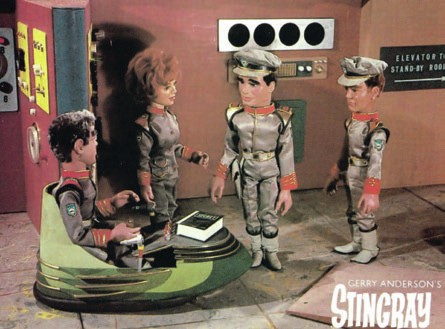
Above left: Gerry Anderson and Stingray. It was the first British TV series to be made entirely in colour, a move intended to increase its appeal to the lucrative American market. Stingray was the first Supermarionation series whose puppet characters had interchangeable heads showing a range of facial expressions
Even more hideous for many was Oink the Seal, introduced in the third episode in production, Sea of Oil, a misguided throwback to the most juvenile aspects of Supercar and Fireball XL5; the supposedly cute but in fact intensely annoying pets such as Mitch the monkey and Zoony the Lazoon.