SCOTLANDS’ DEFENCE
A Most Responsible Proposition
By Geoff Tompson
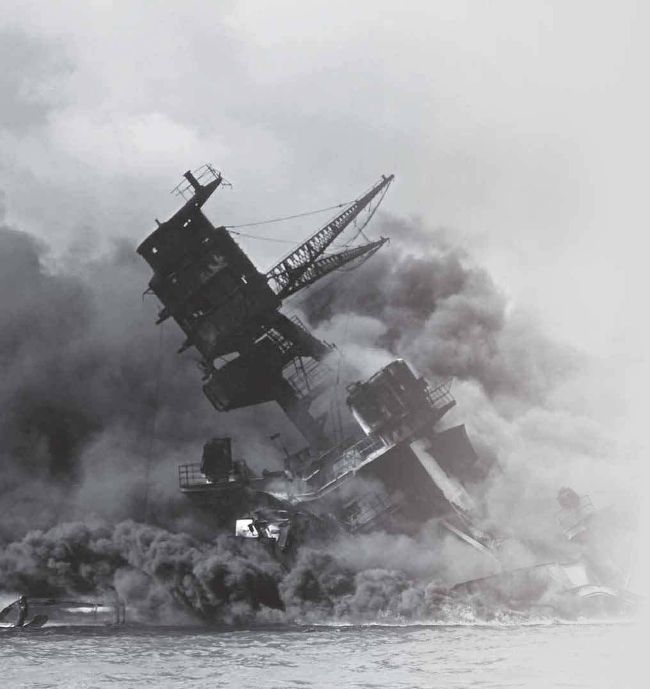
The USS Arizona (BB-39) burning after the Japanese attack on Pearl Harbor
WHEN considering the lessons from the Japanese attack on Pearl Harbor, Professor Ron Spector of the George Washington University said, ‘American popular disapproval for going to war should not have allowed its government to fail in preparing for one.’ The 2014 independence Referendum White Paper therefore quite rightly incorporated a section on the defence of an independent Scotland.
However, those proposals were described by the UK’s Minister of Defence (at the time Philip Hammond) as being ‘a most irresponsible proposition’. I confess I think his analysis was correct though, as my previous article in iScot explained, the capabilities of the UK’s defences at that time were in decline after years of ill-conceived cuts and, in reality, it was more a case of the ‘pot calling the ketle black’. I don’t want to dwell on the failings of the 2014 White Paper but it’s important to clarify why I agree the defence proposals at that time were indeed ‘a most irresponsible proposition’ but from Scotland’s perspective.
Scotland inheriting well-used, secondhand assets would have saddled the country with significant, unbounded maintenance costs as most spares would have come from a single source - the remaining UK (rUK). Such a strategy would indeed have been a most irresponsible proposition – militarily, financially and with few benefits for Scottish businesses and employment.
In my view, Scotland should instead start with a blank sheet of paper and create the defences that would truly meet the country’s needs. Unfettered by the need to maintain and operate within the limitations of legacy equipment or aspiring to regain some long-abandoned ability to project power, an independent Scotland could create defence forces that would effectively defend our country, its assets and its exclusive economic zone (EEZ), whilst enabling us to play our part in the collective defence of Europe and the British Isles.
The obvious question of course would be: ‘How could we afford to create credible forces from scratch’? However, before looking at how that could be done, let’s consider Scotland’s strategic location, current defence trends and relevant lessons from recent conflicts, and see how other countries, including the UK, are mitigating their capability / funding gap. By shedding preconceived ideas that merely replicate how it’s always been done in the UK, and instead adopting some novel solutions that capitalize on the latest defence thinking and equipment trends, Scotland could create credible defences in ways that also boost its industrial base, jobs and civilian infrastructure. Defence can, and should be, an asset to the country and not merely a money pit.
During the 2014 independence referendum, Better Together set out to frighten Scots into believing a vote for independence would have severed all ties between Scotland and the rUK. They stopped short of saying we’d be thrown out of the Commonwealth but their message was clear, there would be a hard border and all trade between the rUK and Scotland would cease. In contrast, immediately following the EU referendum, in which Scotland had voted emphatically to remain, Nicola Sturgeon set a much more conciliatory tone by saying “Let me be clear about this, whatever happens as a result of this outcome [Brexit], England, Wales and Northern Ireland will always be Scotland’s closest neighbours and our best friends – nothing will change that.” As the close ties between the UK and its former overseas colonies show, it is possible for them to be independent and remain friends.
Trade across the border would not cease. After all, England relies on importing a significant proportion of its energy from Scotland and Brexit Britain will need all the export markets it can access. However, this article is about defence of an independent Scotland so my focus will be on that aspect of any future relationship.
The Threat
The UK’s perceived military threat is predominantly from Russia, whose strategic bombers and naval vessels armed with cruise missiles would suffer significant losses if they tried to approach the British Isles from the east, where they would encounter NATO and Swedish defences long before reaching the UK. Their likely option would therefore be to approach the British Isles from the north, which is presumably why the UK has stationed 60% of its Typhoon fighters in Scotland.
Scotland could create defence forces that would effectively defend our country, its assets and its exclusive economic zone
Much of Europe’s trade with the rest of the world is by sea, so ensuring the free movement of commercial shipping is essential. The receding polar ice cap has opened the Northern Sea Route from the Pacific along Russia’s north coast to Europe and the Atlantic. This has reduced the distance, time and shipping cost by a third compared to the Southern Sea Route via the Suez Canal, ensuring the Northern Sea Route will inevitably grow in importance. Scotland sits strategically at the Atlantic end of this route and, in defence terms, is therefore at the UK’s and western Europe’s front door. Scotland also provides the eastern pillar of the Greenland / Iceland / UK (GRIUK) Gap, whereby Russian attack submarines access the North Atlantic to seek out and track NATO naval assets and, in wartime, to destroy those assets and interdict Europe’s sea lines of communication.