INFRASTRUCTURE
WILL EAST WEST RAIL GO SOUTH?
Work is already underway rebuilding EWR Stage One from Oxford to Bletchley, to be followed by Stage Two upgrading from Bletchley to Bedford. But Stage Three to Cambridge is looking increasingly controversial, as Ashley Butlin discovers.
THE January 2018 issue of The Railway Magazine carried a short report stating: “The creation of a direct rail link between Oxford and Cambridge came a step closer on December 14 [2017] when Transport Secretary Chris Grayling officially launched the East West Railway Company at Bletchley Park. The new company will oversee the reconstruction of a key missing link in the country’s rail network, the route already being dubbed the UK’s own ‘Silicon Valley’ ”.
East West Rail (EWR), linking Oxford and Cambridge via Bletchley and Bedford, is the latest major rail development taking place in England. Stage One between Oxford and Bletchley follows the existing trackbed; Stage Two beyond Bletchley looks likely to follow the Marston Vale Line to Bedford; but Stage Three beyond Bedford is where the route will diverge away from the former LNWR Varsity Line, and therefore where major difficulties and costs begin to occur.
The line previously ran from Bedford St Johns to Sandy, where it crossed the East Coast Main Line, before continuing via Potton to enter Cambridge just south of the city’s main station. Since the line closed on January 1, 1968, however, development has taken place on the trackbed and the new line will need to follow a new route.
The communities along the Oxford to Cambridge route are described as ‘the Arc’, and – according to Government figures – is already home to 3.3 million people, supports 1.8 million jobs, and contributes £90 billion of Gross Value Added (GVA) to the UK economy each year. However, without investment in new infrastructure designed to support additional homes and join up local communities, the area will struggle to attract or retain the talent that is needed to sustain its economic prosperity, hence the need to build EWR.
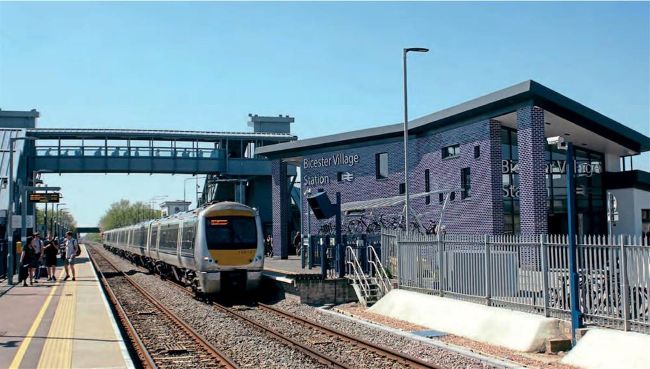
The Oxford to Bicester section was upgraded in 2014/15 and reopened from Oxford Parkway in October 2015 (followed by the main Oxford station in December 2016) for Chiltern Railways services from Marylebone. This is a view of Bicester Village station (the former Bicester Town) on May 5, 2018 as Chiltern’s Nos. 168107+168325 call with a Marylebone-bound working.
GEOF SHEPPARD/CC BY-SA 4.0
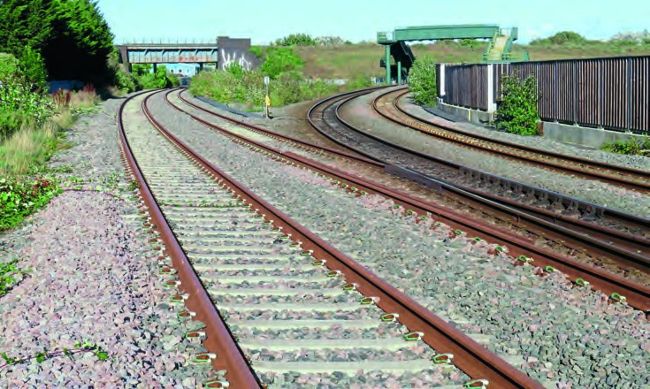
A shot of Gavray Junction, east of Bicester, on September 12, 2019 showing the Bicester Chord (right) branching off from East West Rail to meet the Chiltern Main Line that crosses overhead in the distance.
ALL PHOTOS BY PHIL MARSH UNLESS STATED
What is not clear is the aim of the line, which is a fundamental question. On the one hand there is the promise of a high-speed link between Oxford and Cambridge taking 90 minutes; on the other, it promises to be a commuter railway for Oxford, Bletchley, Bedford and Cambridge – and integrating these two aims may be difficult to achieve.
Stage One & Two work
Stage One has already seen a major upgrade of the existing line from Oxford to Bicester completed in December 2016, with new stations at Oxford Parkway and Bicester Village. Work is now underway to rebuild the mostly-mothballed route from Bicester to Bletchley, including a new station at Winslow, rebuilding Bletchley Flyover, and new highlevel platforms at Bletchley – with a target opening date of 2025.