Understanding Flat Earthers
BY DANIEL LOXTON
REFLECTING UPON SOME STRIKING 2018 SURVEY findings, Skeptics Guide to the Universe host Steven Novella wrote that he was “stunned that there are seemingly average people walking around today with the firm belief that the world is actually flat.” That astonishing fact does indeed cry out for explanation. He wanted to know, “What Drives the Flat-Earthers?”1
That’s an interesting question—and a complicated one. I’ve spent a fair bit of time reviewing the history of Flat Earth claims for Junior Skeptic and various other articles.2 Reviewing the literature is a good first step. If we want to grapple with claims, it helps to know what those claims are and how they have developed over time. However, this may not answer the “Yes, but why?!” question. As one reader challenged me:
I was hoping to see something about why there are people who invest so much in it that they form a Flat Earth Society. … Something else is going on. Finding that something else was what I hoped the writer would do, but he didn’t give me that.
I conceded this point:
Yes. Explaining what people say and asking whether they are correct are the easy tasks; finding out what’s really going on is harder.
Much of my work involves straightforward description and assessment. However, I’m intensely interested in that harder question. I want to understand weird beliefs.
With that in mind, I’d like to try to expand upon Novella’s preliminary thoughts. I think that digging deeper might help to expose some of the root systems from which paranormal, pseudoscientific, and fringe claims grow.
Who Are These People?
When 8215 U.S. adults were asked “Do you believe that the world is round or flat?” in a February 2018 YouGov survey, only 84 percent of respondents felt certain that the world is round. Five percent had doubts, two percent affirmed a flat Earth, and seven percent weren’t sure.3 (There is reason for some caution about the YouGov survey. Scientific American blog contributors Craig A. Foster and Glenn Branch were unable to reconcile discrepancies between the reported results and data supplied by the pollster.4) This and other surveys support the idea that around one or two percent of Americans and Britons believe in a Flat Earth.5
This suggests that several million Americans believe in a Flat Earth. Tens of millions more are open to the idea or unsure what to believe. It’s been widely reported that YouTube and social media are propelling Flat Earth beliefs to new heights of popularity (or at least visibility). Twentieth century Flat Earth advocates were generally lonely figures who struggled to attract any serious consideration for their ideas. Today, there is a growing, thriving Flat Earth community.
These Flat Earthers comprise a broad cross-section of people, “all of them unfailingly earnest and lovely” in the experience of The New Yorker’s Alan Burdick.6 I recommend the 2018 documentary Behind the Curve to humanize this oddly familiar community. The film reveals Flat Earthers as generally bright, funny, nerdy, morally motivated folks who rather resemble skeptics. Their shared convictions provide many of the same rewards that skeptics find together, such community, fellowship, common interests, and intellectual engagement. Flat Earthers often describe their community as finding a family or a home—a place to belong. And, like the skeptics, they enjoy the powerful emotional rewards of joining together to pursue moral goals (such as truthseeking).
They’re bonded by a shared desire to change the world for the better. Flat Earth advocate Patricia Steere says this about her podcasting co-host: “We’re both in cause together. And that is a kind of love.”7 These rewards are all goals in themselves. Independent of the content of their beliefs, we can see that the Flat Earth community offers all of the comfort of any community (along with the typical dysfunctions that most communities experience, such as routinely accusing each other of being undercover CIA agents).
Conspiracy Theories
Novella correctly notes that there is “an intimate relationship between belief in a flat earth and conspiracy thinking.” Flat Earthers often accept a variety of conspiracy theories about “chemtrails,” vaccines, evolution, 9/11, and so on. Many were conspiracy theorists before they encountered Flat Earth claims. This may have predisposed them to accept a flat Earth as just another (or perhaps the ultimate) part of the hidden truth.8
Flat Earth thinking does not merely correlate with conspiracy thinking. Modern Flat Earthers must necessarily be conspiracy theorists in order to dismiss evidence such as photographs and video of the Earth from space.
This was not always the case. The conspiracy component of Flat Earth beliefs has grown over time in response to advancing scientific knowledge. In the 19th century, it was easier for proponents of Flat Earth “Zetetic Astronomy” to charitably view round Earth believers as sincerely mistaken. They argued that mainstream astronomers had been misled by an overreliance on theoretical dogma. Proponents believed that astronomers and the public would accept the flatness of the Earth as soon as they were able to set aside their preconceptions and look frankly at the empirical evidence.
This perspective could not survive the dawn of the Space Age. Flat Earth believers were knocked on their heels by the first photographs of the Earth from space. “It was a terrible shock,” admitted International Flat Earth Research Society founder Samuel Shenton in 1966.9One of two things had to be true: either Flat Earthers were mistaken about the shape of the Earth, or NASA and other space agencies must be concealing the true nature of the cosmos using manufactured evidence. Flat Earthers deeply committed to the latter. Believers insist that all images of the Earth from space are manufactured fakes. Every aspect of space exploration— astronauts, satellites, rocket launches, and so on—is part of an elaborate facade.
Religion
Religion is another key factor. Over half of those who asserted a Flat Earth in the YouGov survey also ranked themselves as “very religious,” compared to only 20 percent of globe-believers.10 I would have predicted a high level of religiosity based on the history and content of Flat Earth ideas.
In the 19th and 20th centuries, Flat Earth beliefs were driven more or less exclusively by Biblical literalism. In recent decades, Flat Earthers have been a subset within the community of so-called “scientific creationists,” where they were (and still are) viewed as a fringe by other creationists.11 However, Flat Earth beliefs are consistent with a literalist approach. As skeptical Flat Earth expert Robert Schadewald argued in 1987, “the Bible is a flat Earth book.”12 Although not explicitly spelled out, numerous Biblical passages imply that the Earth is a plane, that it is immobile, or that it is enclosed within a dome (the sky, or vault of the heavens).
Flat Earth Concepts
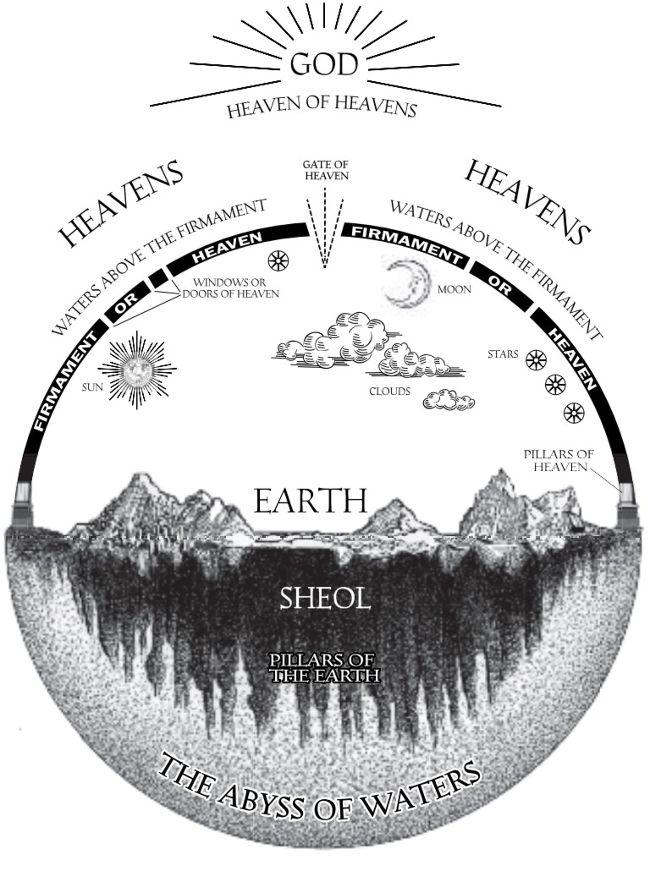
The ancient Hebrew concept of the Earth— the inspiration for the Flat Earth movement.
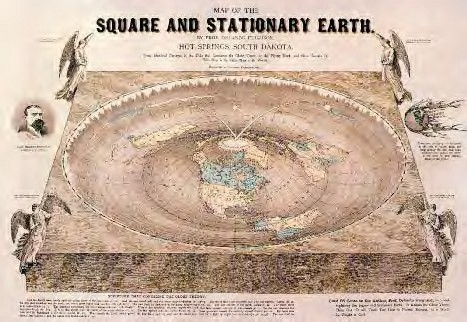
Orlando Ferguson’s 1893 Flat Earth model is shaped somewhat like a roulette wheel. In the map’s margins he has printed biblical passages and an attack on the idea that the earth moves. The image is from the Library of Congress.
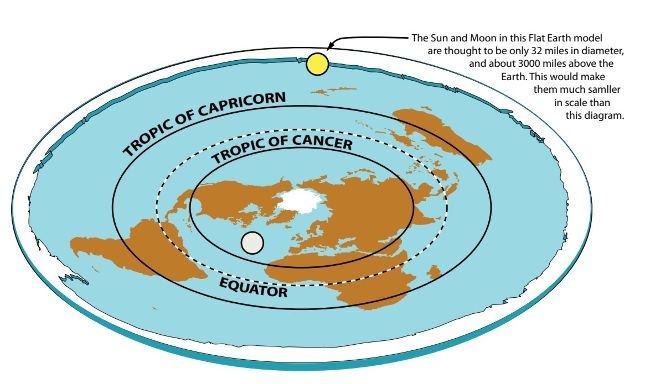
The contemporary Flat Earth Society imagines a flat disk surrounded by an ice wall to keep the oceans in place. A tiny spotlight-like Sun moves back and forth from the Tropic of Cancer to the Tropic of Capricorn to create the seasons. Referenced from the Flat Earth Society website:
https://bit.ly/2kLlbKG.
Modern social media may now attract a growing percentage of secular people to the Flat Earth movement, but there are reasons to think that religion still plays a crucial, central role. First, Flat Earthers often say so. Christian creationism is a standard presentation topic at Flat Earth conferences. During one such Bible panel at the 2018 Canadian Flat Earth Conference in Edmonton, Alberta, Christian moderator Robbie Davidson called for a show of hands: were there any atheists in the audience? A single hand went up. “I’ve been waiting a long time to meet a Flat Earther who’s one hundred percent atheist!” Davidson marvelled.13
For many Flat Earthers, creationism is the whole point. A Flat Earth could not form through natural processes. The existence of such an object would imply intelligent design. Some versions could conceivably be constructed by advanced aliens, but others— such as the “infinite plane” Flat Earth—would require a supernatural creator. As another Flat Earth conference speaker told The New Yorker last year, “You are a created individual. This is a created place.”14
This implication is a major part of the appeal of Flat Earth belief. Prominent Flat Earth YouTuber Mark Sargent describes our world as a “terrarium” that he likens to the enclosed sound stage imagined by the movie The Truman Show. Flat Earth beliefs bring spiritual solace. “You are not alone,” Sargent says. “You are the centre of the universe, as a matter of fact. You are the star of the show.”15
Skeptics and mainstream media typically treat the Flat Earth as an essentially secular belief system. This is a fundamental mistake. The founder of the modern Flat Earth movement, Samuel Birley Rowbotham, positioned the Flat Earth as an Intelligent Design-style “wedge” strategy. When “the Atheist is met by the Christian upon purely scientific grounds,” he may be “led to admit” that Biblical descriptions of “natural phenomena are literally true,” Rowbotham said in 1865. This realization would then lead disbelievers to admit that the Bible is “truly the ‘word of God.’”16
We’ll come back to religion later to help us shed light on Flat Earth activism. But first let’s consider the source of Flat Earth beliefs.
Flat but Round
Most Flat Earthers at some point adopted Flat Earth beliefs that they did not previously hold. They were persuaded by arguments they encountered in Flat Earth videos, podcasts, and the like. To understand how this happens, and perhaps suggest which people might be more susceptible to these arguments, it’s helpful to consider how younger people understand the cosmos.