RUNNING WITH THE WOLVES
Trevor Hogg has a transformational encounter with Cartoon Saloon, which concludes its Irish folklore trilogy with the release of Wolfwalkers…
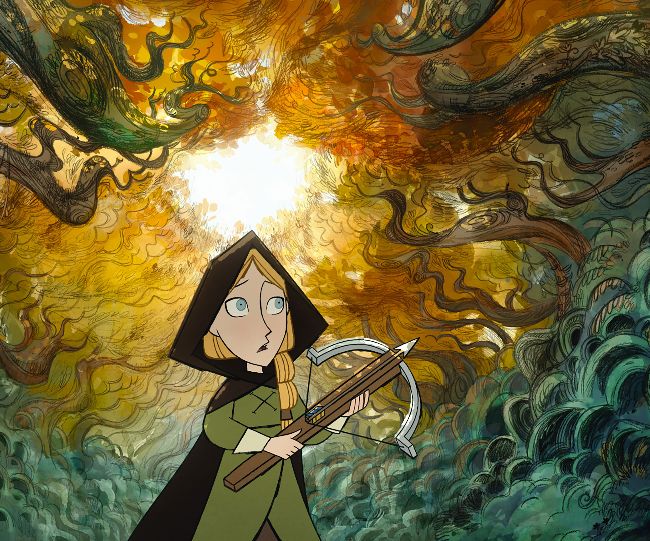
The angular hood emphasises that Robyn Goodfellowe does not belong in the forest
Images courtesy of Apple TV+ and Cartoon Saloon
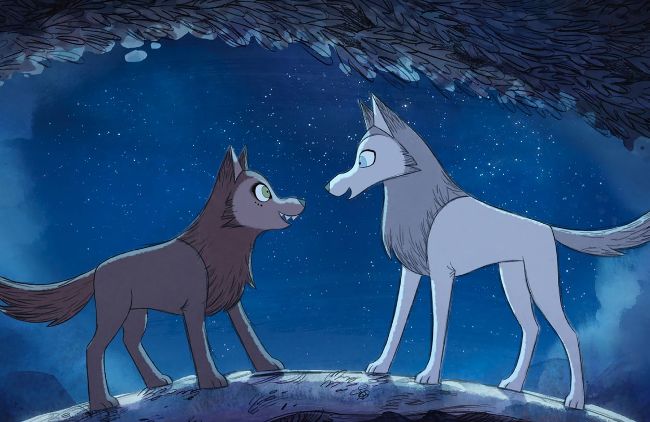
Right: The hardest characters to design were the wolf versions of Mebh and Robyn as they needed to reflect their human form and personalities
E merging from the global shadow cast by Pixar and Studio Ghibli is Cartoon Saloon, a Kilkennybased animation studio which has received Oscar nominations for each one of its three feature films, and is expected to do so again with Wolfwalkers. The animated family adventure, directed by Tomm Moore and Ross Stewart, had a world premiere during the 45th Toronto International Film Festival and streams on Apple TV+. Ordered by English invaders led by Oliver Cromwell, a hunter is accompanied by his daughter as he attempts to exterminate the native wolves of Ireland.
A trailer was released in 2017 as part of an effort to pitch the concept as a feature film. “That was a test to see if we could do everything that we wanted to do,” notes Stewart. “We tried a little bit of ‘wolfvision’, the forest and town style, and the clean-up style.” Whereas the animation style was established, the first act went through a major rewrite in 2018. “Getting the story right is the part where you’re terrified that it’s all wrong and you’re going to embarrass yourself,” admits Moore. “It’s hellish. After that, everything else is more blood, sweat and tears to get it up on the screen.” The town was inspired by linocut printmaking while the neighbouring forest has a watercolour and pencil sketch aesthetic. “Because we were willing to go down this German Expressionism route with the town, we had big areas of black and crazy abstract shapes,” remarks Stewart. “The Lord Protector goes from being positive to negative depending on whether he’s walking through light or shadow. For the forest, we looked at the painted backgrounds of Disney’s Robin Hood and Winnie The Pooh.”
“The clean-up style of the animation of the villagers including Robyn and Bill Goodfellowe was also based on the woodcut printing of the 1600s,” explains Stewart. “The forest style was scratchy, loose and wild. It was much more energetic. The clean-up style for that was utilising the rough animation and putting sketchier lines on top.” The farmland situated between the forest and village allows for a gradual transition in the animation styles. “It was a whole process of, whereabouts are they on this journey from the forest to the town, and how much etching or sketchy pencil should there be?” The geometrical design of Robyn evolves into a sketchier look to reflect the arc of her character. “We had a few tricks to make Robyn feel out of place and at home in the forest. As Robyn gets more comfortable with Mebh Óg MacTíre, she gets the rougher clean-up style and the big angular hood is down. When the soldiers come in at the end, they’re all angles and are like an army of robots coming into this organic world. Robyn is the only one who can bridge the divide between the village and forest.”