BUZZ AT 90
STILL AIMING HIGH
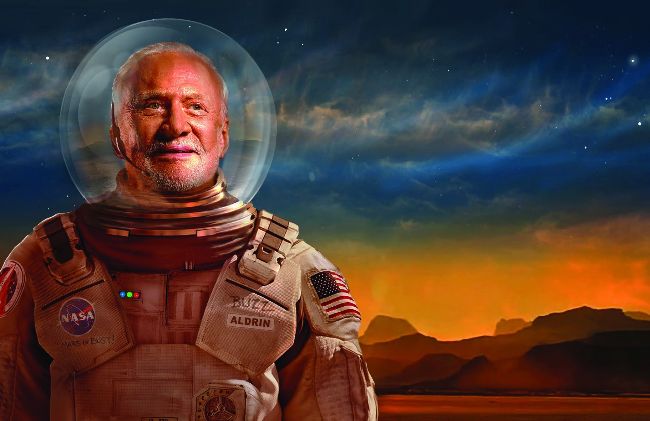
Buzz on Mars.
Credit: James Vaughan
Buzz Aldrin stood in the open hatch of the Gemini 12 spacecraft, watching Earth slowly pass below him. The view was spectacular—he’d been warned it would be mesmerizing, and that staying focused on his tasks could be a challenge. As his eyes were drawn by the sparkling teal blue of the oceans and the dazzling white cloud cover, somewhere down there, over 130 miles (209 kilometers) below him, technicians were already working on the Apollo Command Module that would soon carry astronauts to the Moon. While he hoped that he would be among those chosen, he had no way of knowing just how lifechanging that assignment would be.
After taking some photographs and collecting a micrometeorite experiment mounted near the hatch, he had a few minutes to simply marvel at the incredible view. Then, as he held his glove near his helmet, he noticed something completely unexpected.
“During the second night EVA pass I saw blue sparks jump between the fingertips of my gloves,” he later said. “Space clearly was not just an empty void. It was full of invisible energy: magnetism and silent rivers of gravity.
Space had a hidden fabric, and the fingers of my pressure gloves were snagging the delicate threads.” It was November, 1966, and although he did not know it at the time, in just under three years he would be standing on the surface of the Moon.
When one sits down to interview Aldrin, it’s not a trivial affair; even at 90 years of age he is still at the top of his form. Once he gets rolling the ideas come fast, and you’d better keep up, because he’s not slowing down. Every time I’ve interviewed him, he’s continued to refine ideas he has been working on for years, as well as coming up with new ones. These range from better ways to explore the solar system (preferably with humans), new systems that will accelerate our journey to Mars, and new ways to engage and inspire young people.
Aldrin still stands ramrod-straight, speaks with energy and passion, and continues to generate new ideas. He recently founded the Human SpaceFlight Institute to seek more collaborative approaches to leaving our planet and create a global alliance of spacefaring nations to facilitate international cooperation in space exploration and development.
“I want to put together an advisory group with the National Space Council; a world alliance for space exploration that would include NASA, the European Space Agency, Japan, and China. Let NASA put it together, then the partners talk to each other about opportunities. NASA can then bring in ULA, SpaceX, and Blue Origin,” he said during our recent conversation on the eve of his birthday. Ever pragmatic, he added, “Of course, this creates problems with vested interests, but if you supply the foreign markets and foreign contributions, a space exploration alliance makes more sense.”