THE CURATORS
Clifford R. McMurray
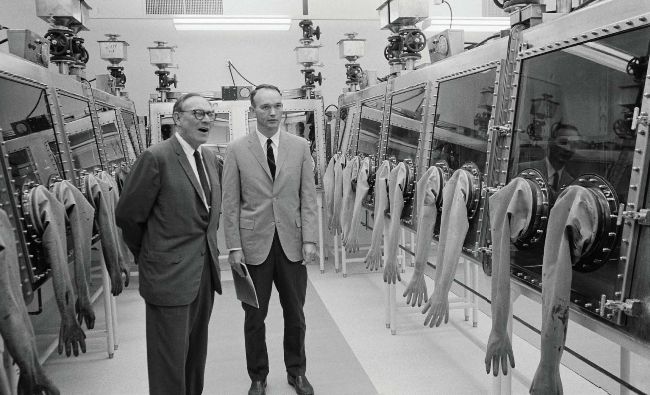
Apollo 11 astronaut Michael Collins tours the Lunar Receiving Lab
Credit: NASA
On the morning of July 28, 1969, geologist Ross Taylor was feeling the pressure. Just four days after Apollo 11 had splashed down in the Pacific, at 11:45 a.m., he was about to put the first sample of lunar regolith under his emission spectrograph. The work conditions were difficult, and he only had a tiny amount of Moon dust in a nitrogen-filled glove box. Nevertheless, working faster than usual for typical sample analyses, much less such a historic one, by 4 p.m. the visiting professor from the Australian National University delivered his preliminary results at an afternoon press conference. “When other people measured it later,” says Judy Allton, they found that “he did a pretty good job.”
Allton, who came to the Lunar Receiving Laboratory (LRL) at Houston’s Johnson Space Center in 1974, missed the excitement of the first opening of the rock boxes from the Apollo missions, but she’s been working at the laboratory and its successor, the Lunar Sample Laboratory Facility (LSLF) ever since. Today she’s one of seven curators of the samples stored there from Apollo and other missions; her responsibility is the single milligram (a few grains of salt worth) of solar wind particles returned by the Genesis mission, the first to return material from beyond the Moon. It’s not much compared to the 842 pounds (382 kilograms) of rock and dirt brought back by the Apollo astronauts, but “you can do a lot with those tiny particles,” she says. Referring to the Stardust mission that retuned a comparably small sample of dust from comet Wild 2, she explains that “grains of Wild 2 from Stardust aerogel [the material used to capture the sample] can be subdivided; 10 micron grains can be subdivided among 10 research groups.” The ability to analyze such tiny samples shows how far planetary science has come since the Lunar Receiving Laboratory first opened for business.