Greatest Battles
NIVELLE OFFENSIVE
CHEMIN DES DAMES, FRANCE 16 APRIL – 9 MAY 1917
Written by Louis Hardiman
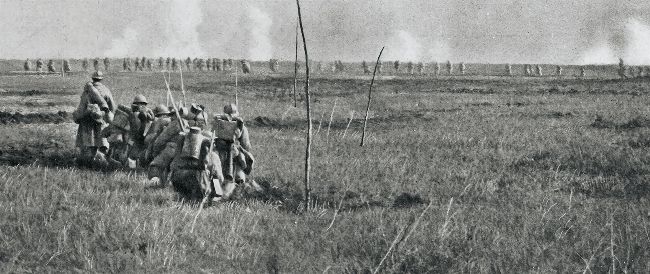
Men of the II Colonial Corps launch a second wave of attacks, while in the distance the first wave reaches the German outpost trenches on the Chemin des Dames
On a cold night in January 1917, German infantry launched a raid at Main de Massiges, east of Reims, and came across enemy plans to attack the Aisne River. General Erich Ludendorff declared it a “capital piece of information”. The Germans’ alarm grew after another raid in March 1917 led to the discovery of French General Robert Nivelle’s “Instructions Concerning the Aim and Conditions of a General Offensive”, revealing the planned operation’s incredible scale. Despite these disastrous leaks, Nivelle continued widely circulating operational plans. The dam of his secrecy ultimately burst open with the capture of a sergeant carrying a document detailing the movements of specific units.
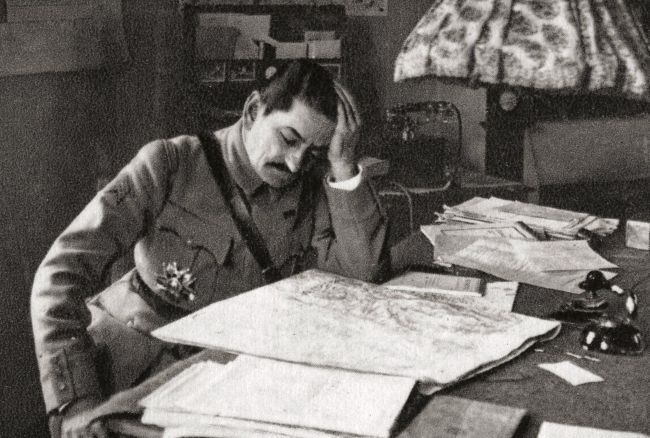
Nicknamed ‘The Butcher’ by his men, General Charles Mangin was scapegoated by Nivelle for failures during the offensive
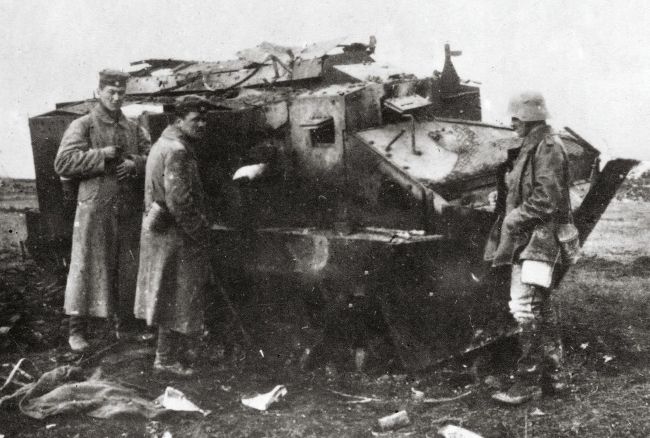
A destroyed French Schneider CA tank. They were deployed for the first time at the Nivelle Offensive but struggled to navigate mud, anti-tank ditches and German artillery. Of the 128 deployed, 52 were destroyed on the first day
All images: © Alamy, © Getty Images
That is not to say that Nivelle ever seriously tried to protect intelligence on the offensive. While lobbying for support, he showed the press and politicians his ambition and promised a breakthrough within 48 hours. The press and the Chamber of Deputies then publicly debated aspects of his proposal. It was said every waiter in Paris knew about the coming action. Yet Nivelle’s openness with the French political and media establishment made his rise to commander-inchief possible. The French needed a charismatic and politically acceptable alternative to General Joseph Joffre, who had resisted any attempts from politicians to interfere in military matters.
Nivelle wasn’t just an effective lobbyist, he was also a respected general who had cut his teeth at Verdun in 1916. There, he had ended localised stalemates by deploying overwhelming violence concentrated on weak points in the enemy line. By removing the need to attack along the whole front, Nivelle hoped to bring to an end the long, grinding battles that defined the Western Front. Nivelle’s offensive began to take shape as he implemented his Verdun tactics on a larger scale at the front, between the bastions of Soissons and Reims.
He chose the Chemin des Dames as the site for the battle, a road hugging the plateau north of the Aisne River. The ancient route had been paved by King Louis XV so his daughter could visit one of her ladies-in-waiting, and it had been the site of a critical battle during another invasion of France in 1814. Located 100km from Paris, it naturally blocked the most direct route to the capital. The sector had been quiet since 1914 and Nivelle hoped to stretch its relatively small defensive force through Allied diversionary attacks elsewhere. These were primarily at Vimy Ridge and Arras from the British and Canadian forces, and Nivelle was pushing for further attacks from the Russians and Italians. Then, his 52 divisions and 7,000 big guns could smash through the German lines, advancing 10km each day, bringing the stalemate on the Western Front to a victorious conclusion. Convinced his triumph was inevitable, he promised “a splendid harvest of glory for the British and French armies”.