GREATEST BATTLES
73 EASTING
SOUTHEASTERN IRAQ 26-27 FEBRUARY 1991
Written by Michael E Haskew
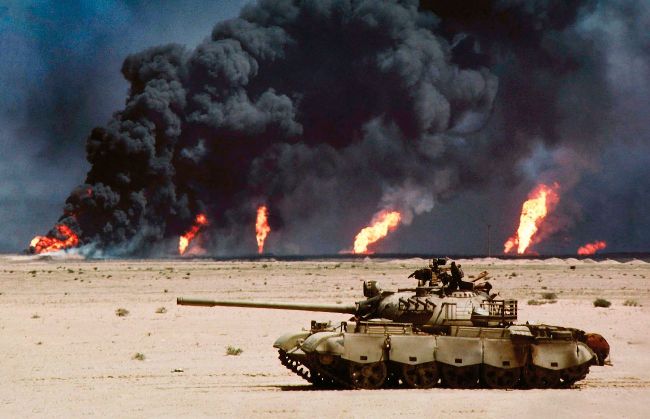
An Iraqi tank stands abandoned as burning oil wells fill the sky with smoke
All images: © Alamy, © Getty Images
On 2 August 1990, Saddam Hussein ordered his army to invade neighbouring Kuwait. The unprovoked attack and brutal Iraqi occupation sparked outrage, international condemnation and a demand from the United Nations that Iraq withdraw immediately. Three days after the invasion, US President George HW Bush declared: “This will not stand, this Iraqi aggression against Kuwait.”
During the subsequent Operation Desert Shield, the United States led a coalition of 35 nations in a build-up of overwhelming military capability on land, sea and air in preparation for the forcible ejection of the Iraqi Army from Kuwait. Within five months, the coalition had assembled more than 950,000 troops, 3,000 tanks, 1,800 aircraft and 2,200 artillery pieces – along with considerable naval fire-support capability – to oppose the Iraqi forces, which numbered over one million troops, 5,500 tanks and 700 aircraft. On 17 January 1991, the coalition unleashed a torrent of cruise missiles launched from submarines and warships, along with a sustained aerial bombing campaign designed to degrade the Iraqi combat effectiveness prior to the initiation of ground operations.
Thirty-eight days later, on 24 February 1991, coalition ground forces commenced operations against the Iraqi military, intent on driving the aggressors from Kuwait and destroying their fighting capability, particularly that of the elite Republican Guard divisions – well-trained and equipped troops, some of whom were veterans of the Iran-Iraq War of 1980-88.
US General Norman Schwarzkopf, commander of coalition forces, devised a plan to accomplish the mission at hand. Utilising overwhelming air power to erode Iraqi command and control and reduce enemy combat capability, he also employed a successful campaign of deception. While large-scale amphibious manoeuvres complemented by covert operations and phoney radio traffic created the impression that the coalition intended to invade Kuwait from the south and into the most formidable Iraqi defences, Schwarzkopf directed a massive force of several combat divisions to sweep westward in a wide arc, taking up positions to attack to the north and then northeast into Iraq in a wide envelopment.
Air bombardment had blinded the Iraqi high command, maximising the effectiveness of the southern deception such that the bulk of the enemy forces were oriented toward the coastline in anticipation of an amphibious landing. Meanwhile, the four divisions of the XVIII Airborne Corps, the US 82nd and 101st Airborne Divisions, US 24th Infantry Division (Mechanized) and the French 6th Light Division established flank security for the sledgehammer of the US VII Corps. The US VII Corps comprised of the US 1st and 3rd Armored Divisions, 1st Infantry Division and 1st Cavalry Division, along with the British 1st Armoured Division churning from its jump-off points in Saudi Arabia and racing to cut off the retreat of Iraqi forces once the enemy realised the major threat was to its rear.