ASK Space
Our experts answer your questions
How can a galaxy appear to have a massive hole in the middle?
The massive hole in the middle is caused by a collision with another galaxy. However, not all galactic collisions result in gigantic holes. Only a head-on collision, similar to a ‘bullseye shot’, can produce a hole surrounded by a ring, or sometimes multiple rings. The hole is formed as the galactic ‘heart’ gets knocked off, and stars at the inner parts of the galaxy oscillate outwards in response to the gravitational disturbance. The rings are density waves that spread out from a single point.
In addition to a bullseye collision, two additional conditions must be met. Firstly it needs a thin galactic disc to serve as an ‘aiming board’ and a smaller galaxy to be the bullet, and secondly it needs a cheering cosmic environment where the ‘galactic Olympic shooting games’ can be held without any disruptions. In the current universe such conditions are easily met, and all we need is a bullseye champion.
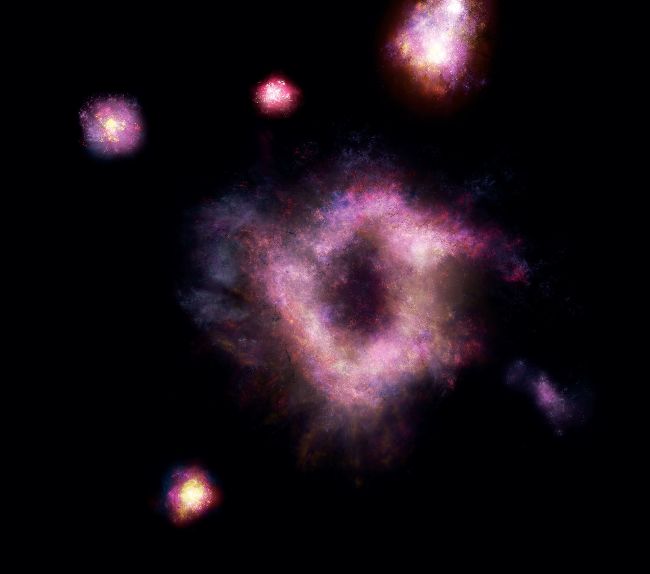
An artist’s impression of a super-rare galaxy, described as a ‘cosmic ring of fire’
In the young universe there were more ‘Olympic games’, but the two conditions were compromised. There were not many aiming boards and the cosmic environment was very chaotic, with constant gas accretion and many satellite galaxies dancing around. A galaxy with a gigantic hole seems to be a rare phenomenon throughout the history of the universe: only one out of 10,000 galaxies would hold the title of a collisional ring galaxy.
Dr Tiantian Yuan is an ASTRO 3D fellow at the Centre
for Astrophysics and Supercomputing at Swinburne University of Technology, Melbourne, Australia