GB
  
You are currently viewing the United Kingdom version of the site.
Would you like to switch to your local site?
8 MIN READ TIME

ASK Space

Our experts answer your questions

EXOPLANETS

How does a planet’s colour influence its habitability?

Much like a white shirt keeping you cool on a bright summer day, a planet’s colour plays an important role in keeping a planet’s temperature just right for life. Our search for life is currently focused on finding exoplanets with temperatures in a range that allow for liquid surface water. An exoplanet with a dark surface like ocean or basalt will absorb a lot of the incoming stellar energy and heat up. A brighter surface like snow or sand will reflect stellar energy and prevent the temperature from rising.
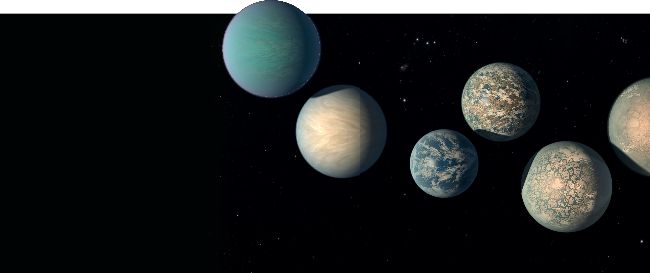
Darker exoplanets typically absorb more heat than lighter reflective ones
© NASA/JPL-Caltech

Because colour plays such an important role in temperature, there are sweet spots in the interaction between type of starlight, exoplanet colour and exoplanet-star distance that allow for liquid water to exist. Having a better understanding of this complex system of interactions will help us find a habitable planet.

In the coming decade we will be able to assess the habitability of exoplanets with direct measurements. Until then we need to model many different scenarios so we are prepared for a wide range of possible environments. By modelling the way exoplanet colour influences habitability, we can focus our search on the exoplanets that show the most promise for life. This gives us a way to compare real observations with the physics we expect.

SOLAR SYSTEM

Could asteroids still be forming in the Solar System?

Unlock this article and much more with
You can enjoy:
Enjoy this edition in full
Instant access to 600+ titles
Thousands of back issues
No contract or commitment
Try for 99p
SUBSCRIBE NOW
30 day trial, then just £9.99 / month. Cancel anytime. New subscribers only.


Learn more
Pocketmags Plus
Pocketmags Plus

This article is from...


View Issues
All About Space
Issue 107
VIEW IN STORE

Other Articles in this Issue


In This Issue
Welcome
As I write this, I’ve just come back from a
LAUNCH PAD
COMET NEOWISE EDITION
This photo was taken from Inisheer, the smallest of the
’Partial supernova’ blasts white dwarf star across the Milky Way
A strange white dwarf star hurtling through the Milky Way
Strange ancient ‘failed stars’ found by citizen scientists
Citizen scientists recently helped direct astronomers to a pair of
Gigantic structure stretching 1.37 billion light years across discovered
Spectacular 3D maps of the universe have revealed one of
Four mysterious objects spotted in deep space
There’s something unusual lurking out in the depths of space:
NASA human spaceflight chief makes no guarantees on return to Moon
Putting astronauts back on the Moon by 2024 will be
Curiosity starts road trip up Martian mountain
Words by Elizabeth Howell NASA’s Curiosity rover is embarking on
Jedidah Isler
Jedidah Isler is an exceptional astrophysicist and an excellent modern-day
FEATURES
THE CRASH THAT MADE OUR MOON
It’s the brightest thing in our night sky. Over the
INTERSTELLAR RAMJET
The trouble with rockets is that you have to pack
IS THIS THE END OF SPACE AND TIME?
As in history, revolutions are the lifeblood of science. Bubbling
WHAT IS ZODIACAL LIGHT?
If you go to an area with low light pollution,
“THIS COMING DECADE WILL BE THE GOLDEN AGE OF SOLAR AND HELIOPHYSICS RESEARCH”
Dr Nour RaouafiRaouafiis a Tunisian astrophysicist at Johns Hopkins Univerisity’s
HOW BIG IS ANTARES?
The night sky, especially when viewed from an area with
WHAT HAPPENS WHEN WE CONTACT ALIEN LIFE?
In August 2016 the entire world was gripped with the
SHOOTING FOR THE MOON HOW NASA TRAINED ITS APOLLO ASTRONAUTS
We choose to go to the Moon in this “
ON BOARD A TOP-SECRET SPACE SHUTTLE
There are many mysteries surrounding the nature of the universe
STARGAZER
In order to preserve your night vision, you should read
STARGAZER
This month’s planets
This month Venus will be visible in the east before
Mountains of Pico and Plato
Summer is a great time to enjoy looking at the
Naked eye & binocular targets
At magnitude +1.25 Deneb is the 19th-brightest star in the
Sizzling summer’s clusters and nebulae
Many sky-watchers think the summer sky is just too bright
The Northern Hemisphere
With the Sun setting not long after 19:00 this month,
Sky-Watcher Explorer-130PS AZ PRONTO
A telescope that can be easily transported to sites untouched
Chat
X
Pocketmags Support